
Alwar’s Raj Dak: Offices, Runners, Accounts and Traffic before 1902
Alwar’s own post from the 1870s to 1902: the Sudder office at Ulwur and eighteen branch offices, 35 runners at four or five rupees, free Raj Service mail, the post office accounts and the letters carried.
Updated June 4, 2026
In this article
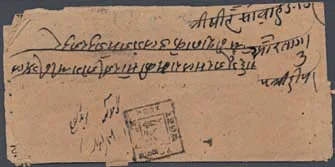
Alwar ran its own post, the Raj Dak, beside the Imperial post. The State’s administration reports of the 1890s describe it in figures: its offices, its runners and peons, its accounts and the letters it carried.
Two posts before the stamps
Alwar’s postal arrangements are older than the first published report of its stamps. P. W. Powlett’s Gazetteer of 1878 includes the post office in the State’s actual accounts for 1872–73 and 1873–74. Receipts fall under a miscellaneous heading and expenditure under the administrative establishment, so no postal income, cost or profit can be taken from those totals; the separate heading for stamps does not show sales of postage stamps.[A13]
The Indian Postal Guide of 31 May 1872 lists Ulwur and Tijara as offices of the Imperial post, Tijara subordinate to Ulwur, with Jeypore as the disbursing office for both, in the N.W.P. postal circle and the Jeypore inspector’s division. That is the Imperial network in Alwar territory, not a list of the State post’s offices.[A14]
The Sudder office and eighteen branches
The State report for 1892–93 describes a local Sudder office at Ulwur that exchanged letters and parcels with the Imperial post office, and eighteen branch offices: one at each of twelve tehsils, and six more at Mandhan, Partabgarh, Tapukra, Mala khera, Narainpur and Bahadarpur. Tehsil peons distributed letters and parcels in the mofussil.[A27]
The report for 1896 gives eighteen local offices, unchanged from the year before, and again describes the Sudder office’s exchange with the Imperial post. It does not repeat the word “branch”, so the two counts should not be compared as if an office had closed.[A28]
Runners and peons
In 1892–93 the post had 35 runners, paid four or five rupees a month, who carried the mail bags from station to station; the stations are described as equidistant. Two extra letter peons were taken on to deliver letters returned undelivered by the branch offices, and one extra temporary runner was appointed. The Sudder Post Master’s pay was raised by ten rupees a month (an increase, not his whole salary). The report says undelivered letters fell from 10,897 to 5,735, mainly because of the extra peons; that explanation is its author’s. The same passage criticises the working of the local post and promises improvement. No runner is named.[A27]
The report for 1896 records 37 runners, the same as the year before, without their pay. For the Ramlila Horse and Cattle Fair of 7–16 October 1896, carts were supplied so that postal peons could take mail to the fairground twice a day, soon after the Up and Down Mail Trains arrived: a service for the fair, not a year-round cart post.[A28]
Free service mail
The reports record one charging practice: Raj Service covers to and from the mofussil were carried free. Both the 1892–93 report (p. 71, paragraph 301) and the 1896 report (p. 81, paragraph 382) say so. No private letter rate, weight scale, registration fee or penalty for unpaid letters has been found, and dividing revenue by the number of letters does not produce a tariff.[A27][A28]
The post office accounts
Unlike Powlett’s mixed categories, the reports of the 1890s give separate accounts for the postal department, in rupees, under columns labelled 1892, 1893, 1895 and 1896. The printed expenditure for 1893 is Rs. 3,351, but its parts add up to Rs. 3,357; the report’s statement that spending rose by Rs. 236 over the year before fits the sum of the parts. Both figures are kept. The postal tables do not restate the September–August financial years used elsewhere in the reports, and the difference between receipts and spending is not a full measure of profit.[A27][A28]
| Category | 1892 | 1893 | 1895 | 1896 |
|---|---|---|---|---|
| Paid covers etc. | 852 | 678 | 484 | 544 |
| Registered covers | 936 | 971 | 1,232 | 1,488 |
| Bearing | 1,599 | 1,559 | 2,175 | 2,251 |
| Sales of postage stamps | 205 | 243 | 67 | 67 |
| Total receipts (printed) | 3,592 | 3,451 | 3,958 | 4,350 |
| Establishment pay | 3,046 | 3,314 | 3,644 | 3,900 |
| Contingencies | 75 | 43 | 62 | 4 |
| Total expenditure (printed) | 3,121 | 3,351 | 3,706 | 3,904 |
| Sum of the expenditure figures | 3,121 | 3,357 | 3,706 | 3,904 |
The letters carried
The 1892–93 report counts 165,918 articles, including 6,443 registered covers, 49,890 bearing (unpaid) covers and 84,002 service covers. The 1896 report counts 199,629, including 9,872 registered, 64,140 bearing and 94,365 service covers. The counts show that registration and bearing mail existed; they do not give the fees or prove the service of any one cover. A “…” in the tables below is printed in the reports and is not a zero.[A27][A28]
| Category | Sent to the mofussil | Received from the mofussil | Total |
|---|---|---|---|
| Paid covers | 6,685 | 16,183 | 22,868 |
| Bearing | 47,960 | 1,930 | 49,890 |
| Registered covers | 2,798 | 3,645 | 6,443 |
| Service covers | 39,331 | 44,671 | 84,002 |
| Newspapers | 550 | … | 550 |
| Parcels | 67 | … | 67 |
| Money-order intimations | 2,098 | … | 2,098 |
| Total | 99,489 | 66,429 | 165,918 |
| Category | Sent to the mofussil | Received from the mofussil | Total |
|---|---|---|---|
| Paid covers | 8,473 | 18,799 | 27,272 |
| Bearing | 59,716 | 4,424 | 64,140 |
| Registered covers | 4,561 | 5,311 | 9,872 |
| Service covers | 43,650 | 50,715 | 94,365 |
| Newspapers | 1,332 | … | 1,332 |
| Parcels | 166 | … | 166 |
| Money-order intimations | 2,482 | … | 2,482 |
| Total | 120,380 | 79,249 | 199,629 |
The Imperial rates are not Alwar’s
For comparison only: the Imperial Postal Guide of 31 May 1872 charged a prepaid inland letter half an anna up to half a tola, one anna up to one tola, two annas up to two tolas, then one anna for each further tola; unpaid letters paid double, underpaid letters double the deficiency, and inland registration cost four annas on top of postage. The Guide defines its Inland Post as the Government of India’s post between Indian post offices. It does not set rules for Alwar’s Raj Dak, and its four-anna fee neither confirms nor rules out a later Alwar registration fee of two annas.[A14]
Later Imperial changes are no better guide: the revision of inland letter rates from 1 October 1898 for weights above half a tola, and the rise in the pattern-packet limit from 40 to 80 tolas in 1899–1900, were Imperial measures, and there is no evidence that Alwar’s post adopted them. How postage was shared or collected when mail passed between the two posts is not recorded either.[A38]
The post, salt and the tahsils
Postal work went beyond letters. The official report for 1902–03 names Alwar head office among three offices that received traders’ orders (indents) for salt from government depots: Alwar, Pindwara and Rajgarh together handled eight orders for 1,600 maunds, worth Rs. 4,300. The figure cannot be given to Alwar alone, and it does not mean the post carried the salt. The same review describes post offices being financed through State tahsils in the states that had accepted postal unity.[A33]
An older network to explore
Nidhi Sharma’s study of 2019 describes Alwar’s resistance in 1838 to restrictions on its Delhi dak and names the Delhi banker Lala Ramji Mall, with references to the National Archives of India (Foreign Department, 11 April 1838, no. 55 P.C., and related proceedings of 1839). It points to an earlier political and commercial network, not to the later State post with stamps.[A37]
Sources
- [A13] P. W. Powlett, Gazetteer of Ulwur (1878), pp. 25–26, 74, 100–101, 114.
- [A14] Indian Postal Guide, 31 May 1872 (Calcutta: Government Printing), pp. 2, 62, 200, 202.
- [A27] Annual Administration Report of the Ulwar State for 1892–93, pp. 71–72.
- [A28] Rao Bahadur Munshi Balmokand Das, Report on the Administration of the Ulwar State for 1896 (Allahabad: Pioneer Press, 1897), pp. 9, 81.
- [A33] Report on the Political Administration of the Rajputana States and Ajmer-Merwara for 1902–1903, Foreign Department Selections No. CCCCX, serial no. 145 (Calcutta, 1904), postal report pp. 38–40.
- [A37] Nidhi Sharma, “Postal System of the Princely State of Rajputana and the East India Company”, Rajasthan History Congress Proceedings XXXIII (2019), pp. 114–118.
- [A38] Reports on the Political Administration of the Rajputana States for 1897–98, 1898–99 and 1899–1900 (Calcutta, 1898–1900): postal reviews dated 17 May 1898, 10 May 1899 and 10 May 1900.
Notes 0
Add what you know: a cover or stamp in your collection, a date or source, a correction or a question.
No notes yet.
Sign in to add a note.
Notes show straight away. Keep them kind and about the article; anyone can report one that isn't. House rules
