
Reading ALWAR and ULWAR: Seals, the BEARING Mark and the Circular Town Datestamps
Alwar’s oval seals, rectangular native-script and BEARING marks, Benns’s circular types C1 to C6 with their offices, the Tijara mark and datestamps set upside down.
Updated July 2, 2026
In this article
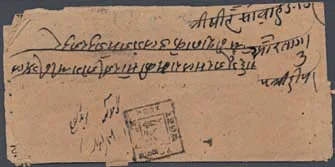
The older English spelling, Ulwar or Ulwur, connects the catalogue name with the postmarks. Dawson describes early oval seals, rectangular native-script cancellations and later circular English devices. Rectangular strikes can be weak or blurred, so a transcription should separate readable characters from guesses.[1]
A working classification of the devices
Alwar’s early seals do not name a branch office. Benns grouped them apart from the later town datestamps and warned that blurred impressions can hide differences between devices. His suggestion that the early marks were used at the head office is an interpretation, not a surviving allocation order.[A7]
The English-lettered circular datestamps give a much better record by town. The date usually lies inside a dagger-shaped compartment, and the direction and form of the dagger distinguish several groups. The town name can appear above ULWAR STATE, or the device can read ULWAR above POST OFFICE. A partial strike should not be assigned from a fragment of the outer circle.[A7][1]
| Group | What to look for | Dates |
|---|---|---|
| Oval seals | Devanagari only or bilingual lettering; several sizes | The small seal on early material; registered covers reported dated 1881 and 1883 |
| Rectangular B1 | Dagger in an inner square; date in native figures | Clear examples seen by Benns dated 1890 |
| Rectangular B2 | BEARING in native script with a half-anna indication | Also used to cancel stamps; dates set upright and inverted |
| Circular town devices | English office name, ULWAR STATE and a dagger with the date | Earliest circular date in the handbook 7 September 1898 |
When BEARING meant postage due
The rectangular BEARING mark cannot be read from its wording alone. It often cancels prepaid Alwar stamps, but whole incoming Indian postal cards show its other use. A card from Bombay of 2 January 1897 was first misdirected to Ramgarh in Jaipur, then reached the Imperial office at Ulwur on 9 January, where the State BEARING mark was applied for onward delivery inside Alwar.[A7]
A card from Deeg dated 20 September 1899 received the Imperial Ulwur mark on 22 September, the State BEARING mark later that day and a Rajgarh State datestamp on 23 September: an exchange between two postal administrations. Benns also illustrates an English ULWAR STATE POSTAGE DUE mark on a card passing through on 2 January 1901.[A7]
Benns’s six circular types
Benns’s handbook (p. 25) gives the six circular types and the offices he assigned to them. They are his allocations; modern place names and the dates each office opened have not been worked out.[A7]
| Type | Offices, as printed | How to tell it |
|---|---|---|
| C1 | ULWAR | ULWAR above, STATE across below the date dagger, POST OFFICE below; the left-pointing dagger reaches the circle and has a blank triangular blade. Earliest date reported 7 SE 98; used through 1900 and to mid-1901 |
| C2 | BAHADURPUR, GOBINDGARH, MALAKERA, MANDAWAR, MANDHAN, NARAINPUR, TAPUKRA, THANAGHAZI, TIJARA | Office above, ULWAR STATE below; long left-pointing date dagger like C1 |
| C3 | BANSORE, KATHUMAR, KISHENGARH, LACHMANGARH, PARTAPGARH | Short date dagger not reaching the circle; a horizontal line inside the point and an open, splayed right end |
| C4 | BEHRAR, RAMGARH | Left-facing dagger point reaches the circle, with vertical shading; splayed end closed by a curve |
| C5 | RAJGARH | As C4, but the dagger points right |
| C6 | BAROD, DUSOD, HARSORA | Small left-pointing dagger above a two-line date; town above, ULWAR STATE below, with fleurons; Benns thought them late, probably 1901 |
Benns also records a HARINAGAR circular mark dated 14 JU 02, reported by Medhora, without a dagger frame, and a Hindi Tijara mark, his C7, of about 28 mm with a two-line date of 21 October and no year, which he transliterates DAK THANA TIJARA (डाक थाना तिजारा). Citing Rover, he adds Harsaoli, Jindoli, Khairtal and Tehla to make twenty-five offices, while allowing that their cancellations might not yet have been found. Reported offices, illustrated strikes and identified devices should not be counted together. Benns’s page 26 gives a total of ten covers with native-type postmarks, though the groups he lists add up to nine.[A7]
Read the date, but check the setting
Benns reports months set upside down at Tijara and Tapukra, years upside down at Bansore, Mandawar and Ulwar, and Kathumar strikes without a year. A partial date on a loose stamp needs support before it becomes an earliest or latest use; Bansore’s MY.19.92 should not simply be read as 1892.[A7]
| Office | Date as printed | Fault |
|---|---|---|
| TIJARA | 25 FE 02 | Month inverted |
| TAPUKRA | 9 MA 19? | Month inverted; year incomplete |
| BANSORE | MY.19.92 | Year inverted |
| MANDAWAR | 22.NO.1901 | Year inverted |
| KATHUMAR | February and March, days not given | Year omitted |
| ULWAR | 7.OC.99 | Year inverted (type C1) |
A collection of 38 datestamps
David Feldman’s lot 80212 of 2025, from the Dan Walker collection, is described as 38 circular datestamps on three album pages, with a map, dated 1877–1901. The one page shown, numbered 11, has the collector’s headings C3 and C4 and seven offices: Bansore, Kishengarh, Kathumar, Lachmangarh, Partapgarh, Behrar and Ramgarh, with seventeen stamps (none under Partapgarh). The headings follow Benns’s types. The full group would be a strong starting point for a study of Alwar’s offices and devices, but its description is not yet a census.[A30][A7]
Sources
- [1] L. E. Dawson, “Alwar: This Indian Feudatory State’s Postage Stamps”, The Collectors Club Philatelist, vol. 39, no. 3, May 1960, pp. 111–115 and 120.
- [6] Christoph Gärtner, Park Collection, Indian States, 7 March 2011, descriptions p. 107, lots 537–555.
- [A7] R. J. Benns, Alwar, Handbook of Indian Philately, India Study Circle, August 1972, revised 1982.
- [A30] David Feldman, Spring 2025, lot 80212, 30 May 2025.
Notes 0
Add what you know: a cover or stamp in your collection, a date or source, a correction or a question.
No notes yet.
Sign in to add a note.
Notes show straight away. Keep them kind and about the article; anyone can report one that isn't. House rules
