
Alwar Covers: Eight Letters, Combination Mail and the Two-and-a-Half-Anna Question
Alwar covers with State and Indian stamps: four-stamp registered envelopes, the Maroth cover of 1897, Kishengarh and Kathumar in 1898, a value-payable letter of 1893 and Ram Gopal’s later mail.
Updated July 28, 2026
In this article
A cover keeps evidence that loose stamps lose. The surviving Alwar letters described in the research are few, and several have been sold more than once; each is counted once here.
What a franking of two and a half annas proves
A recurring native combination is two quarter annas and two one annas, 2½ annas in all. Benns thought a half-anna letter charge plus two annas registration a possible explanation, while noting there was no other evidence for registration. The arithmetic fits; it is not a proven rate. His cover register also includes mixed frankings with Indian stationery or Indian stamps for destinations outside the State. His total of about 90 covers was a census of its day, not of what survives now.[A7]
Eight covers and letters
| Object | What it shows |
|---|---|
| Gärtner 537 | Folded letter without a stamp, with a rectangular native-script postage-due mark with a dagger; part of the letter is missing; undated |
| Gärtner 539 = Köhler 10001 | Envelope with two blue quarter annas and two brown one annas, each with a dark oval strike; Perso-Arabic manuscript on the other side. Gärtner calls it local and registered |
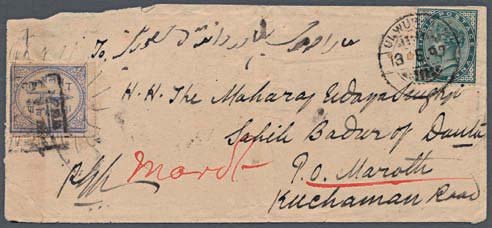
| Gärtner 540 = Köhler 10002 | Alwar quarter anna and British India half anna, addressed to the Maharaj of Danta, P.O. Maroth, Kuchaman Road; Ulwur 13 February 1897, Maroth B.O., Marwar, 14 February 1897 |
| Gärtner 543 | Two brown and two blue stamps tied by square native strikes; called a homemade registered cover |
| Gärtner 549 | Envelope made from newspaper with value-payable labels and a British India half anna, Ulwur 13 September 1893, delivered at Moriani, Sibsagar, 22 September (described in the catalogue, not illustrated) |
| Feldman 80213 | Blue quarter anna, dispatched 26 December 1898 and received at Kishengarh, Ulwar State, 27 December |
| Feldman 80215 | Brown one anna cancelled KATHUMAR / ULWAR STATE, day 30, 1898 |
| Köhler 10005 | Letter without a stamp, with a rectangular bearing mark; catalogued as local mail of 1893, postage to be collected |
Two four-stamp envelopes
The four-stamp envelope sold as Gärtner lot 539 is the same as Köhler lot 10001, which shows its address side for the first time. On the stamp side two quarter annas and two one annas make 2½ annas. Gärtner calls it registered and assigns part of the amount to registration; no registration endorsement, tariff or weight has been found. Gärtner lot 543 is a different cover, with square rather than oval strikes, also described as registered. The catalogues’ “1877” is the year of the stamp issue, not the date the letters were carried.[6][A24]
A royal address via Maroth, 1897
The combination cover once summarised as going to Kuchaman is addressed in English to the Maharaj of Danta through P.O. Maroth, with Kuchaman Road on the line below; the personal name is hard to read. An Alwar quarter anna and a British India half anna represent the two posts, but do not give the full rate or the weight.[6][A24]
It appeared as Gärtner lot 540 in 2011 and Köhler lot 10002 in 2021: the same handwriting, red routing strokes, stamps, cancellations and edges. Köhler’s photograph of the back shows a clear Maroth B.O., Marwar mark of 14 February 1897; the front has Ulwur evidence of 13 February, which Köhler expands to Ulwur City. The first State office, the transport between and the final delivery are unknown.[6][A24]
Within the State: Kishengarh and Kathumar, 1898
Feldman’s lot 80213 of May 2025 records a short journey inside the State. The quarter anna is tied by a dispatch mark of 26 December 1898, with an arrival mark of 27 December. The town name is incomplete, but the catalogue identifies Kishengarh and the device reads Ulwar State: a place inside Alwar, not the separate princely state of Kishangarh. The back has no further readable postmark, and the sender and addressee are untranscribed.[A25]
The Kathumar one-anna cover in Feldman lot 80215 is shown on a modern exhibit page with both sides. The office and the year 1898 are clear; the month is not. The exhibitor’s type C3 follows Benns. Lot 80214, between them, is two blocks of stamps, not a cover.[A26][A25]
Indian mail from Alwar
Gärtner lot 549 is an envelope with a British India half-anna Queen Victoria stamp cancelled ULWUR on 13 September 1893, a value-payable label and a delivery mark of Moriani, Sibsagar, of 22 September. It shows why British Indian mail from Alwar belongs beside the State stamps, even in the years of the State post.[6]
Peter Congreve’s study of Ram Gopal & Co. describes a cover from Alwar City to London of 6 September 1922 franked five annas: two annas surface postage for the first ounce and three annas foreign registration. His London airmail cover of 13 March 1933 is described at 13½ annas: 2½ annas surface postage for the first ounce, eight annas airmail per half ounce and three annas foreign registration. The same study describes registered dealer mail from Alwar City in 1948–49, including a 1949 Indian stationery envelope with added Indian stamps. These show the city office under the Indian post, not that Alwar stamps were still valid after 1902.[A49]
What is still to be found
A dated native tariff (letter rates, weights, registration, bearing and exchange charges), the names of the State post’s staff and a payroll, the signed postal-unity agreement and the terms of the office transfer, the Council orders of the 1896 reform, a reading of the handwritten names on the covers, a photograph of Gärtner 549, the full 38-datestamp group, and the original Philatelic Journal of India article behind the katar legend are all still to be found.
Sources
- [6] Christoph Gärtner, Park Collection, Indian States, 7 March 2011, descriptions p. 107, lots 537–555.
- [A7] R. J. Benns, Alwar, Handbook of Indian Philately, India Study Circle, August 1972, revised 1982.
- [A24] Heinrich Köhler, Gems of Indian States 1864–1950, sale 377, 21 September 2021, lots 10001–10006.
- [A25] David Feldman, India & Indian States, Spring 2025, lot 80213, 30 May 2025.
- [A26] David Feldman, India & Indian States, Spring 2025, lot 80215, 30 May 2025.
- [A49] Peter Congreve, “From Alwar to the World: Reconstructing the Network of Ram Gopal & Co., 1894–1949”, History in the Mail, 5 April 2026.
Notes 0
Add what you know: a cover or stamp in your collection, a date or source, a correction or a question.
No notes yet.
Sign in to add a note.
Notes show straight away. Keep them kind and about the article; anyone can report one that isn't. House rules
