
SARKARI: Bahawalpur’s Official Stamps, 1945–1949
Bahawalpur’s first stamps in use were officials: the six SARKARI pictorials of 1 January 1945, the Nasik provisionals, the chocolate camel, later SERVICE printings, portraits and the Victory stamp of 1946.
Updated November 10, 2026
In this article
Bahawalpur’s first regular postal stamps were for government mail, not the public. SARKARI marks them as official. They need to be kept apart from the ordinary stamps that began in December 1947.
Six official pictures, 1 January 1945
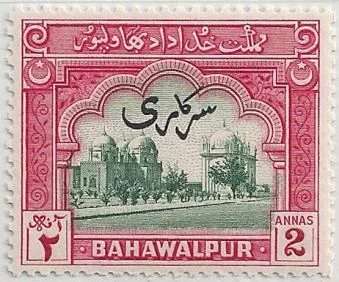
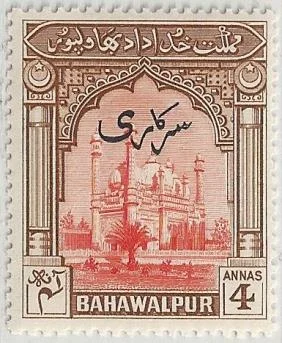
Jal Cooper’s account of 1945 dates the official set to 1 January and lists six values: half anna, one, two, four and eight annas and one rupee. He gives the subjects as the Panjnad Weir, camels, blackbuck, pelicans, the mosque by Fort Derawar and the Pattan Minara near Rahim Yar Khan. The set was recess printed by De La Rue on paper with a repeated crescent-and-star watermark, in sheets of a hundred: details of this first group, not of every later official.[7]
Rab illustrates a first-day cover of 1 January 1945 from the Amir to the State Prime Minister, Richard Crofton, with the note enclosed in it. Its Sadiqgarh Palace cancellation and enclosure confirm January use, independently of the March provisionals; a first-day cover gives no tariff.[13]
The provisionals of March 1945
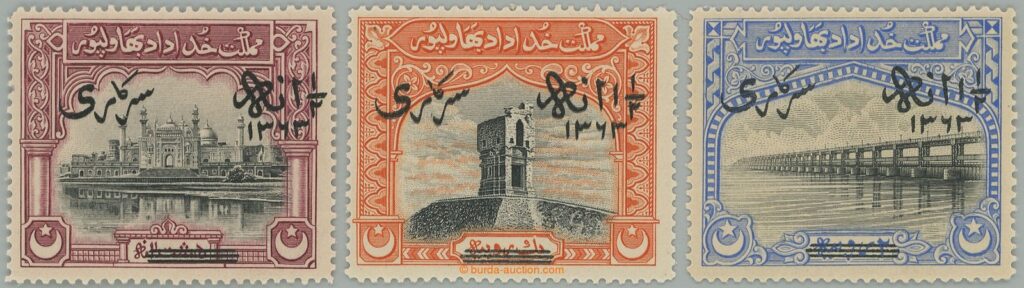
Low official values soon ran short. Cooper says that half an anna on eight annas and one and a half annas on one rupee were issued on 1 March, and that one and a half annas on two rupees was expected shortly: in his article an announcement, not a release on the same day. The surcharges, with the SARKARI wording and the Hijri year, were reported as applied at the Security Printing Press, Nasik, on unwatermarked paper; the half anna was surcharged on an eight annas in claret, not the earlier brown.[7]
Rab cites a De La Rue packing note of 2 March 1945 listing dies sent to Nasik, including a separate SARKARI die, which separates the London die maker from the Indian workshop that applied the values. It sits awkwardly with Cooper’s date of 1 March, and which dies served the first supplies is still open. Rab also describes a bold Urdu overprint by an unnamed Lahore calligrapher on trial material, which is not the Nasik work. The stamps sent to Nasik were already gummed and perforated, and the sheets curled or split along the perforations in handling.[13]
The Rab sale includes an official envelope of 29 November 1945 to Baghdad-ul-Jadid with the one-and-a-half-annas-on-one-rupee provisional and a one-anna official, and an expertised used example with a doubled vignette and the surcharge placed so low that the old value shows. A trade catalogue groups the three provisionals in March–May 1945. StampWorld lists them under a heading that prints the year as 1963 and gives watermarked paper; the specialist evidence says 1945 and unwatermarked.[21][22][15][13]
Cooper’s article also announced a planned replacement series of twelve values, not yet expected for some time: a programme, not a date for every later stamp.[7]
The chocolate camel
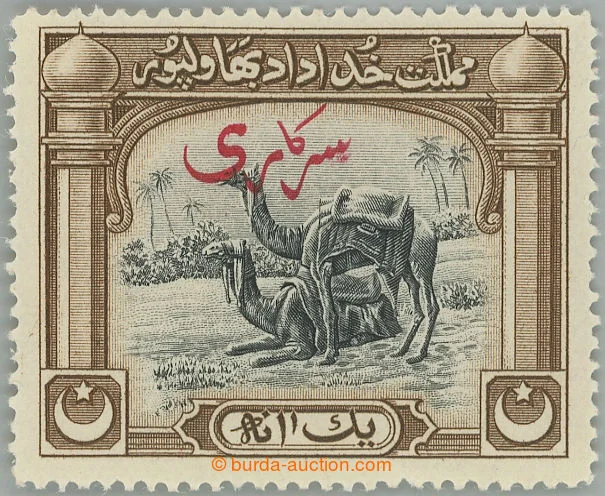
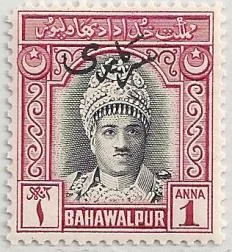
The chocolate one-anna camel is a stamp of its own, apart from the carmine one anna and the provisionals. Cooper later reported its issue on 10 March 1945, with an intimation of 11 March, a supply letter of 10 April and an explanation of 17 April 1946: old revenue stock in the treasury had been overprinted for urgent official needs. It was on unwatermarked paper.[8]
Rab measured its frame at about 33.5 mm, the width of the later pictorials, against 32 mm for the early printing, so it is a later printing of the baggage-camel design, not original 1933 stock; the Rab sale gives 34 mm. The Amir’s correspondence records 60 sheets for the red-overprinted supply, and another letter a Treasury stock of 8,700. Cooper gives sixty sheets, six thousand stamps; Pollard and Wood give ten thousand. Stock, quantity overprinted and quantity sold are different figures, and none is a count of survivors.[13][21][8][9][37]
Flaws in SARKARI
Pollard records a missing left upstroke in SARKARI at row 6, stamp 3, on several values. The Rab sale also records the two-annas SARKARK flaw at row 10, stamp 1, and the four annas in stages with a thin or doubled stroke. Keep value, position and stage together. Later printings of the half anna and one anna have white gum instead of the original brown, streaky gum, which is worth checking but proves nothing alone after storage, washing or regumming.[9][21]
The Rab catalogue records frame plate 1 under row 10, stamp 2 on corner blocks of the first officials, and vignette plate 1 under row 10, stamp 1 on the one anna.[21]
SERVICE and SARKARI, June 1945
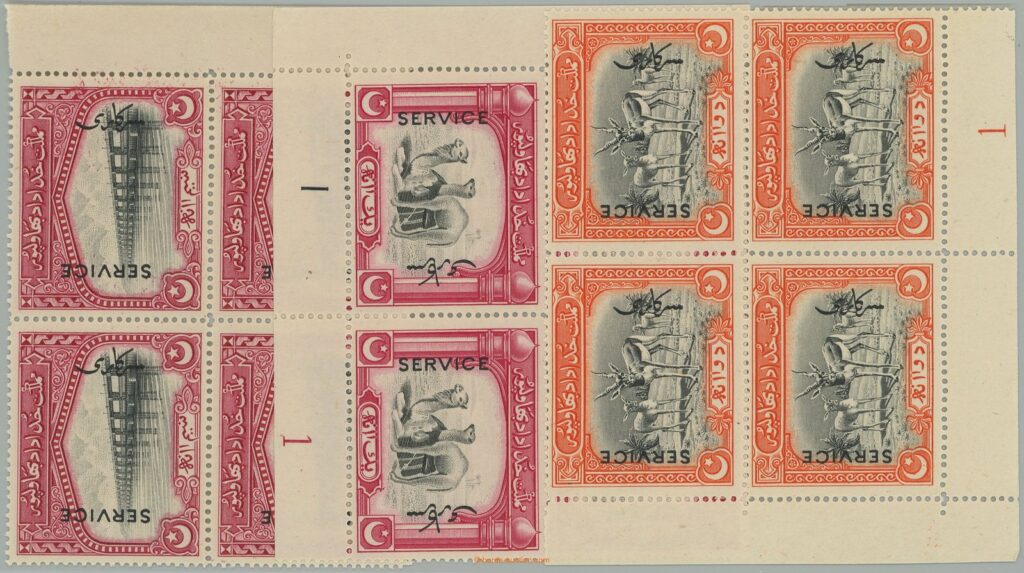
Wood reports the new SERVICE/SARKARI overprint submitted on 1 June 1945 and approved on 6 June, and Rab dates the resulting three low-value pictorials, made to an urgent De La Rue order, to June. They carry SERVICE in English as well as SARKARI in Urdu. Rab illustrates one with the marking missing because of a paper fold.[37][13]
A cover from Deh-Rawal dated 24 March 1946 carries the four-annas red SARKARI and the two-annas bilingual official together, with a certificate of the Philatelic Federation of Pakistan: both printings in use by that date.[23]
The portrait officials
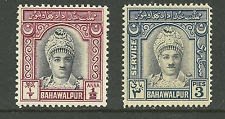
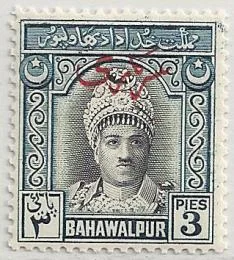
Two small-format officials, three pies and one and a half annas, show Sadiq Muhammad Khan V. Dawood and her colleagues report a De La Rue imprint. The Rab sale records a half-anna proof of the small design, an ultramarine three-pies trial and a strip of the issued three pies with plate numbers; an engraved proof with blank value tablets belongs to the larger series that was planned. Designer and engraver are unknown.[24][21]
Victory, 1 May 1946
The green-and-grey one-and-a-half-annas Victory official is dated 1 May 1946. Bromide proofs of 1945 include rejected versions at one anna and at one and a half annas, with different lettering below VICTORY. Wood describes the green frame as recess printed and the background as lithographed, with cylinder number 1 in the lower-right margin and the imprint Thomas De La Rue, London at the foot. The specialist Victory exhibit credits the design to E. Meronti, without a signed drawing or record; the British Library’s O. C. Meronti designed for Bahrain later and does not identify the Bahawalpur artist.[5][37][25][26][27][28]
At row 2, stamp 1, Stamp Magazine in 2001 describes a coloured dash above the T of VICTORY, while Wood describes a green dot above the V and I; a positional block is needed to know whether they are the same flaw. Reports of 1946 describe great variation in the grey centre, especially where it covers the Russian and Chinese flags, and a metallic-looking centre; the catalogue note wonders whether green-and-black copies were colour trials. Wood also records a green spot under the left-hand coconut tree on the last stamp of the sheet, the “falling coconut”, thinks light and charcoal grey rays probably an inking difference, and calls gold rays possibly clandestine.[5][37]
According to the Rab sale, a Victory official on a cover from Sadiqgarh Palace is dated 4 December 1946 with a delivery mark of the same day; an unaddressed envelope with ten Victory stamps cancelled at Baghdad-ul-Jadid on 5 April 1947 proves cancellation, not a journey.[21]
Officials on the later designs
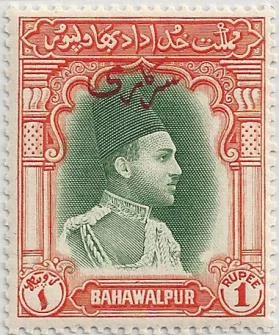
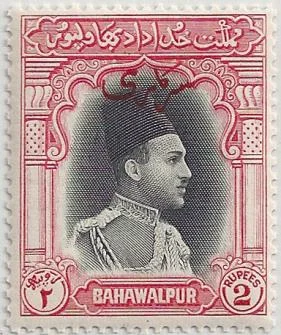
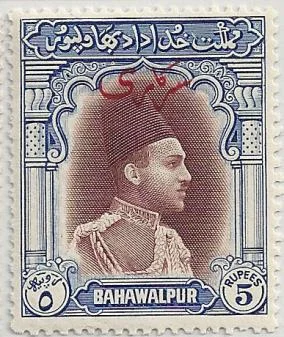
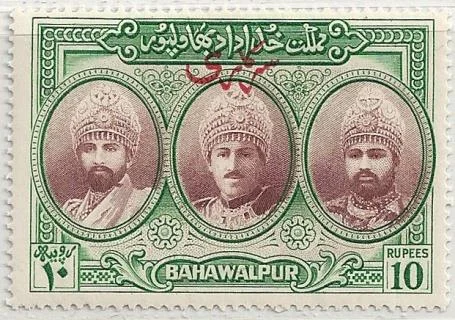
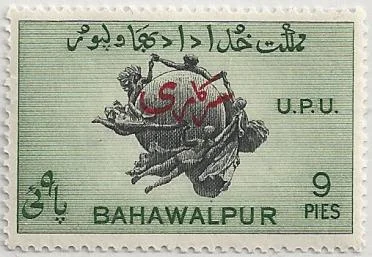
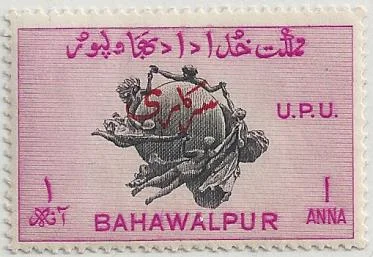
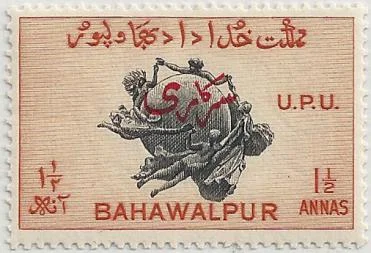
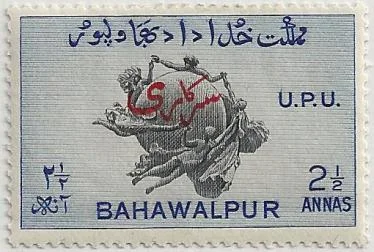
After 1947 the ordinary definitives of 1948 were overprinted for official use in eight values, three pies to ten rupees, and the four UPU stamps of 1949 likewise. Pollard warns of apparently cancelled-to-order sets and contrasts them with commercial correspondence; his blanket warning about dates after 1949 is not a verified rule.[9][12]
Sources
- [5] “Bahawalpur”, note on the Victory issue varieties, Stamp Magazine, November 2001, p. 70.
- [7] Jal Cooper, “Stamps of Bahawalpur”, The Stamp Lover, October–November 1945, pp. 59–60; credited as a permitted reprint from India’s Stamp Journal.
- [8] Jal Cooper, “The Lone Wolf of the Bahawalpur Officials”, Philatelic Magazine, 17 March 1950, p. 225.
- [9] Dickon Pollard, “Separated at Birth”, Stamp Magazine, September 1999, pp. 83–85, especially Bahawalpur discussion on p. 85.
- [12] W. Michael Adkins, Bahawalpur: State of Pakistan album, pp. 1–5 (page revisions 2013–2014).
- [13] George Rab, “The First Stamps of Bahawalpur”, Gibbons Stamp Monthly, March 2017, pp. 60–65.
- [15] StampWorld, Bahawalpur official stamps. Official rows 1–16, pre-independence groups.
- [21] Stanley Gibbons Baldwin’s, The George Rab Collection of Bahawalpur, sale S24011, 26 November 2024, lots 28–33, 102–134, 164–170 and 188–203.
- [22] Universal Philatelic Auctions, sale 75, Bahawalpur officials.
- [23] Christoph Gärtner, auction 20, Asia catalogue, 3 November 2011.
- [24] Humaira Dawood, Sumera Jawad, Naela Amir and Aqsa Malik, “An Account of Bahawalpur’s Stamps Through Colonial Times and After”, Contemporary Journal of Social Science Review 3(4), 2025. PDF-text pp. 5–7, small-format portraits and Victory.
- [25] Stanley Gibbons, auction 5923, Bahawalpur, May 2021. Lots 901–905, including three Victory bromides.
- [26] Philately Life, Bahawalpur Official Issues (1945–1949). 1946 Victory and small portrait listings.
- [27] P. Voller, Britain Postal History 1939–1945, Victory issues. Bahawalpur entry no. 118, SG O19.
- [28] British Library, Universal Postal Union Collection, Bahrain definitives, Philatelic 72/167/2/15. Scope and Content, 1 July 1960.
- [37] Ron Wood, The God-Given Kingdom of Bahawalpur, Petersfield: R. and J. L. Wood, 1990, pp. 8–19.
Notes 0
Add what you know: a cover or stamp in your collection, a date or source, a correction or a question.
No notes yet.
Sign in to add a note.
Notes show straight away. Keep them kind and about the article; anyone can report one that isn't. House rules
