
Bahawalpur 1947–1949: the Star-and-Crescent Handstamps and the Ordinary Issues
The disputed star-and-crescent handstamps on Indian stamps in 1947, then Bahawalpur’s ordinary stamps: the bicentenary of 1947, the 1948 definitives and commemoratives, and the 1949 jubilee and UPU sets.
Updated September 8, 2026
In this article
Two studies, not one
Bahawalpur’s ordinary stamps, from the bicentenary of 1947 to the UPU issue of 1949, form a collection in their own right; the officials began earlier and have their own families. Neither should be treated as a preface to the debate over the star-and-crescent handstamps.[1][2][3]
The star-and-crescent handstamps of 1947
The star-and-crescent handstamps on Indian stamps are a specialist field with open questions about colours, proofs, approval and postal status. Sandeep Jaiswal’s follow-up of 2023 corrects the end of the period from 3 October to 5 October 1947.[1]
Blue, violet and purple are not a settled set of three colours: George Rab and Jaiswal disagree about the recorded blue examples and whether violet differs from purple. Colour approvals on proof sheets, loose stamps and certified postal use are different kinds of evidence.[1]
The preparations came before August. A household submission of 7 June 1947 calls the proposed handstamp temporary, pending the overprints that had been ordered, and Spink reproduces a De La Rue letter of 27 June about metal dies for Nasik. These separate the temporary handstamp from the machine overprint; they do not settle later postal use.[16]
What happened to SERVICE?
Another open question concerns Indian official stamps after the Bahawalpur handstamp was applied. One view treats them as converted to ordinary postage; another explains apparent ordinary use as a mistake or a shortage. Jaiswal prints both, so not every handstamped Indian SERVICE stamp is an undisputed ordinary issue. Bahawalpur had its own officials from 1945 to 1949, which matters to the argument, but unused quantities cannot show the stock at one counter on one day. A cover has to be tested on its date, address, markings, service and any expert opinion.[1]
Proofs, forgeries and counts
The same follow-up identifies an earlier illustrated item as a forgery and corrects statements about sheets and quantities. Its proof totals concern defined groups, not every Bahawalpur proof ever recorded. For a proposed discovery, keep the complete object, its provenance, both sides, the measured handstamp, a description of the ink and an expert certificate if there is one. A certificate authenticates the item it describes, not every inference about policy. Start with the Indian stamp and any SERVICE marking, then the handstamp and its colour, then the dated postal evidence and the provenance: a proof approval, a loose impression and a letter that travelled answer different questions.[1]
The bicentenary of 1 December 1947
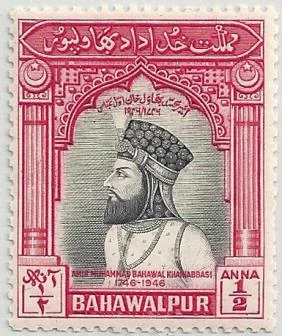
The ordinary series begins with the half-anna stamp of 1 December 1947 for the bicentenary of the State’s founding.[2]
The definitives of 1948
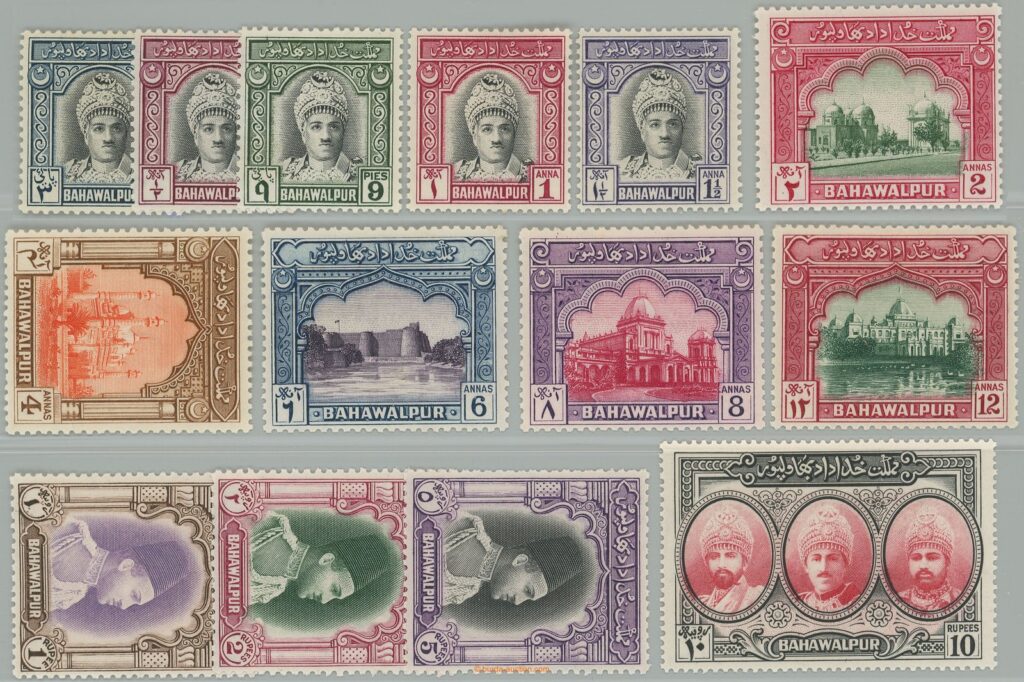
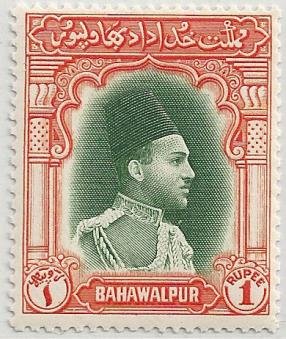
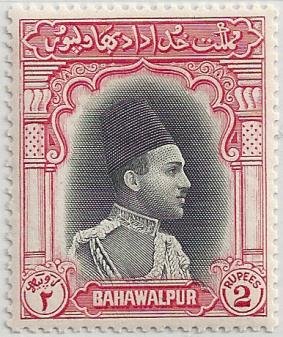
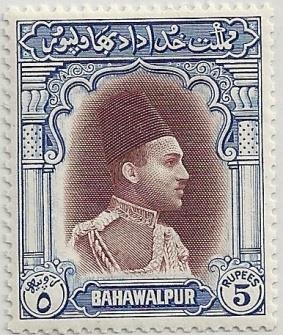
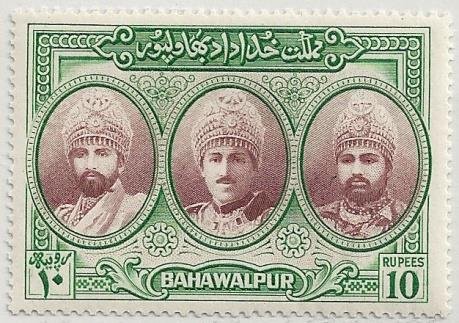
The definitive set of 1 April 1948 has fourteen values from three pies to ten rupees: five small portraits, then architecture, then larger rupee portraits, ending with a ten-rupee design showing three generations. The high values were later issued in new colours: one rupee orange and deep green, two rupees carmine and black, five rupees blue and reddish-brown, and ten rupees green and reddish-brown. A shared portrait does not make the two groups interchangeable; read the values from the inscriptions, not the colours.[2][11][12]
Commemoratives of 1948 and 1949
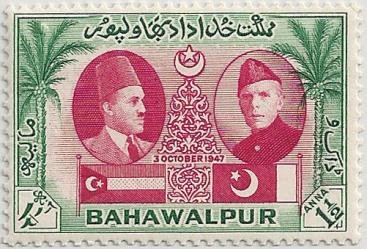
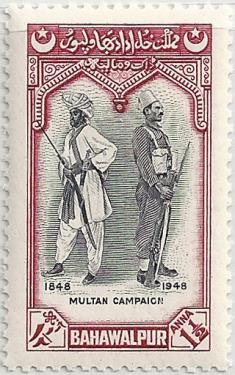
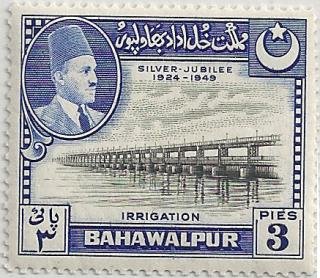
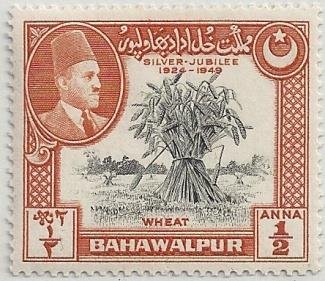
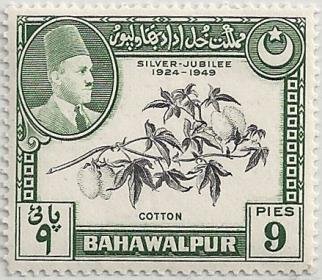
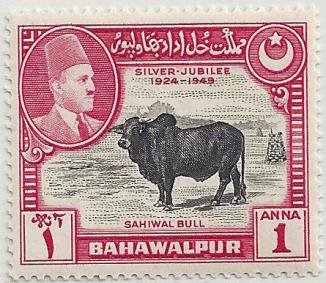
Two commemoratives of October 1948 are separate issues: one and a half annas for union with Pakistan on 3 October, and half an anna for the centenary of the Multan campaign on 15 October; the Multan stamp is half an anna, as its inscription shows. The four-value series of 3 March 1949 marks the silver jubilee of the Amir’s accession, counted from his full powers of 1924; it does not move his childhood succession of 1907. The UPU set of 10 October 1949 has four values, nine pies to two and a half annas, in ordinary and official versions. Album pages list different perforations for the UPU set, which a face photograph cannot confirm.[2][10][12][35]
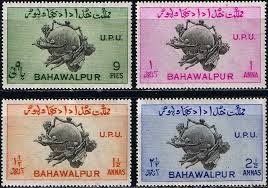
Catalogue prices change and have no place in a history; a catalogue entry also does not prove that a stamp, cancellation or overprint offered for sale is genuine.
What is still open
An office-by-office atlas of postmarks, reconciled tariffs and an inventory of postal stationery still need evidence; a loose cancellation cannot give the route, weight, service or rate of a letter. Cooper’s 1 March and Rab’s 2 March for the provisionals, the release day of the two-rupee provisional and the original terms for official mail in 1944–45 remain open, as do the artists, engravers and die cutters, the Lahore calligrapher and the Victory designer. Leads include the administration report for 1944–45, U. A. G. Isani and Syed Abid Hussain’s The Amirate of Bahawalpur: Postal History and Stamps (1932–1949) of 2006, the De La Rue archive at the University of Reading and the Crown Agents registers of dies and plates at the British Library.[30][31][32][33][13]
Sources
- [1] Sandeep Jaiswal FRPSI, “Bahawalpur: The 52-Day Sovereign Nation Period—A Follow-Up”, The London Philatelist, vol. 132, January–February 2023, pp. 49–51.
- [2] StampWorld, Bahawalpur, ordinary postage 1947–1949, issue dates and denomination listing.
- [3] Pakistan Philatelic Circle, Bahawalpur stamp chronology and official-issue listing.
- [10] Henning Sværd and William E. Steiner, Bahawalpur album pages, stampalbums.com, pp. 3–10.
- [11] Burda Auction, Online Auction 85, Bahawalpur, objects 271780, 271781 and 275810.
- [12] W. Michael Adkins, Bahawalpur: State of Pakistan album, pp. 1–5 (page revisions 2013–2014).
- [13] George Rab, “The First Stamps of Bahawalpur”, Gibbons Stamp Monthly, March 2017, pp. 60–65.
- [16] Spink Insider, Winter 2022, Bahawalpur discussion.
- [30] British Library, Bahawalpur Administration Report, 1944/45, IOR/V/10/717.
- [31] Chughtai Public Library, Report on the Administration of the Bahawalpur State for 1944–45, serial 13.
- [32] University of Reading Special Collections, De La Rue Archive, MS 937. Collection scope and institutional leads.
- [33] British Library, Crown Agents Philatelic and Security Printing Archive, CA 3/3. Registers of Dies and Plates, Thomas De La Rue, finding aid.
- [35] C. U. Aitchison, A Collection of Treaties, Engagements and Sanads Relating to India and Neighbouring Countries, vol. I: Punjab, Punjab States and Delhi, revised to 1929, Calcutta, 1931, pp. 123, 125–126, 243 and 247–248.
Notes 0
Add what you know: a cover or stamp in your collection, a date or source, a correction or a question.
No notes yet.
Sign in to add a note.
Notes show straight away. Keep them kind and about the article; anyone can report one that isn't. House rules
