
Bussahir Values, Monograms and Reprints: Reading the Two Tiger Families
The eight values of the white-letter STAMP family, the coloured-letter POSTAGE family, the RS monogram and its exceptions, laid paper, unissued high values and the revenue ‘essays’.
Updated October 27, 2026
In this article
Two design families, two lists of values
The first white-letter issue and the second coloured-letter family need separate lists. Bateman’s catalogue gives eight first-issue values: a quarter, half, one, two, four, eight and twelve annas and one rupee. That restores the half anna and one rupee missing from lists based only on the advance circular, which mixes postage samples, proofs and revenue material. Haverbeck’s statement that the eight annas, twelve annas and one rupee were not issued concerns the second family only.[6][1]
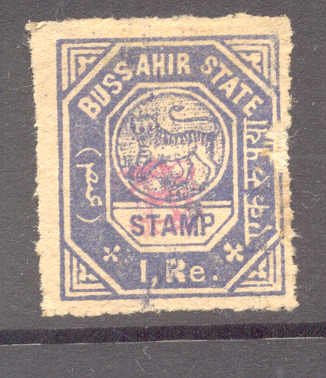
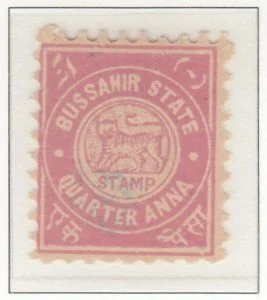
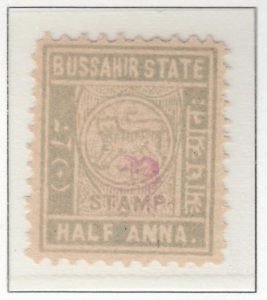
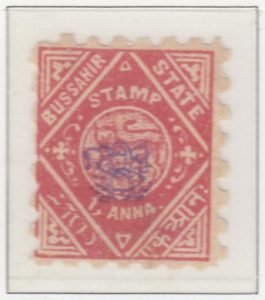
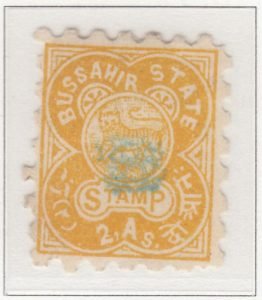
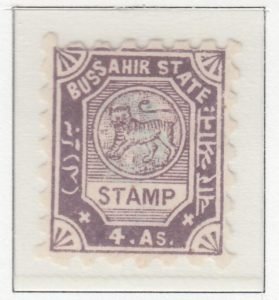
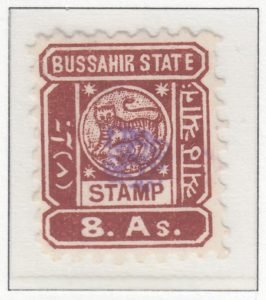
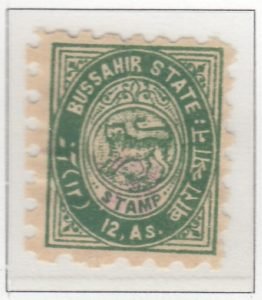
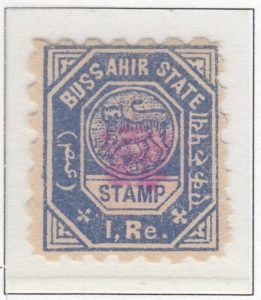
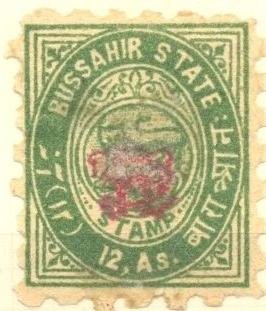
The eight first-family designs can be compared by their frame and value. The quarter-anna photograph is identified by its printed value and exhibition caption, despite a file name that says half anna. The monograms are visible; whether they are genuine, and whether each stamp is an original or a reprint, needs specialist examination.[7]
The coloured-letter POSTAGE family
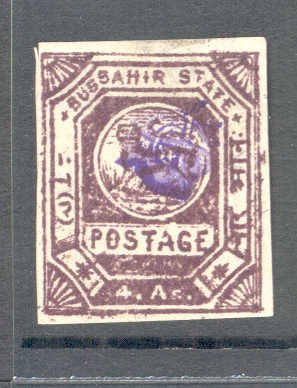
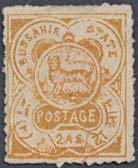
Compare the POSTAGE designs with the earlier STAMP family. The coloured-letter values are ¼, ½, 1, 2 and 4 annas, mostly lithographed from copper-plate transfers, with the small directly engraved quarter- and half-anna group catalogued by Bateman.[6][16]
Bateman records Douie’s report of fifteen second-design quarter-anna slate-violet stamps with rose monograms on letters dated between 14 October 1896 and 5 December 1899, evidence against giving the whole second design a start in 1900. He is more cautious about the second-design four anna: he accepts it as issued but doubts that it was really used, having seen no cancellation he thought beyond suspicion. Neither observation fixes a first day or rules out a genuine used example turning up.[6]
The monogram, and its exceptions
The issue monogram described by Haverbeck has a double-lined R over a single S. Different monograms, wrong colours, changes of paper and later impressions each need their own classification. Haverbeck regards some late laid-paper coloured-letter material as reprints. An online scan cannot prove paper structure, original gum or a monogram setting.[1]
Bateman adds an exception to the rule that a stamp needs its monogram: he allows twelve catalogue-listed stamps that escaped the Type A overprint. That is a specific category, not permission to treat any unmonogrammed tiger as issued. His text places first-family Types B–H among the remainders, and separates second-family remainders on wove paper from reprints on laid paper or in wrong colours. The monogram, design, paper and catalogue entry have to be read together.[6]
Paper and its contradictions
Bateman describes the first family’s laid paper, with fragments of papermakers’ sheet marks; StampWorld records no watermark. A papermaker’s mark on part of a sheet and a stamp watermark are different things. Look at the paper against the light, and at the back and margins, before naming a subtype.[6][16]
His text treats later laid-paper material as reprints, but his own catalogue includes two blue half-anna entries on laid or toned laid paper among the accepted postal issues: no. 79, “4×6 laid”, and no. 85, “toned laid”, both from a private collection. His page 56 says entries 1–131 were valid for postage, and the catalogue heading says wove. The contradiction is unresolved, and neither a rejection nor an acceptance should be made on paper alone.[6]
Unissued high values and revenue ‘essays’
The eight annas, twelve annas and one rupee of the coloured-letter design were, Haverbeck states, not issued for postal use; they are listed only to avoid confusion with issued values.[1]
The word “essay” in a sale description does not prove a postal purpose. Two groups offered by David Feldman on 30 May 2025 include designs plainly inscribed for revenue use, and one description leaves their intended purpose uncertain. They are research leads; they should not add two-, three- or five-rupee stamps to a postal checklist.[26][27]
Reprints, altered monograms and cancelled-to-order stamps
Remainders and reprints have no general postal validity. Compare paper, monogram and cancellation with the specialist study, and keep the modern M.H.B. transcription apart from the M.K.B. of 1901.[6][24][11]
Sources
- [1] Harrison D. S. Haverbeck, “The Postal History of Bussahir”, pp. 29–33.
- [6] Robert Bateman, The Postal History of Bussahir, The Press at Ifield, undated.
- [7] Indian Feudatory States Stamps, Bussahir exhibition, eight displayed first-family photographs with monograms.
- [11] E. B. Evans, “The Stamps of some of the Native States of India: Bussahir”, Stanley Gibbons Monthly Journal, vol. 11, 31 August 1900, and 31 January 1901, p. 143.
- [16] StampWorld, Bussahir, 1895–1900 catalogue groups.
- [24] Stanley Gibbons sale 5942, Alan Jobling Walker collection, 2023-03-23.
- [26] David Feldman, Peter Rover collection, lot 80042, 30 May 2025.
- [27] David Feldman, Peter Rover collection, lot 80043, 30 May 2025.
Notes 0
Add what you know: a cover or stamp in your collection, a date or source, a correction or a question.
No notes yet.
Sign in to add a note.
Notes show straight away. Keep them kind and about the article; anyone can report one that isn't. House rules
