
Bussahir Covers, Postmarks, the Stamped Envelope and Cancelled-to-Order Material
Rampur–Rohru covers of 1896 and 1899, the town datestamps and the bogus marks, the violet stamped envelope whose value is disputed, and how to recognise favour and CTO cancellations.
Updated June 28, 2026
In this article
Covers on the Rampur–Rohru route
Heinrich Köhler’s lot 10511 is a piece with a quarter-anna pink stamp, a RORHU mark dated 7 December 1896 and a Rampur mark on the back dated 8 December, with Dawson provenance. These are marks on a fragment; the whole letter, the sender, the fee and the route between are unknown.[19]
Corinphila describes a quarter-anna pink stamp with a “TRS” overprint on a cover posted at Rampur on 20 August 1899 and arriving at Rorho, or Rohru, on 23 August. It fits the cross-valley route described in the postal study, but the auction’s reading of the monogram and its genuineness are not independently confirmed.[10]
A dated mark can still be a favour strike
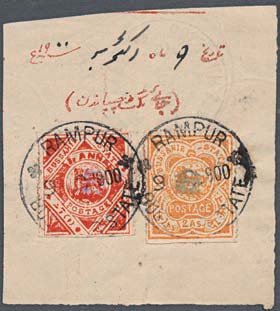
Haverbeck describes two English-letter town datestamps and two other markings that need separate treatment. Bateman later subdivides the two main circular forms by layout and date-setting, including a short experiment with numeric months reported for late 1899. The illustrated Chini strike reads 18 SE 99 and the Rampur strike 16 AP 96; these are examples, not first or last dates.[1][6]
| Form and size | Features | Status in the study |
|---|---|---|
| Circular, about 25 mm | Date between two horizontal lines; 16 mm inner circle; barred segments; BUSSAHIR-STATE below | One of the two main town-mark families |
| Circular, about 27 mm | Town above with a cross either side; BUSSAHIR STATE below; date without framing lines | The second main town-mark family |
| Circular, about 20 mm | Vernacular inscription with no English; not deciphered | Reported on remainders and reprints only |
| Rounded rectangle, about 20 × 12 mm | Vernacular quarter-anna inscription | Regarded as bogus; reported beyond Bussahir too |
Haverbeck cites a Rampur strike reading 19 MA 1900 among cancelled-to-order material, alongside 10 SE 1901; the abbreviated month is given as printed. A date before the closure does not prove a real journey. He also reports pieces made about 1905 by mounting and postmarking stamps inside pencilled squares on large sheets, and traces of that pencil ruling can give the preparation away. The whole object, the tying marks and the provenance matter as much as a clear date.[1]
The reported stamped envelope
A private research sheet reports a violet envelope with an RS monogram used from Rampur to Rohru, without a photograph and with an uncertain value. The United Postal Stationery Society reproduces a low-resolution photograph of the front and back of a registered Bussahir envelope from the Veldman sale of 15 June 2006: a violet envelope with a rose monogram, an added imperforate 2-anna stamp, two Rampur datestamps and a boxed manuscript registration mark. Its date is given as “13 December 1900?”.[3][9]
The value is disputed. The 2006 sale reads the impressed stamp as ½ anna; Bateman’s catalogue lists a 1-anna lilac envelope with a Type A monogram in mauve, from a private collection; and the private sheet gives ¼ anna. The three descriptions may refer to different objects, so none is merged into another.[3][6][9]
The Royal Philatelic Society London’s notice for Sandeep Jaiswal’s display of 26 February 2026 describes a violet half-anna envelope with a rose monogram and an added orange-yellow 2-anna stamp. The visible value band agrees with half anna, though a cancellation crosses the inscription; the manuscript Rampur address and the added stamp are clear, but the front view does not settle the date or prove delivery. The notice also says Ascher recorded an unused example whose whereabouts are unknown. This strengthens the half-anna reading for the pictured envelope, without showing that Bateman’s one-anna entry, the quarter-anna description and this envelope are the same object.[30]
How to identify the issues
Identify the family and the printing process before the monogram: white letters or coloured letters, lithograph or the rare direct engraving, which differs in paper, relief on the back, margins and separation. Use full multiples, or study photographs, before assigning a single stamp to a stone, since the two anna had both a 2 × 2 experimental stone and a 5 × 10 setting. A loose face scan cannot prove the process.[6]
What is still open
The exact opening of the public service, a dated commissioning order, the engraver of the copper plate and the value of the stamped envelope are unknown. An office-by-office register, a census of covers and the full list of stones remain to be made. The conflict between Bateman’s text and his catalogue over laid paper, and between the M.K.B. and M.H.B. imprints, can only be settled by the objects themselves.
Sources
- [1] Harrison D. S. Haverbeck, “The Postal History of Bussahir”, pp. 29–33.
- [3] “Bussahir”, an undated, unsigned one-page research sheet on the postal stationery.
- [6] Robert Bateman, The Postal History of Bussahir, The Press at Ifield, undated.
- [9] United Postal Stationery Society, Postal Stationery Miscellany #37, “Indian Feudatory State of Bussahir Envelope”, with the Veldman sale description of 15 June 2006.
- [10] Corinphila, Indian States auction, Bussahir cover of 1899 from Rampur to Rorho/Rohru.
- [19] Heinrich Köhler, auction 377, Gems of Indian States, Bussahir lots 10507–10530.
- [30] Royal Philatelic Society London, India Postal Stationery display by Sandeep Jaiswal, 26 February 2026.
Notes 0
Add what you know: a cover or stamp in your collection, a date or source, a correction or a question.
No notes yet.
Sign in to add a note.
Notes show straight away. Keep them kind and about the article; anyone can report one that isn't. House rules
