
Duttia’s Ganesh Stamps, 1893–1899: Dating, Printing and the Maharaja’s Seal
The disputed manuscript-valued Ganesh stamps, the double frame, the trefoil frame and the red one anna, printed one impression at a time at a private press and validated by the Maharaja’s seal.
Updated November 11, 2026
In this article
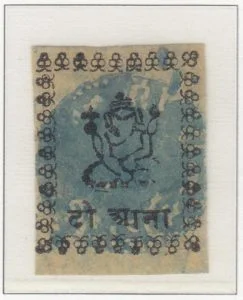
Duttia’s first stamps show Ganesh, the elephant-headed god, and they carry all the complications of a very small printing operation. Their dates, their order and even the genuineness of the earliest group are still argued over, so the stamps themselves are the best place to start.
An elephant god and an unsettled beginning
The stamps with handwritten values, traditionally dated 1893, remain disputed. Peter Röver accepted them as genuine while acknowledging the controversy, and that is how they are presented here: as his position, not as an undisputed fact.[1]
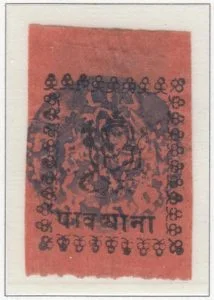
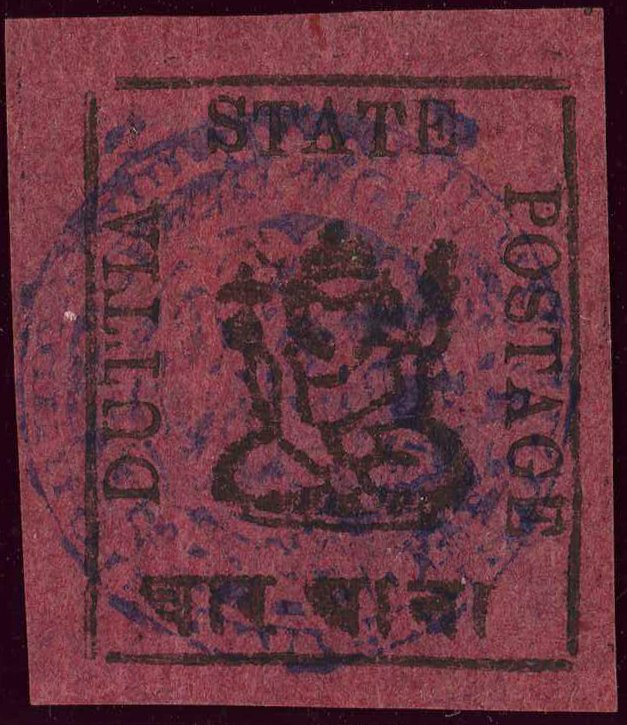
Röver traces the early typeset designs through one shared Ganesh cliché, and separates a later, larger replacement. An undamaged trunk, a damaged trunk and changes to the surrounding frame can matter more than a catalogue’s convenient date heading. In particular he argues that the double-frame-and-stars stamps and the modified red one anna came before the trefoil family, which reverses the usual order.[1]
The early catalogue sequences do not line up. Röver’s tentative manuscript set has half, one, two and four annas. StampWorld shows a first group of quarter, half, two and four annas, followed by a separate one anna with a red overprint. The two lists are a classification problem; one cannot be swapped for the other.[1][6]
What the Gazetteer dates to 1893
The Eastern States Gazetteer of 1907 dates the founding of Datia’s State postal system to 1893. Before that, it says, letters went from the British post office to the nearest police station or tahsil office. This is an official account of how delivery was organised, not a first-day notice for the disputed early stamps: it supports the administrative chronology without settling their dates.[9]
The same Gazetteer describes the local stamps as bearing Ganesh and their value in Hindi, a contemporary identification of the motif and the inscription that does not depend on modern catalogue captions. It names no designer, engraver or printer and says nothing about why the deity was chosen.[9]
The order Röver proposed
Röver tentatively places the double-frame-and-stars two annas, grey-blue on yellow, in 1894; the half anna surcharged on eight annas in 1895; and the modified one anna, red on white, in 1896, before the trefoil family. His reconstruction is not a confirmed calendar of first days. Other unsurcharged values in the double-frame design are conjectures in his account, and they are not counted as issued stamps here.[1]
| Date | Design | Values |
|---|---|---|
| Traditionally 1893 (disputed) | Ganesh, value written by hand | ½, 1, 2 and 4 annas |
| Tentatively 1894 | Ganesh, double frame and stars, grey-blue on yellow | 2 annas |
| Tentatively 1895 | Half anna surcharged on eight annas | ½ anna on 8 annas |
| Tentatively 1896 | Ganesh, trefoil frame | ¼, ½, 2 and 4 annas |
| Tentatively 1896 | Modified Ganesh design, red on white | 1 anna |
| 1897–1899 | English DUTTIA inscription, black on coloured papers | ¼ (in the 1899 group), ½, 1, 2 and 4 annas |
Two judgments on the manuscript stationery
The manuscript group is not one packet of evidence. Röver accepted the manuscript postcard that goes with it, but rejected the particular envelope illustrated by Staal as a modern fabrication, because of its drawing, handwriting, address conventions and the way the marks were applied. That judgment concerns the one illustrated envelope, not every manuscript card or envelope.[1]
He also read a seal on an apparently unused postcard or stamp as a contemporary cancellation applied to order. Keep this apart from the blue control seal on the later printed stamps: a seal alone does not prove that an item went through the post.[1]
Inscription, seal and value
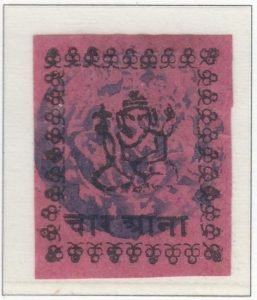
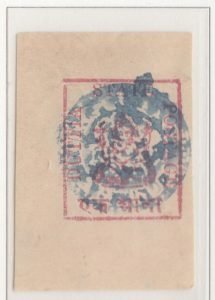
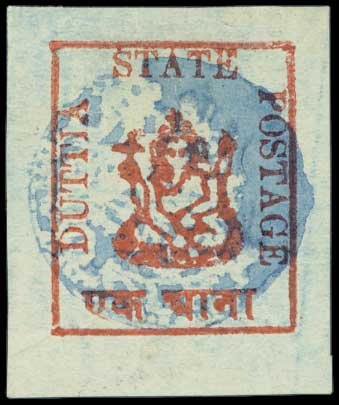
Later designs use English forms of the name, DUTTIA and DATIA. The blue control seal is a separate applied feature. Record its colour and how complete it is, without assuming that a large, clear seal proves the stamp underneath genuine.[3]
DUTTIA and DATIA should not simply be sorted into a correct spelling and a printer’s error. Röver explains DUTTIA as an older phonetic English spelling and DATIA as the form adopted under Hunter’s transliteration system, and he describes a short DATIA interlude. The checklist calls it a spelling variant and keeps badly formed letters and setting errors as separate descriptions.[1]
The checklist separates the manuscript values, the trefoil frame, the provisional half anna on eight annas and the later English-inscribed groups. It does not claim that every design existed in every value.[1][3]
A private press, and a separate act of validation
The account of the Duttia State Post published in February 1897, compiled from notes supplied by C. L. Pigott, says that stamps and stationery were printed at a private press. A second operation made them valid for postage: the impression of the Maharaja’s seal. That is a description of the arrangement in 1897, not a test of authenticity for every later stamp. Neither the press nor its owner is named.[12]
The same account names the post’s structure: a head postmaster at Duttia, inspection by senior Darbar officials and accounts rendered to the State Treasury. It does not name the people who held these posts or say who commissioned the designs. Pigott supplied the notes; that does not make him the designer or the printer.[12]
Type, ornament and a hand press
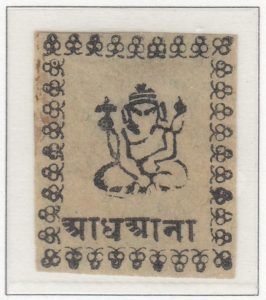
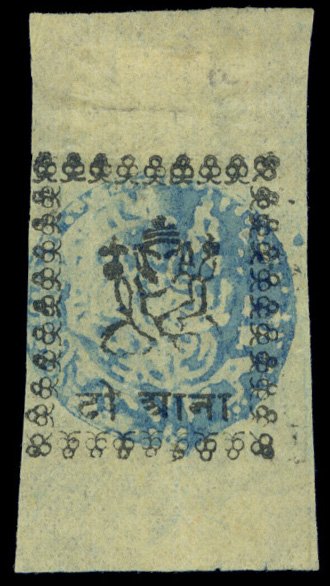
The 1897 account describes two Ganesh designs built up from type. Design A, with English lettering and represented by the red one anna, measured about 25 by 20 mm and had a plain frame. Design B measured about 25 by 21 mm and surrounded Ganesh and the Hindi value with trefoil ornaments, without the name of the state. Both were printed one impression at a time: design B in horizontal strips of eight, design A in strips of six. These are rows built up by repeated impressions, not evidence of a printing plate of eight or six subjects.[12]
A frame made of separate pieces
In 1900 E. B. Evans explained that the trefoils were separate pieces of printer’s type, not a continuous border. He distinguished the single-stalk ornaments at the corners from the pieces with two curved stalks used along the sides, and noted that the published illustrations were not exact enough for such comparisons. The position and direction of an ornament is therefore useful evidence of how a stamp was made, though it does not identify a designer or die cutter.[13]
Frame, paper and two Ganesh clichés
Ian Faucitt’s undated handwritten study separates the early DUTTIA settings by the way the top frame projects beyond the left bar, the join at the lower right corner and the position of the dots. It records wove and laid papers, with the mesh in different directions, and small and large Ganesh impressions: concrete features to record under a glass. The dates written on his charts are his own assignments, not dated postal notices.[5]
Röver says the first Ganesh cliché was used throughout SG 1–15, and that a larger replacement Ganesh also occurs on SG 6–10. Faucitt’s final chart separates a small Ganesh, Setting VI, from a large Ganesh, Setting VII, and finds the large one with both undamaged and damaged trunks. An undamaged trunk is therefore not by itself a test for the earliest issue across both clichés: compare design, frame, cliché and damage together.[1][5]
Joined strips and incomplete rouletting
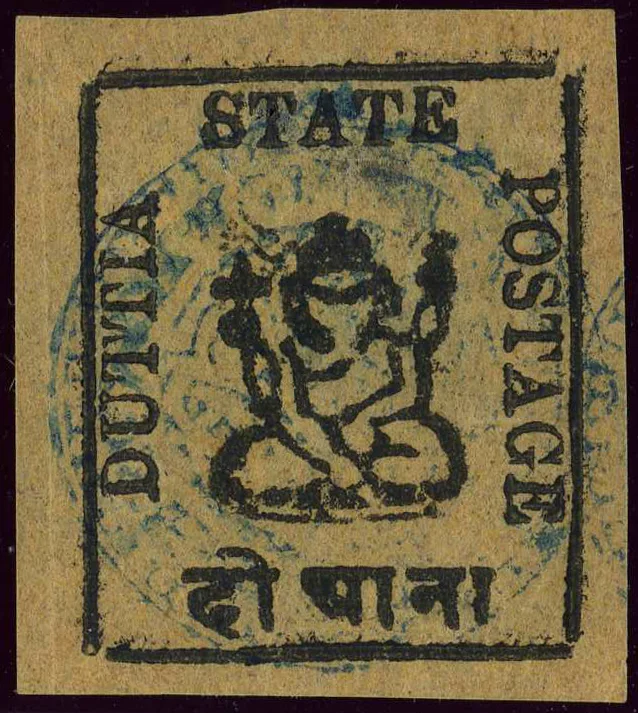
For the sans-serif issue of 1899, Evans’s later study of sheets set the half, one, two and four annas apart from the quarter anna. He concluded that the first four were printed from joined horizontal strips of eight clichés: the rows could change places, but spacing and alignment within a row stayed the same. Notched rules could therefore run round the pane and between the rows, but not between single stamps. The quarter anna was different, because its plates were made up of single clichés from the start. This is his reconstruction from surviving sheets, not a record of the press itself.[14][15]
In 1900 Evans had suggested that the sixteen subjects of the later printing were probably made by casting or stereotyping. That is a proposal: no foundry, maker, metal or production order is known. His 1922 analysis is stronger on how the printing subjects were arranged than on how they were made.[13][14]
Paper
The 1897 report describes the early coloured-paper stamps on thin wove paper, the red one anna on white wove, the envelopes on thin white laid paper and the postcard on stout white wove. Evans later compared opaque and thin, semi-transparent papers, but warned that the dates in his lists were the dates he obtained his specimens. No paper supplier is known.[12][13][14]
Evans suggested that two early Ganesh envelope variants were lithographed, because of their smooth impressions and irregular hand-drawn ornaments, and that a later envelope setting was typographed, because its impression shows through on the back. These are his observations; neither means that the Duttia stamps were lithographed.[13][14]
Printed stationery is a separate family
The printed stationery described in February 1897 should be kept apart from the disputed manuscript pieces. The report records a half-anna envelope on thin white laid paper, about 120 by 68 mm, with a black rectangular stamp of three lines of Hindi text; and a quarter-anna postcard about 160 by 94 mm, on stout white wove, with a trefoil-framed text stamp and the heading DATIA STATE POST-CARD. These are stationery designs of their own, not Ganesh stamps stuck on envelopes and cards, and the measurements are of the examples the writer had.[12]
How to tell them apart
Compare frame and paper together, using Faucitt’s points: the top frame against the left bar, the lower right corner and the dots. Separate the two Ganesh clichés before looking at damage. And remember that the hand-printed strips of six or eight described in 1897 and Evans’s joined rows of eight clichés belong to different production families; do not run the two processes together.[1][5][12][14]
The half anna on eight annas shows that an eight-anna stamp was revalued; it does not show that an unsurcharged eight annas was ever sold. And the Maharaja’s seal was what made a stamp valid in 1897; a similar-looking seal on a scan today cannot prove genuineness, date or postal use.[1][12]
Sources
- [1] Peter Röver, “Duttia: Duttiah: Dutia: Datia, 1893–1993: A Stamp Centenary?”, The London Philatelist, vol.103, November 1994, pp.290–297.
- [3] Evert Klaseboer, online catalogue, “Indian States, Datia”, issue and forgery listings.
- [5] Ian Faucitt, “Duttia SG8–11 settings”, undated handwritten study, five leaves.
- [6] StampWorld, Duttia, the opening 1893 groups.
- [9] C. E. Luard, Eastern States (Bundelkhand) Gazetteer, Central India State Gazetteer Series, vol. VI-A: Text, Lucknow: Newul Kishore Press, 1907, preface pp. i–ii and Datia pp. 104–106, 116–117.
- [12] “The Duttia State Post”, from notes supplied by C. L. Pigott, The Philatelic Journal of India, vol. I, no. 2, February 1897, pp. 38–40.
- [13] [E. B. Evans], “The Stamps of Some of the Native States of India: Duttia”, Stanley Gibbons Monthly Journal, vol. X, 30 April 1900, pp. 232–233, continued 31 May 1900, pp. 249–251.
- [14] E. B. Evans, “The Stamps of Duttia, 1899 and Later: ½ a., 1 a., 2 a., and 4 a.”, Stanley Gibbons Monthly Circular, March 1922, pp. 17–19.
- [15] The late Major E. B. Evans, “Stamps of Duttia: ¼a. of 1899 and later”, with an accompanying letter, Stanley Gibbons Monthly Circular, 1922, pp. 4–6.
Notes 0
Add what you know: a cover or stamp in your collection, a date or source, a correction or a question.
No notes yet.
Sign in to add a note.
Notes show straight away. Keep them kind and about the article; anyone can report one that isn't. House rules
