
Sarkari: Hyderabad’s Official Stamps and New-Value Surcharges
What the Sarkari overprint meant, how it moved from handstamps to whole-sheet printing in 1909, and the 1930 four-pies and eight-pies surcharges.
Updated May 5, 2026
In this article
An official marking shows how a stamp was to be used; a surcharge changes its value. A stamp can carry both.
What Sarkari means
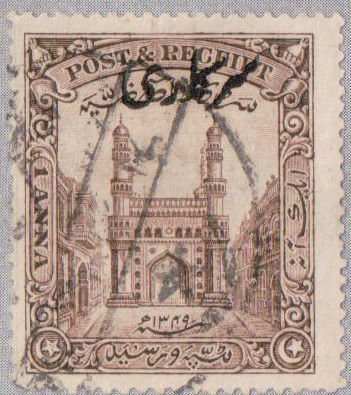
Sarkari is the marking for official use, and it does not change the printed value: the black marking on the one-anna Charminar leaves it a one-anna stamp. Government mail could have privileges an ordinary letter did not. Rodger’s account of 1946 describes official stamps serving government correspondence within British India and other Indian states, but not overseas, a description of its own time, not of every earlier period.[H1]
From handstamps to whole-sheet overprinting
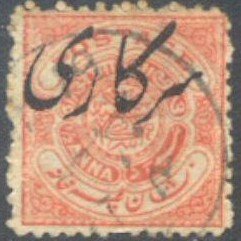
Murland describes a change in how Sarkari was applied around 1909. After three new brass handstamps were made, their slow hand application was replaced by a chase of 240 copies in sixteen rows of fifteen, so that a whole sheet could be overprinted in a hand press; he calls this marking Die V. A smaller marking of early 1911, also applied from 240 brass dies, is his Die VI. These are Murland’s own labels; they do not settle modern catalogue numbers or authenticate an overprint, and he could not assign his first four dies securely to particular stamps.[25]
The value changes of 1930
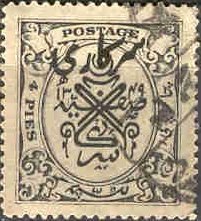
Red surcharges turned a quarter anna into 4 pies and a half anna into 8 pies. With twelve pies to the anna, these were new values, not another way of writing the old ones. Official stamps can combine a black Sarkari and a red surcharge, and the checklist records both.[H14]
The seal stamps of 1944 and later
StampWorld lists a separate pair of seal official stamps of 1944 at 4 and 8 pies (its Official 42 and 43), apart from the 1934–1935 pair (Official 34 and 35). Its second official page lists 44 for the half-anna seal, 45 for the two-pies seal and 46 for the six-pies seal, with watermark type 3 and perforation 13½. These are StampWorld numbers; read the official marking and value first, then check paper and perforation on the stamp.[H34][H33]
Locked bags for official covers
Lawder’s annual report, reprinted in Ind Dak, describes ending the separate receipt routine for ordinary Service covers, whose paperwork had held up delivery until government offices opened. Officials willing to pay could use leather bags with padlocks and two keys, one kept by the official or his appointee and the other by the postmaster. The official’s messenger carried the locked bag, which could hold both Service covers and ordinary paid covers. This was a way of handling office mail, not the end of registration or proof that every official cover went free.[H46]
Overprints can be later than the stamp
W. Michael Adkins records that official markings were applied after the early official issues had become obsolete, including on reprints. A genuine base stamp does not by itself authenticate the overprint or show official use at the time.[H23]
Sources
- [25] Capt. H. F. Murland, “Notes on the Stamps of Hyderabad”, The Philatelic Record XXXVI, no. 7 (July 1914), pp.115–119; no. 8 (August 1914), pp.125–126.
- [H1] Gordon Roger, The Stamps of Hyderabad—I. The Philatelic Adviser, December 1946, pp. 8–10.
- [H14] Evert Klaseboer, Indian States: Hyderabad. Early issues, perforations, officials and documented forgery comparison.
- [H23] W. Michael Adkins, Hyderabad illustrated album, 2011, pp. 1–8.
- [H33] StampWorld, Hyderabad official stamps, page 2. Rows 42–46, especially the late seal types AR, AS and AT.
- [H34] StampWorld, Hyderabad official stamps, 1944: Official 42 (4 pies) and 43 (8 pies).
- [H46] C. Lawder, “Annual Report of Mr. C. Lawder, Postmaster General, Nizam’s Dominions”, Ind Dak, August 1984, p. 148 and continuation, paragraph 12.
- StampWorld, Hyderabad official stamps, 1930–1939.
- William E. Steiner, India—Feudatory States, album pages, Hyderabad pp. 60–67.
- StampWorld, Hyderabad official stamps page 1, explicit 1873–1935 tables read 31 October 2026.
- David Feldman, June 2026 Auction Series, lot 60316. Early Sarkari group, lot description and named Stanley Gibbons references.
Notes 0
Add what you know: a cover or stamp in your collection, a date or source, a correction or a question.
No notes yet.
Sign in to add a note.
Notes show straight away. Keep them kind and about the article; anyone can report one that isn't. House rules
