
Charminar to Golconda: Hyderabad’s Pictorials and Late Issues, 1931–1949
The 1931 architectural pictorials, the 1937 Silver Jubilee, the Victory stamp and the post-war views, and the last two-pies stamp of 1949.
Updated June 8, 2026
In this article
The later stamps turned the State’s buildings and institutions into a visual record, while their production details still matter.
The 1931 pictorials
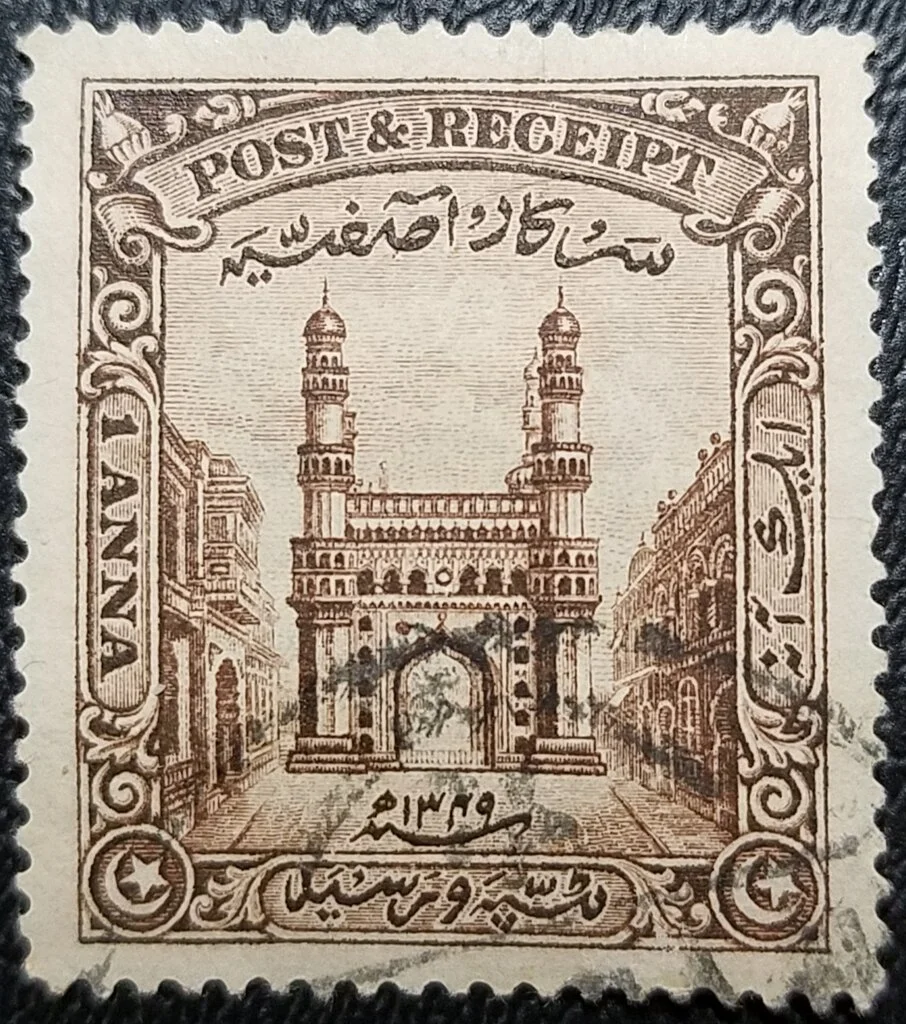
Charminar, the High Court, Osman Sagar, Ajanta, Bidar and Daulatabad appear across the pictorial set, alongside low-value seal designs.[H5]
| Value | Subject |
|---|---|
| 1 anna | Charminar |
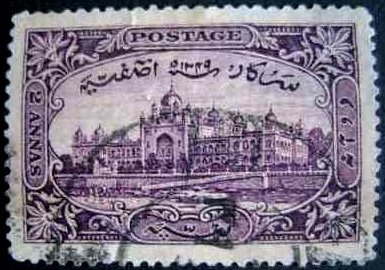
| 2 annas | High Court |
| 4 annas | Osman Sagar reservoir |
| 8 annas | Ajanta cave entrance |
| 12 annas | Bidar madrasa |
| 1 rupee | Chand Minar, Daulatabad |
Preparatory drawings are not extra stamps
Progressive pencil sketches dated 12 and 19 August 1930 show changes to the lettering and ornament before the pictorial issue, and M. G. Pittie also records colour trials. They belong to the story of the design, not to the stamps issued for postal use. Pittie’s study does not name the artist.[H5][H4]
The sources disagree about the printer of 1931: Pittie names Nasik, while Kulkarni names the Hyderabad Mint. The question stays open until production records are found.[H5][H4]
What the surviving proofs show
The Peter Röver sale of 2025 records progressive dies for the one-anna Charminar and colour trials for the twelve annas and one rupee inscribed POSTAGE & REVENUE. They show how the design developed, but do not settle the designer or the Nasik and Hyderabad Mint attributions.[H32]
The 1937 Silver Jubilee
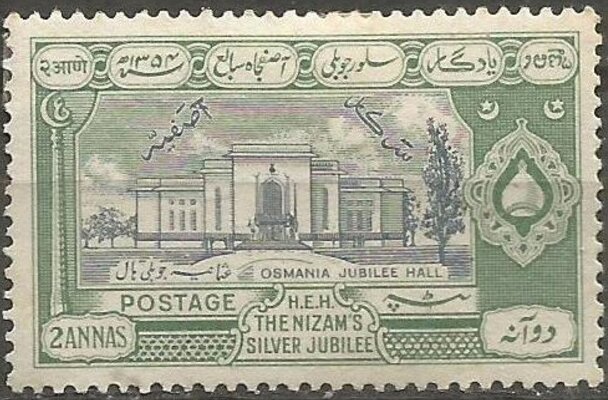
Four architectural stamps mark the Silver Jubilee of Mir Osman Ali Khan: the Unani Hospital, the Osmania Hospital, Osmania University and the Jubilee Hall, at 4 and 8 pies, one anna and two annas.[H4]
Victory and the post-war views
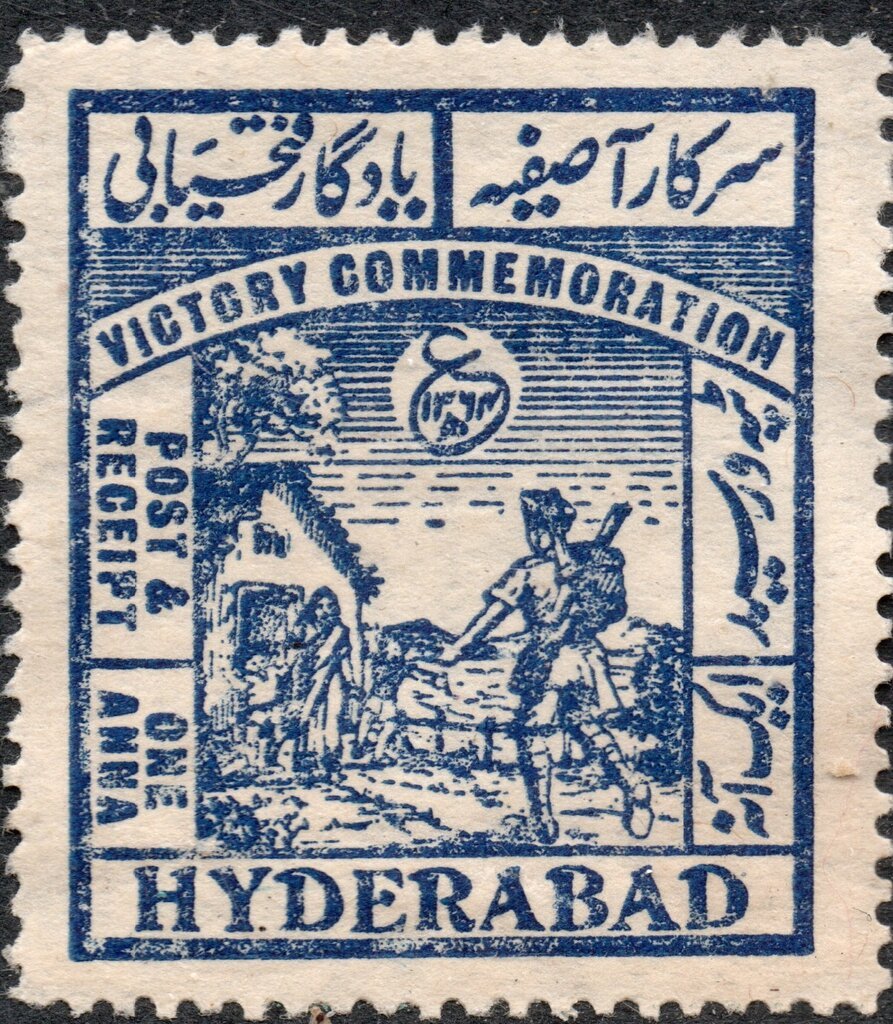
The one-anna returning-soldier design of 1946 rewards a close look at the background. Kulkarni separates two plates, one with blurred or broken lines and one with fine continuous lines, and three papers: faintly watermarked wove, unwatermarked wove and laid.[H4]
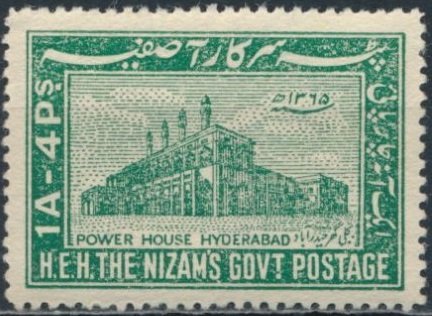
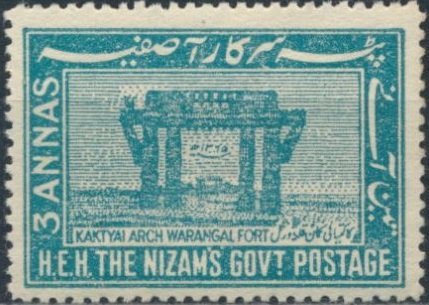
The later buildings are the powerhouse at 1 anna 4 pies, the Kakatiya Arch at Warangal at 3 annas and Golconda Fort at 6 annas. Kulkarni records a change of the six-anna colour from sepia to reddish-brown in 1949. The Town Hall commemorative of 1947 and the late seal values are listed separately in the checklist.[H4]
The Judicial Reform stamp of February 1947
StampWorld credits the design of the one-anna Judicial Reform issue, dated 17 February 1947, to T.I. Archer, an attribution not yet confirmed by a commission record or a production account of the time. This is the one-anna Town Hall and Reformed Legislature stamp in the checklist, not an extra stamp; the source names no engraver or printer.[H41]
The last two-pies stamp: a new value and a new year
The bistre-brown two pies of 1949 reused the low-value seal design but changed both the value and the Hijri year, to 1368. A. N. Medhora describes it as printed by lithography at the Government Central Press, in sheets of a hundred, ten by ten, with no plate number. It was a new printing of the last low value, not a surcharge on a four-pies stamp.[3]
Medhora compares the figure 2 and the last two digits of the year across a sheet, noting differences in how they were formed and places where the fine background mesh gives way to white around the changed digits. The surviving page ends in mid-discussion, so a full list of constant varieties is not available. His remark that the stamp supplemented increased postage does not mean two pies was the full charge for a letter or card.[3]
Sources
- [3] A. N. Medhora, “The Last Issue of Hyderabad State”, Ind Dak, February 1978, p. 28.
- [H4] Subhas Kulkarni, Hyderabad. The Stamp Magazine, February 1973, pp. 62–64.
- [H5] M. G. Pittie, Hyderabad: 1931—Artist’s Sketches of the Pictorial Issue, pp. 206–210.
- [H32] David Feldman, Peter Röver collection, Spring 2025, lot 80105. Description of Holland’s plating study, progressive Charminar dies and high-value trials.
- [H41] StampWorld, Hyderabad, 1947 Judicial Reform, no. 41.
- StampWorld, Hyderabad postage stamps, 1940–1948 (returning soldier, Town Hall and local motifs).
- StampAlbums, Classic-era corrections, 26 August 2019, Hyderabad (late seal and building denominations).
- De Montfort Stamp Co., auction 135, lots 661–664: SG 43–46 pictorial design identifications.
Notes 0
Add what you know: a cover or stamp in your collection, a date or source, a correction or a question.
No notes yet.
Sign in to add a note.
Notes show straight away. Keep them kind and about the article; anyone can report one that isn't. House rules
