
Hyderabad Forgeries, Reprints and How to Build a Reference Collection
The Treherne forgery of 1909, reprints of about 1880, laid-paper puzzles and what to record when building a Hyderabad collection.
Updated July 13, 2026
In this article
Four languages on the early half anna
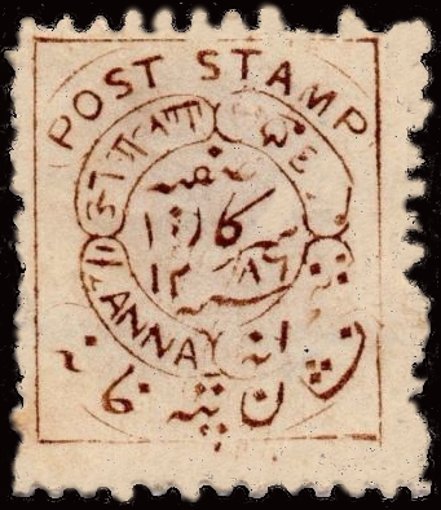
Nayeem places the value panels of the early half anna in Marathi at upper left, Telugu at upper right, English at lower left and Urdu at lower right. Compare lettering and frame details in more than one genuine plate position, since the original plate itself varied.[4]
The Treherne forgery: making a forgery is not using it
A letter from the British Resident of 16 August 1909 enclosed an impression from a Hyderabad forgery implement seized in the Treherne investigation. Nayeem reproduces the letter and compares the half-anna design with genuine stamps. The genuine plate had positions engraved one by one, so small original differences must be allowed for before one irregular line is called a forgery.[4]
His study compares the English POST STAMP label, the central calligraphy, the value panels and the frame. One feature of this forgery is a small join between the S and T of POST, one point in a much larger examination, not a single test for every Hyderabad forgery.[4]
The official inquiry reported in February 1910 found no recorded use of forged Hyderabad stamps. Nayeem argued that heavy cancellation and little chance of detection could explain this, and concluded that the forgeries must have been used; that goes beyond the evidence. The implement and the inquiry are documented; successful postal use of this forgery is not.[4]
Other traps
The Spud Papers comparison in Klaseboer’s catalogue describes two rows of honeycomb ornament at the bottom of one forgery, against one row on the genuine design; that identifies one forgery, not every one.[H14]
The reprints of about 1880 have a different perforation and may come in additional colours. A later printing, a proof, an official overprint and a forgery are different classes, and a stamp that looks like an early design is not thereby an early stamp. A reported black four-pies marking on the quarter anna has its own disputed history, so read the value before calling every black addition Sarkari.[H14][7]
Unusual laid paper
Medhora’s note on paper separates three laid-paper forms listed in the catalogues (the four and eight pies of 1931 on horizontal laid paper, and the one-anna Victory stamp on vertical laid paper) from other material he had found: unused, ungummed, unwatermarked copies of the 1908–11 design and of the eight-pies-on-half-anna provisional on vertical laid paper. He asked whether these were trials or stamps prepared but not issued, and they should stay as reported paper studies, not extra issued varieties.[6][7]
Describe the stamp and the cover separately
For a stamp, record its design, value, inscription, paper, watermark, perforation, gum and any added markings. For a cover, add the offices, the original dates and calendars, the service, the franking and any receiving marks, and note the catalogue edition when giving numbers or type names.[H14]
Keep fiscal stamps, charity or war-fund labels, proofs, colour trials and reprints in clearly labelled sections; similar calligraphy or the State’s name is not enough to show postal validity.[H14]
What is still to be found
A complete register of offices, a continuous dated tariff, a definitive withdrawal order, all the watermark and perforation combinations, and the printer of the 1931 issue, Nasik or the Hyderabad Mint, are still to be established. So are most designers and hand engravers, plate histories and exact issue dates, the full sequence of red and black Sarkari types, the missing page of Werner’s envelope study and the rest of Medhora’s article on the last issue.
Sources
- [4] M. A. Nayeem, “Hyderabad—Second Issue: Postal Forgery”, The Collectors Club Philatelist, vol. 43, no. 6, November 1964, pp. 335–344.
- [6] A. N. Medhora, “Hyderabad: Laid Paper”, p. 171.
- [7] J. Gordon Rodger, “The Stamps of Hyderabad—VII”, The Philatelic Adviser, pp. 10–14.
- [H14] Evert Klaseboer, Indian States: Hyderabad. Early issues, perforations, officials and documented forgery comparison.
Notes 0
Add what you know: a cover or stamp in your collection, a date or source, a correction or a question.
No notes yet.
Sign in to add a note.
Notes show straight away. Keep them kind and about the article; anyone can report one that isn't. House rules
