
Morvi’s Darbar Post: the 1931 Opening, Its Offices, Routes and Marks
Government mail on the Morvi road in 1912, the disputed opening date of 1931, 98 offices by 1940–41, railways and tramways, the A and JA marks, traffic and a postage-due account book.
Updated May 25, 2026
In this article
Morvi’s Darbar post opened to the public in 1931, beside the Imperial post offices already in the state. Being near an Imperial office did not give Morvi stamps validity throughout India.[15][17][1]
Before the State stamps: the mail road in 1912
Morvi’s postal history did not begin with its own stamps. The State’s report for 1912–13 records a robbery of Government mail on 13 August 1912 between Bagthala and Morvi, in which the rural messenger Atit Gulabgar Motigar was killed. It describes the State police response and the correspondence with the political authorities: mail was moving through Morvi nearly twenty years before the Darbar stamps.[13]
The Dewan, Bhanji Kanji, used the incident to recommend the tramway between Morvi and Navalakhi Bunder as a safer way to carry Government mail. That was a proposal; it does not show that the Postal Department adopted the route, or that later State mail all went the same way.[13]
The opening date is disputed
Navin Dhroove reported in 1980 that the Morvi Gazette of January 1931 announced public use from 1 April 1931. Peter Röver later quoted the administration report for 1931–32, saying the State postal system was inaugurated from 1 April 1931, and found the same date in a later report’s paragraph on the Darbari Post. These two reports from official records support an April opening.[15][17][1][26]
The later account by Lt. Col. J. Dutta gives 4 January 1931, while placing postcards and envelopes on 1 April. The difference should be stated, not explained away as a January inauguration and an April public opening, which no document records. The safest account gives 1 April 1931, the date reported from official records, and notes the conflicting later date.[15][17][1][26]
| Question | Earlier report | Later account or catalogue | How it is treated here |
|---|---|---|---|
| Public opening | Dhroove and Röver: 1 April 1931, from official records[15][17] | Dutta: 4 January 1931[1] | The original Gazette or report is needed |
| Order 10104 | Dhroove: 19 July 1942; postcards and book post six pies from 1 September[15] | Dutta: 19 April 1942; postcard increase on 9 January 1943[1] | The original order is needed |
| Early acknowledgement fee | Dhroove: nine pies[15] | Röver: six pies[18] | Each kept with its source |
| Later Morvi Press issue | Stoney’s catalogue account: 1936[22] | Modern grouping begins in 1935 | Both kept |
| Registered envelope | Dutta, 2000: 1936[1] | Dutta and Dutta, 2016: 1938[26] | Notice and value unresolved |
A village list is not a post-office list
The network grew after 1931. Röver’s survey of 1985 identifies 98 offices in 1940–41, while the surviving list derived from the notification of 1931 names only 47 of about 70 original offices. The smaller number reflects the way villages were grouped under the offices that served them; an omitted village did not necessarily lack a post.[4]
The survey prints office villages of 1931 in capitals and dependent villages in lower case, and marks later additions and names that could not be located. Copying its whole table as a list of post offices would create offices the author never claimed.[4]
Offices, letter boxes and villages served
Röver’s table from the administration reports separates post offices from letter boxes and from the villages served. For 1934–35 it records seventy-eight offices and forty-two letter boxes, serving 120 villages. By 1940–41 there were ninety-eight offices: one central office, twenty-three sub-offices and seventy-four branches, with thirty-four letter boxes, serving 132 villages.[18][4]
For 1942–43 and 1943–44 the table gives ninety-five offices: the central office, twenty-one sub-offices and seventy-three branches. These are totals for their years, not a permanent census, and a dependent village, a letter box or an office Röver inferred is not a documented opening.[18][4]
| Year | Post offices | Letter boxes | Villages served |
|---|---|---|---|
| 1934–35 | 78 | 42 | 120 |
| 1940–41 | 98: 1 central, 23 sub-offices, 74 branches | 34 | 132 |
| 1942–43 and 1943–44 | 95: 1 central, 21 sub-offices, 73 branches |
Offices that were inferred
Röver’s list goes further than the incomplete record of 1931. He added twenty-five proposed original post offices, where he thought independent villages must have had one. That is his geographical inference, different from an office named in the list or a dated cancellation. A register should separate a documented office, an inferred office and a dependent village; his map is a finding aid for marks, and his request for more postmarks shows he regarded the network as still under investigation.[4]
Names, enclaves and routes
Gujarati names were spelt in English in different ways. M. K. Bhojak’s transcriptions and the Survey of India maps sometimes differ; the 1985 survey follows the maps and records the alternatives. Compare a reading of a cancellation with the Gujarati and with the alternative names before declaring a new office.[4]
The state’s villages in Cutch are listed separately, because it is not known whether the Morvi post served them. The Mota Dahisara–Malia tramway opened only on 10 July 1949, after the state post ended; a later map showing the line cannot show that Morvi mail used it.[4]
Railways, tramways and the limits of route reconstruction
The transport map is not a postal timetable. Röver began his discussion of routes by saying that the postal lines and the means of transport were not known. He then reconstructed the likely use of the State railway and tramway, with possible bus and runner links to villages; the bus routes he expressly left unconfirmed.[19][13]
The report of 1912 makes the same point: even with the Morvi–Navalakhi tramway in existence, using it for Government mail was urged as a change, not assumed. For the Darbar post, a railway line or a station nearby is a lead to a route, not proof, unless postal records or transit marks support it. Röver also identified the Bagasra–Jangi line on his map as an Imperial postal route, and thought Darbar service to the Adhoi area uncertain.[19][13]
Incoming and outgoing marks
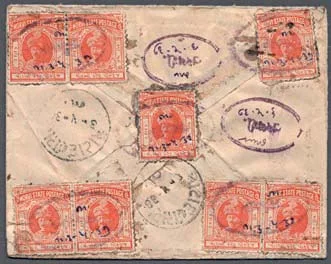
David Griesedieck’s study of 1980, from about thirty covers and cards, some seen only in photographs, separated a Gujarati circular datestamp from a double-lined oval. He did not know what the accompanying syllables A and JA meant. Dhroove explained them: A stands for avak, incoming mail, and JA for javak, outgoing mail. Their meaning should not be guessed from one example on a returned letter.[16][15][19]
Dhroove also corrected doubtful place readings, Jetyar to Jetpar, and the last circular-office name to Vavania. Röver later linked metal datestamps with movable dates to sub-offices, and rubber name stamps with dates added by hand to branches, and distinguished two oval forms. These give a useful classification, but a partial strike or worn lettering does not justify a new office without comparison with a legible strike and the village list.[16][15][19]
Traffic: an estimate, not a count
Röver’s financial analysis has its own limits. The State-post figures in the narrative accounts for 1942–43 and 1943–44 did not match the budget figures he found. He printed both and suggested the years might have been transposed, admitting this was only one explanation; his rearranged table is not a corrected State account.[19]
His estimate of about 120,000 public postal items a year was a calculation from revenue, assuming equal numbers of postcards and single-rate letters and leaving out other paid services. It was not an official count. He separately noted that mail endorsed “On Morvi State Service” and “On Morvi Railway Service” was unpaid official mail, outside the calculation.[19]
Postage due kept in an account book
Dhroove described and illustrated a Gujarati account book for unpaid and underpaid mail. Its imprint, “50 Books 11.5.37”, he read as fifty books printed in 1937. Its heading translates as “Details of Not Paid”, and “Post No. 7” at the upper right is probably a form number rather than a post-office number.[15]
Its nine columns recorded the serial number, date, address, kind of article, amount due, the postman’s collection and signature, the reasons for non-collection, the postmaster’s signature and a space for stamps. The amount collected was acknowledged and stamps were stuck in the book and cancelled. A stamp cancelled on such a sheet does not pay the sender’s postage, and the book shows an accounting procedure, not a postage-due stamp.[15]
Sources
- [1] Lt. Col. J. Dutta, “Morvi State Post Cards”, Ind Dak, December 2000, pp. 240–243.
- [4] Peter Röver, List of Post Offices and Maps of Morvi State, India Study Circle for Philately, 1985.
- [11] Christoph Gärtner, 17th auction, India and Indian States, 7 March 2011, Morvi lots 1395–1405, plates pp. 78–79.
- [13] Morvi State, Annual Administration Report for the year 1912–13, Morvi: State Press, 1913, p. 3, paragraphs 10–12.
- [15] Navin Dhroove, “More About Morvi,” India Post 14/4, no.66 (October–December 1980), pp.116–117.
- [16] David Griesedieck, “Morvi Postmarks,” India Post 14/1, no.63 (January–March 1980), pp.24–25.
- [17] Peter Röver, “Morvi: Some Further Notes,” part 3, India Post 19/2, no.84 (April–June 1985), pp.65–68.
- [18] Peter Röver, “Morvi: Some Further Notes,” part 4, India Post 19/3, no.85 (July–September 1985), pp.134–136.
- [19] Peter Röver, “Morvi: Some Further Notes,” part 5, India Post 19/4, no.86 (October–December 1985), pp.151–153.
- [22] R. F. Stoney, “The Stamps of Morvi”, The Philatelic Journal of India, vol. XLVI, no. 8 (August 1942), pp. 105–110 and unnumbered plate after p. 105.
- [26] Col. Jayanta Dutta and Dr Anjali Dutta, “Postcards of Morvi State”, India Post, vol. 50, no. 200 (July–September 2016), pp. 116–120.
Notes 0
Add what you know: a cover or stamp in your collection, a date or source, a correction or a question.
No notes yet.
Sign in to add a note.
Notes show straight away. Keep them kind and about the article; anyone can report one that isn't. House rules
