
Morvi’s Portrait Stamps, 1931–1948: Halftone Portraits, Settings and the London Printing
The wide and narrow portrait stamps of 1931, the redrawn sheets of eight of 1932–33, the new portrait of 1934 printed in London, and the later Morvi Press printings, perforated 11.
Updated October 8, 2026
In this article
All Morvi’s stamps show the ruler, Maharaja Sir Lakhdirji Waghji, and are inscribed MORVI STATE POSTAGE. Within that, three portrait groups, a London printing and later printings at Morvi make a compact but varied field.
Three early portrait groups
The early register separates three portrait groups: the wide format of 1931, the narrower design that followed, and the group of 1932–33. The values listed for each are those documented, not a range filled in between the lowest and highest.[2]
Record the size of the portrait, the frame, the lettering, the value, the paper and the perforation of each stamp. A new frame is a change of design; a new value printed over an old one is a surcharge. A loose stamp needs a dated cover before it can prove use in a particular period.
The register continues with the London printing of 1934 and the later perforation 11 family, grouped today as 1935–48. Measurements and dates keep their sources: Lt.-Col. F. M. Douie recorded line perforation 14 and received two values in May 1934, while R. F. Stoney quoted the catalogue’s perforation 14¼ and a date of 1936 for the later Morvi Press stamps.[21][22]
How the first portraits were printed
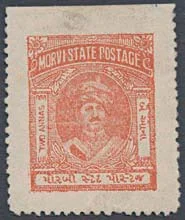
The first stamps combined an oval portrait with MORVI STATE POSTAGE above it, Gujarati lettering below, and value tablets in English at the left and Gujarati at the right. Douie, writing at the time, describes the portrait as a halftone and the stamps as typographed. He found pairs of recurring types in most values and four recurring types in the three pies. That is firmer evidence of the printing method than calling the stamps simply locally made.[21][22]
Douie cautiously said the corner ornaments looked like flowers; Stoney later called the ornament at lower right on the one anna a lotus. Neither names a designer, a photographer of the portrait, an engraver or a workshop, and the ruler shown is not the designer.[21][22]
Douie also mentioned engraved four-anna and eight-anna items inscribed MORVEE STATE, without deciding whether they were fiscal or postal. They are not in the postage checklist and do not change his description of the ordinary portrait stamps as typographed.[21]
Settings worked out from repeated flaws
Stoney’s study of 1942 followed the same recurring types through different arrangements. His wide three-pies block has four types arranged B–C above A–D, with about 10 mm between impressions. In the closer setting of eight, the upper row reads B–A–B–A and the lower D–C–D–C. He describes thin white wove paper and perforation 12. His suggestion that the wide blocks were printed as sheets of four stays a suggestion, as he could not establish the size of a complete sheet.[22]
The half anna is a useful check. Its wide block has A–B in both rows; the later setting of eight repeats B–A–B–A in each row. A sloping coloured line through the F of HALF identifies Type B. Stoney also records a block of four on thicker paper made entirely of Type B, but the margins were missing, so the sheet size could not be found. These are manufacturing observations, not four new values.[22]
Smaller impressions, then a new portrait
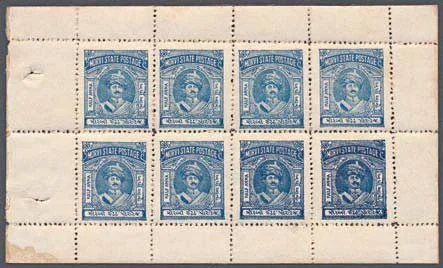
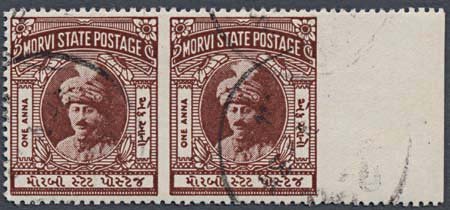
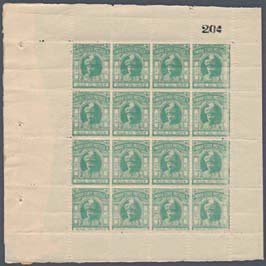
The redrawn group Douie received in 1932–33 was typographed with another halftone portrait, in sheets of eight, four across and two down, on coarse, slightly yellowish wove paper, perforated 11, with a number in the sheet margin. Stoney later measured these impressions at about 20½ by 25 mm, against about 21 by 26 mm for the earlier group. The marginal number is production evidence, not a value or a surcharge.[21][22]
Douie received the three pies and one anna of the next design in May 1934. The new portrait faces slightly to the ruler’s right, not his left, with a plume in the puggari. The sheets held sixteen stamps, four by four, on good white wove paper, line perforated 14, and he believed sixteen separate clichés were used. May 1934 is when he received them, not an established day of issue.[21][22]
The London printing and later work at Morvi
By 1942 Stoney could report that the catalogues identified the improved issue as the London printing. He found no serial numbers on its sheets. The later Morvi Press printings went back to white wove paper, rough perforation 11 and serial numbers in the margin. He thought they came from the same plates as the London stamps, but gave no record of the plates being sent and did not name the London firm.[22]
Stoney says the catalogue of 1938 put the Morvi Press issue in 1936, while the modern register starts this family in 1935; both stay until an issue notice or dated production record settles it. Douie’s line perforation 14 and the catalogue’s 14¼ quoted by Stoney also stay with their sources. A place of printing reported as London does not identify a firm.[22][21]
Two portrait groups and the change in the low values
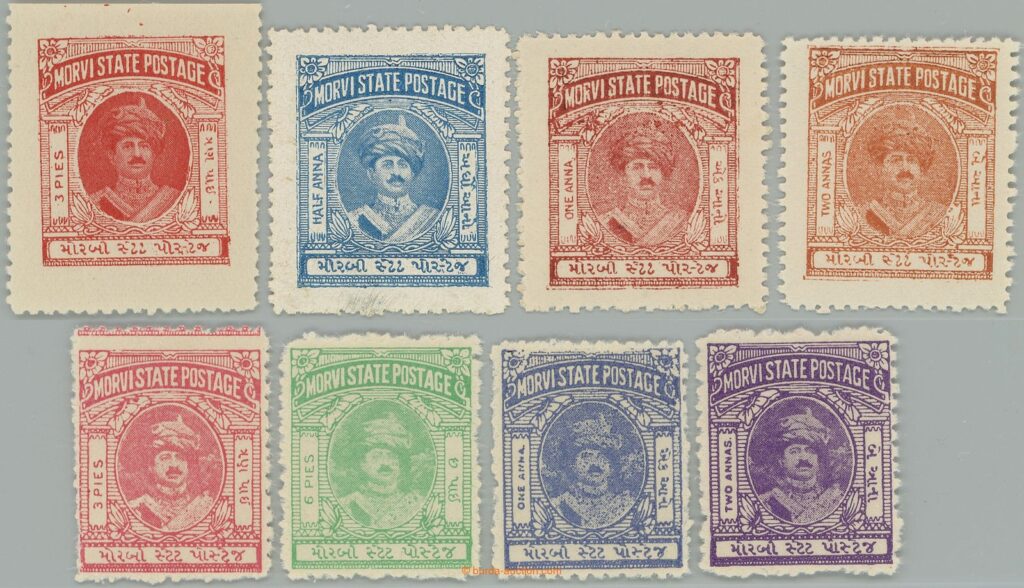
Both rows in the picture below keep Lakhdirji’s portrait and MORVI STATE POSTAGE, but the later group has a smaller portrait and a six pies where the earlier had a half anna. Six pies and half an anna are the same value but different inscriptions, and they are separate entries in the checklist. The set shown is the two locally catalogued early groups, not the London perforation 14 issue.[12]
Covers
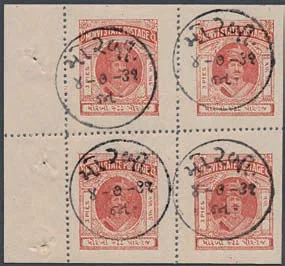
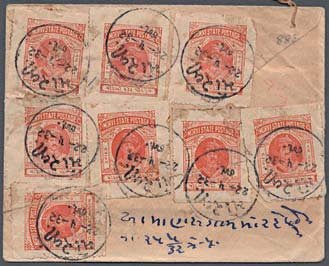
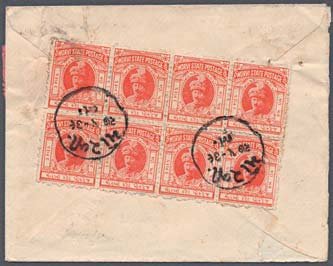
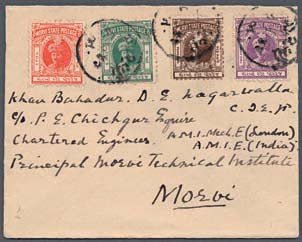
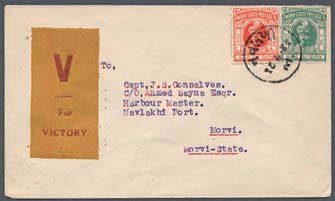
Covers from the Gärtner sale of 2011 show how the stamps were used, with the auctioneer’s descriptions. One registered cover of 1932, returned after the addressee had left for Karachi, carries nine stamps although the description says eight, so no total charge is worked out from it. A cover of 1940 with four values addressed within Morvi is described as philatelic, not evidence of a four-value rate. A registered cover of 1938 with a block of eight three-pies stamps totals two annas, but its face alone does not give the whole registration charge.[11]
Sources
- [2] The Philately Life, “The Feudatory State of Morvi”, illustrated collection page, first three adhesive design groups.
- [11] Christoph Gärtner, 17th auction, India and Indian States, 7 March 2011, Morvi lots 1395–1405, plates pp. 78–79.
- [12] Burda Auction, Public Auction 72, Morvi lot 246504 (SG 4–7 and 8–11).
- [21] Lt.-Col. F. M. Douie, R.E., “The Stamps of the Indian Feudatory States. Morvi”, The Philatelic Journal of India, vol. XXXVIII, no. 11 (November 1934), pp. 138–140.
- [22] R. F. Stoney, “The Stamps of Morvi”, The Philatelic Journal of India, vol. XLVI, no. 8 (August 1942), pp. 105–110 and unnumbered plate after p. 105.
Notes 0
Add what you know: a cover or stamp in your collection, a date or source, a correction or a question.
No notes yet.
Sign in to add a note.
Notes show straight away. Keep them kind and about the article; anyone can report one that isn't. House rules
