
Nawanagar (Nowanuggur): the Jam Sahib’s Native Post, 1875–1895
Nawanagar, the Jam Sahib’s state on the Gulf of Kutch, issued sword, typeset and arms stamps in docras from about 1875 to 1895: the state, its rulers and its stamps.
Updated May 27, 2026
In this article
One state, several spellings
Nowanuggur, Nawanagar and Navanagar are the same Kathiawar state. Its Gujarati name is printed on the stamps, and its capital is Jamnagar. Searching under only one English spelling can hide catalogue entries and research.[1][3]
Nawanagar lay in Kathiawar on the southern shore of the Gulf of Kutch, in the Hallar division. Its capital, Jamnagar, was the seat of the Jam Sahib, the title of the State’s Jadeja Rajput rulers. The India Office map catalogue lists a sheet titled Navanagar or Jamnagar, surveyed in 1874–75 and published in 1876 at one inch to the mile.[3][14][15]
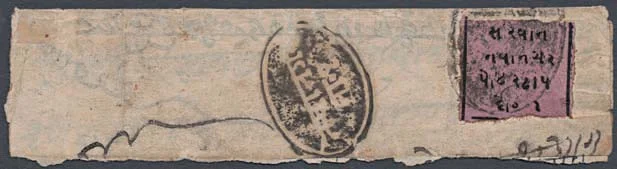
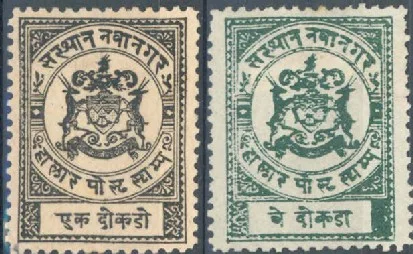
The stamps run from the sword design reported in October 1877, through the typeset values known by 1880, to the arms issue of 1893. The suggested start in 1875 concerns a first one-docra stamp described years later by a postmaster, not every early value. The native stamps are usually said to have ended at the close of 1895, while a separate official Darbari post certainly carried on through 1897–98.[28][27][34][38]
The rulers
The State’s own report records Jam Vibhaji’s death on 28 April 1895 and the installation of his son, Jam Shri Jaswatsinghji, by the Political Agent on 10 May. A British Administrator was appointed for the minority, and W. P. Kennedy took charge on 31 July 1895. These dates give a firm setting for the last native stamps; installation on 10 May is not necessarily the legal date of accession. None of the stamps carries a portrait.[36]
| Reign | Ruler | Note |
|---|---|---|
| 1814–1820 | Sataji | Succeeded his brother Jasaji; died without issue |
| 1820–1852 | Ranamalji (Ranmalji) | Adopted by Achuba, Jasaji’s widow |
| 1852–28 April 1895 | Vibhaji | The native stamps and the 1893 arms belong to his reign |
| 1895–14 August 1906 | Jaswantsinhji (Jaswatsinghji) | Installed 10 May 1895; W. P. Kennedy Administrator during the minority |
| 14 August 1906 – March 1907 | Interregnum | The sources do not name the administrator of this interval |
| March 1907–1933 | Ranjitsinhji | Adopted by Vibhaji before Jaswantsinhji’s birth; after the native stamp period |
| 1933 to 1947 | Digvijaysinhji | Succeeded his adoptive uncle; ruler at independence |
The docra
The stamps are in docras: 1, 2 and 3 docras, no more. At the rate quoted by Evans and Dawson a docra was 2 pies, so the highest value was half an anna.[4][5]
Chronology
| Date | Event |
|---|---|
| 1875? | A first one docra on rose paper, dated Samvat 1931 in an 1884 letter of the State postmaster reported by Evans in 1908 |
| October 1877 | Le Timbre-Poste reports the blue sword stamp on white paper, perforated 12½ |
| November 1880 | All three typeset values chronicled |
| 1884 | The Bombay Gazetteer describes two runner lines from the capital |
| August–November 1887 | Fresh typeset settings received direct from the postmaster |
| June–August 1893 | The State arms issue; the 1 June date is reported, not proven |
| 28 April – 10 May 1895 | Death of Jam Vibhaji; installation of Jaswantsinhji |
| end of 1895 | Native stamp service closed; remainders marked rud |
| 1895–96 | Plans to replace the official Darbari post; 28 post offices of all classes |
| 1896–98 | The Darbari post still carries official letters: 130,300 articles in 1896–97 |
| November 1904 | The rud mark explained as cancelled, not official |
The stamps
The issues and their values, from the research checklist. The settings, papers, perforations and errors of each issue are not listed.
| Period | Issue | Values |
|---|---|---|
| 1875? initial 1 docra; higher values chronicled by 1880 | Early typeset settings | 1 docra, 2 docras, 3 docras |
| 1877–at least 1891 | Sword | 1 docra |
| 1880 onward | Later typeset | 1 docra, 2 docras, 3 docras |
| 1893 | State arms | 1 docra, 2 docras, 3 docras |
Sources
- [1] Frits Staal, “Six Spellings of ‘Post Stamp’ and Other Nawanagar Varieties”, The London Philatelist, vol. 96 (1987), January–February, pp. 28–31, and continuation pp. 50–54.
- [3] Encyclopædia Britannica, 11th edition (1911), “Nawanagar”.
- [4] L. E. Dawson, “Indian Feudatory States VII: Nawanagar (Nowanuggur) (part i)”, The Philatelist, vol. 32, November 1965, pp. 37–39.
- [5] L. E. Dawson, “Indian Feudatory States VII: Nawanagar (Nowanuggar) (part ii)”, The Philatelist, vol. 32, December 1965, pp. 68–71.
- [10] Purshotam Vishram Mawjee, The Imperial Durbar Album of the Indian Princes, Chiefs and Zamindars, vol. I (1911), “Jamnagar”, digitised leaf 219.
- [12] Government of India, Aitchison’s Collection of Treaties, Engagements and Sanads, Western India States, Nawanagar.
- [13] National Portrait Gallery, Digvijaysinhji Ranjitsinhji Jadeja. Biographical entry.
- [14] W. W. Hunter, The Imperial Gazetteer of India, 2nd ed., vol. X, Nawánagar.
- [15] India Office, A Catalogue of Maps, Plans, &c., of India and Burma (1891). Kathiawar table, entry 46, “Navanagar or Jamnagar”.
- [27] E. B. Evans, “The Stamps of some of the Native States of India: Nowanuggur”, Gibbons Stamp Weekly VIII: 25 July 1908, pp. 53–56; 29 August 1908, pp. 133–136; 28 November 1908, pp. 337–341.
- [28] Le Timbre-Poste XV(178), October 1877, “Chronique: Nowanuggur”, p. 73.
- [34] Stanley Gibbons Monthly Journal XV, 30 November 1904, “Indian Native States: Nowanuggur”, p. 98.
- [36] Administration Report of the Nawanagar State for the Year 1895–96, pp. 1, 47–49, §§2, 113–114; signed W. P. Kennedy, Lieutenant-Colonel, Administrator, Jamnagar, July 1896.
- [38] Administration Report of the Nawanagar State for the Year 1897–98, p. 37, §134; signed W. P. Kennedy, Lieutenant-Colonel, Administrator, June 1898.
Notes 0
Add what you know: a cover or stamp in your collection, a date or source, a correction or a question.
No notes yet.
Sign in to add a note.
Notes show straight away. Keep them kind and about the article; anyone can report one that isn't. House rules
