
The 1893 Arms of Nawanagar, the Rud Mark and the End of the Native Post
The State arms stamps of 1893 on Howard & Jones paper, the magenta mark once called official and later shown to mean cancelled, and the close of the native stamp post in 1895.
Updated May 27, 2026
In this article
The 1893 arms
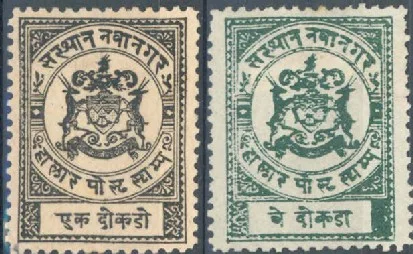
Evans described sheets of 36, six rows of six, printed from casts or electrotypes on several white wove papers. Perforation 12 is usual, and wholly and partly imperforate material is also recorded. The words HOWARD & JONES, LONDON cross sheets of one thin, hard paper: that is the name of the paper, not the printer’s signature, and it does not appear on every stamp. His unused examples had no gum.[32][27]
The design shows the State arms, not a ruler. Evans read the inscriptions as Sasthana Navanagar and Halar Post Stamp, Halar being the district. These readings are his; the design does not reveal a designer or engraver.[32][27]
When did they appear?
The arms belong to 1893, but the first day is uncertain. The Philatelic Record of July 1893 said the new series had been, or was to be, issued on 1 June. In August the journal reported receiving all three values and corrected the colour of the 2 docras from brown-lilac to green; the 3 docras was red-ochre. The correction is evidence against a separate brown-lilac stamp.[32][27]
By August 1893 The London Philatelist had received green two-docras and yellow three-docras arms stamps from Whitfield King & Co. It measured perforation 12 and recorded thin white wove paper watermarked HOWARD & JONES, LONDON in letters 10 mm high, referring back to its illustration in June. Whitfield King advertised all three values in November. The notice shows Whitfield King as the supplier of specimens and the paper’s name; it is not a printing contract, it names no designer, die cutter or printer, and its dates are not the first day of sale in Nawanagar.[19][20]
A later collectors’ catalogue calls the arms unwatermarked, while the 1893 notice names a watermark on two thin-paper values, and Feldman also reports laid paper for the arms. Record what each stamp shows.[19][24][17]
Rud: cancelled, not official
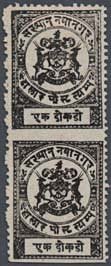
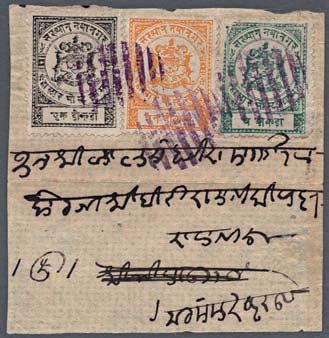
The Gujarati word rud is reported to mean cancelled or waste. It is found in several frames and colours and must not be read as an office datestamp. The English word SPECIMEN is also found on earlier material. When Dawson wrote in 1965 he knew of no used arms stamps; that records what one specialist knew, not a permanent finding about every cover.[5]
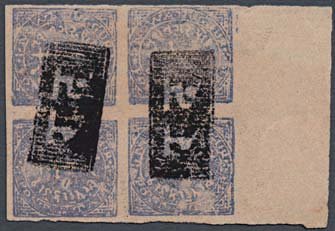
In January 1896 the Monthly Journal repeated a report that arms stamps with a magenta two-character mark were officials. In 1904 Dr Byramji Shavakshah supplied the correction: the word was rud, meaning cancelled by the post office, applied to the remainders when the State post closed at the end of 1895. The journal recorded it on sword and typeset stamps too.[33][34][27]
So an old catalogue or notice can give a confident classification that was later overturned. The mark is not a new 2-docra provisional or an official issue. Other devices still need judging one by one, and a cancellation on a loose stamp does not by itself prove the letter was carried.[33][34][27]
The end of the native stamps, 1895
The Smithsonian dates the replacement of the State post to December 1895, and Feldman gives 1 January 1895 as the date the stamps became obsolete; both are later accounts. A letter of June 1896 from an unnamed officer of the Indian Post Office describes a plan to take over six State posts on 1 January 1895, but says he could not confirm that this had happened at Nowanagar. The 1904 journal places the remainder marking at the end of 1895. The order that ended the public stamp service has not been found.[2][33][34][17]
The 1904 statement about closure at the end of 1895 concerns the native stamps and their remainders. The State’s official Darbari carriage carried on afterwards, which does not mean the native stamps stayed valid.[37][38]
The public stamp service and the official post were different things
The administration report for 1895–96 describes British post offices across the State alongside a Darbari department used only for official letters. Plans had been made to do without that department as railway facilities improved, and permission had been obtained to use Government service stamps for official correspondence. That is a proposed change, not an order giving the day all State carriage stopped.[36]
The next report shows the Darbari post still at work. In 1896–97 it carried 130,300 official articles at a cost of Rs 3,562. One dispatch from Atkot was robbed while passing through Rajkot State, but the articles were recovered. These are official letters after the stamp period, not evidence that the old stamps remained valid or that there was a separate series of official stamps.[37]
Official carriage continued after the railway opened on 8 April 1897. The report for 1897–98 again describes the Darbari post as serving only State official work, and puts its cost at Rs 3,773. The plan to dispense with it should stay a plan in the chronology.[37][38]
What the office return counts
The 1895–96 report counts 28 post offices of all classes in the State. That is not a list of 28 offices using Nawanagar stamps. The towns named after it, Khambhalia, Salaya, Bhanwad, Atkot, Jamnagar, Jodia and Pardhari, belong to the telegraph account: four Government offices, three kept at the State’s expense and four more on the railway made eleven telegraph offices.[36]
Sources
- [2] Smithsonian National Postal Museum, “Feudatory States M–W”, Nowanuggur collection entry (postal replacement in December 1895).
- [5] L. E. Dawson, “Indian Feudatory States VII: Nawanagar (Nowanuggar) (part ii)”, The Philatelist, vol. 32, December 1965, pp. 68–71.
- [17] David Feldman, Indian Princely States, 8 December 2017.
- [19] The London Philatelist, vol. II, no. 20 (August 1893), “New Issues and Unchronicled Varieties”.
- [20] The Philatelic Chronicle and Advertiser, vol. III, Whitfield King & Co. advertisement. November 1893 special offers, Nowanuggur entry.
- [24] Philately Life, The Feudatory State of Nowanuggur. Thick-frame SG 3–5 and arms SG 10, 11, 13–15 entries.
- [27] E. B. Evans, “The Stamps of some of the Native States of India: Nowanuggur”, Gibbons Stamp Weekly VIII: 25 July 1908, pp. 53–56; 29 August 1908, pp. 133–136; 28 November 1908, pp. 337–341.
- [32] The Philatelic Record XV(175), July 1893, p. 157, and XV(176), August 1893, p. 185, “Novelties, Discoveries, and Resuscitations: Nowanuggur”.
- [33] Stanley Gibbons Monthly Journal VI, 31 January 1896, p. 125, and 30 June 1896, “India”, p. 204.
- [34] Stanley Gibbons Monthly Journal XV, 30 November 1904, “Indian Native States: Nowanuggur”, p. 98.
- [36] Administration Report of the Nawanagar State for the Year 1895–96, pp. 1, 47–49, §§2, 113–114; signed W. P. Kennedy, Lieutenant-Colonel, Administrator, Jamnagar, July 1896.
- [37] Administration Report of the Nawanagar State for the Year 1896–97 (Nawanagar: Nawanagar State Press), pp. 1, 49–51, §§5, 155, 158–159; signed W. P. Kennedy, Lieutenant-Colonel, Administrator, 14 June 1897.
- [38] Administration Report of the Nawanagar State for the Year 1897–98, p. 37, §134; signed W. P. Kennedy, Lieutenant-Colonel, Administrator, June 1898.
Notes 0
Add what you know: a cover or stamp in your collection, a date or source, a correction or a question.
No notes yet.
Sign in to add a note.
Notes show straight away. Keep them kind and about the article; anyone can report one that isn't. House rules
