
Orchha’s Arms Stamps: the Disputed Set of 1897 and the Arms of 1913–1916
The lithographed arms stamps reported in 1900 and perhaps prepared in 1897, the jeweller Mr. White, the crude arms of 1913 and the redrawn arms of 1914–1916.
Updated August 17, 2026
In this article
The disputed early arms stamps
An early set showing the coat of arms was reported around 1900, while later testimony put talk of its preparation before May 1898; H. D. S. Haverbeck tentatively assigned late 1897. A report that the State bought the stamps but did not use them for postage has to be weighed against the evidence that they were authorised. Preparation, an order and an issue are three different events, and neither a catalogue heading nor a dealer’s label settles them.[1][13]
The four values are ½ anna red, 1 anna violet, 2 annas orange-yellow and 4 annas dark green. They were lithographed on white wove paper, imperforate or perforated 13, without gum. An oval O within bars was applied to material for collectors; it shows a cancellation, not necessarily that a letter was carried.[1]
A half-anna stamped envelope belongs with them but is a different kind of evidence. Haverbeck describes white laid paper, 137 × 80 mm, with the circular arms lithographed in the upper right corner, unlike the white wove paper of the stamps. He illustrates one used with later stamps and reads its total franking as 3½ annas on registered mail. That is one reported object, not a registration tariff, nor proof that every early stamp went into ordinary postal use.[1]
The account of 1906 should not be used to prove that the early arms stamps were current postage. Its opening paragraph groups Datia, Charkhari and Orchha as states with their own postal arrangements, but names only the first two as issuing their own postage stamps, and its Orchha section describes services and offices without any stamps. That is relevant to the dispute, though it cannot prove that no early stamp was ever used.[12]
A jeweller, and the limits of the evidence
In December 1909 H. F. Hatch published answers from H.H. Bhagvantsinhji, heir apparent of Orchha. Bhagvantsinhji named a European jeweller, Mr. White, as the man through whom the early stamps had been printed. That identifies someone who took part in making them, but not the printing house. Hatch’s further suggestion that White designed them was his own inference; no signed artwork, engraving record or printer’s contract is known.[13]
Hatch remembered hearing of the stamps before he left India in May 1898 and argued for an origin in 1897. In a reply printed with the article, Major E. B. Evans pointed out that this might refer to the stamps being authorised or ordered before they were ready. “Late 1897?” therefore stays a qualified date of preparation, separate from the reports of 1900 and from any proven postal use. White’s first name, his press and any design by him remain unknown.[13]
A receipt stamp once mistaken for postage
An illustration error also coloured the early debate. A discussion of the time records that a common one-anna receipt stamp had been pictured as a bogus postage stamp in the French official catalogue of 1904. Evans replied that the manuscript he had submitted had no illustrations and that he had no chance to correct the picture. It is a reason to check the stamp and its inscription rather than trust an old catalogue picture.[7]
Margins keep the early sheet format
Haverbeck describes the early half anna in sheets of twenty, five rows of four, and the other values in sheets of twenty-four, six rows of four. The sheet inscriptions give the number of stamps and the total face value, so a marginal block keeps evidence a single stamp cannot.[1]
The earliest stamps are known imperforate and perforated 13, without gum. The barred-O cancellations on collectors’ orders are a separate matter from how the sheets were made, and neither a fine marginal block nor a neat cancellation resolves the dispute over ordinary postal use.[1]
Haverbeck records two details of the early stones. A row of four half-anna transfers was reportedly spoiled and removed, leaving twenty subjects. On the one anna he saw traces of half-anna numerals beneath the replacement figures 1, suggesting that its stone had first been prepared for a half anna. These are his observations, not printer’s records or evidence of a second printer.[1]
The arms designs of 1913
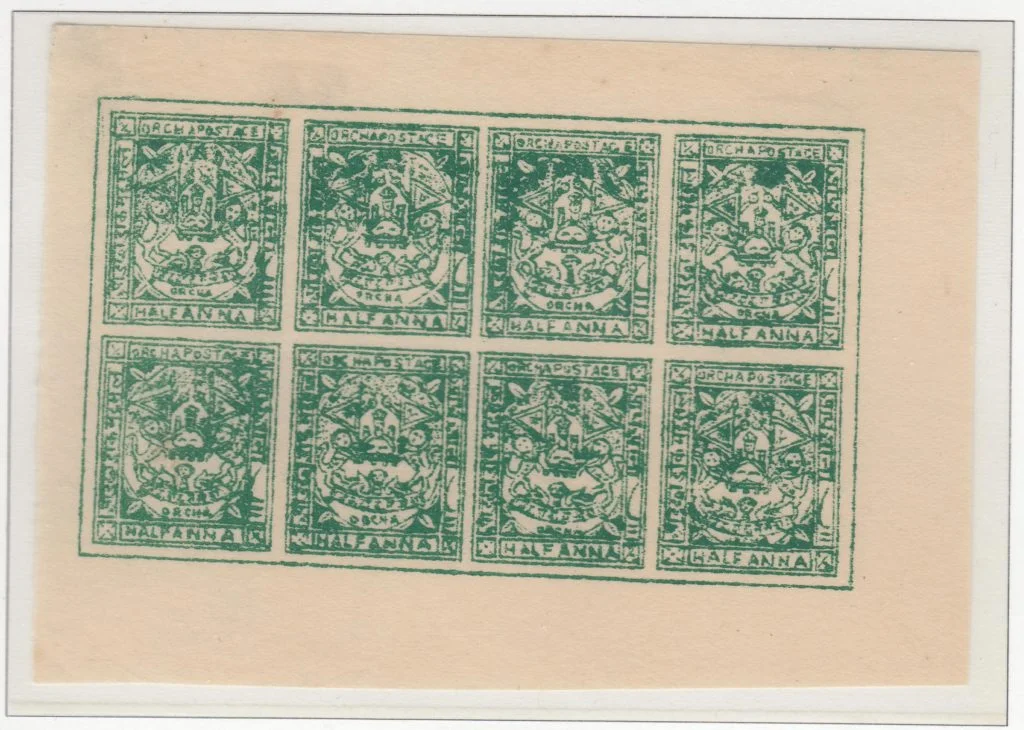
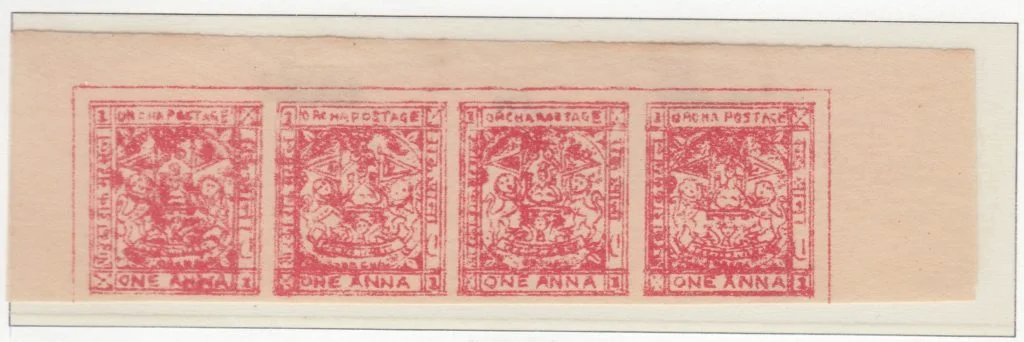
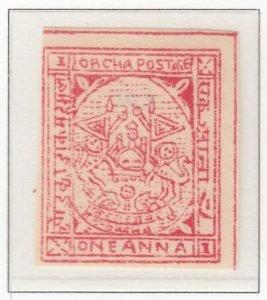
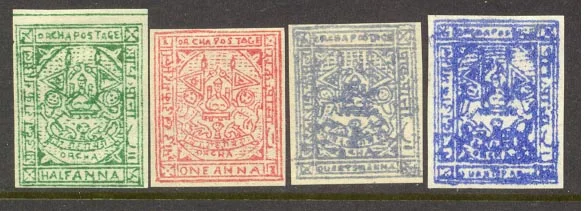
The lithographed half anna green and one anna carmine of 1913 were poorly drawn, with no shading behind the arms. The two-annas and four-annas values announced for that group never appeared.[1]
In the account of 1913 quoted by Haverbeck, Jno. Godinho describes lithographed imperforate stamps in sheets of eight, and fragments of the words BEDFORD BOND in some sheets. That is a reported paper watermark, not a rule that every stamp or sheet shows it, and it should not be extended to the later redrawn printings.[1]
The redrawn arms of 1914–1916
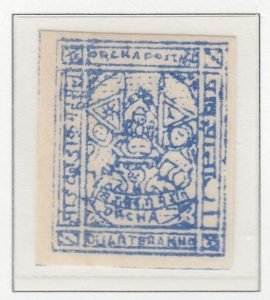
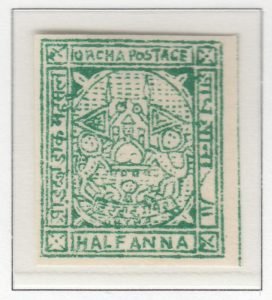
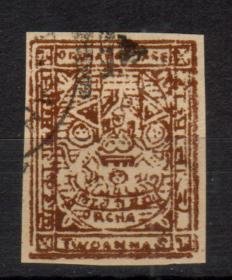
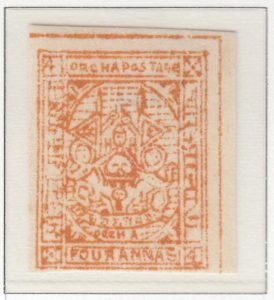
The next stones, introduced in 1914, have horizontal shading behind the arms and a taller design. Eight separately drawn subjects make two rows of four, so differences between them should be studied as sheet positions before anyone counts more stones. The quarter anna was added in 1915 and the two annas in 1916: 1914 is the date of the design, not the first date of every value.[1]
The redrawn family adds a quarter anna and a four annas. Fine horizontal background lines help tell its half anna and one anna from the 1913 impressions. The exhibition gives an earlier date than Haverbeck’s chronology, which is followed here.[10][1]
Sources
- [1] H. D. S. Haverbeck, “The Postage Stamps of Orchha,” The Congress Book 1964, 30th American Philatelic Congress (1964), pp. 33–42.
- [7] The Postage Stamp (correspondence on the 1904 French official catalogue, with a reply by E. B. Evans).
- [10] Indian Feudatory States Stamps, Orchha exhibition: the 1913 arms sheet and strip and the redrawn arms.
- [12] “Notes on the Postal Arrangements in some of the Native States”, The Philatelic Journal of India, vol. X, no. 10, October 1906, pp. 218–227 (Orchha, pp. 219–220).
- [13] H. F. Hatch, “The Stamps of Orcha,” Gibbons Stamp Weekly, vol. 10 (11 December 1909), pp. 568–569, including replies from H.H. Bhagvantsinhji and appended comments by E. B. Evans.
Notes 0
Add what you know: a cover or stamp in your collection, a date or source, a correction or a question.
No notes yet.
Sign in to add a note.
Notes show straight away. Keep them kind and about the article; anyone can report one that isn't. House rules
