
Orchha: Royal Arms, Portraits and Disputed Issues
Orchha in Bundelkhand ran a State post from Tikamgarh from 1895; its stamps run from a disputed arms set of about 1897 to the portraits of 1935 and 1939.
Updated August 9, 2026
In this article
The state behind the stamp
Orchha was a Bundela Rajput state in Bundelkhand. Its old capital on the Betwa gave the state its name; Tikamgarh became the seat of government and the chief postal town.[1][3]
The rulers
Pratap Singh succeeded his brother Hamir Singh in 1874. Government was entrusted to him in June 1874, and the British officer appointed for a time to supervise was withdrawn in May 1876: separate stages, all before the regular State offices of 1895.[15][11]
Aitchison records Pratap Singh’s death on 3 March 1930 and the succession of his grandson Vir Singh Deo, and the Government of India’s Memoranda on the Indian States 1932 gives 3 March 1930 in its succession column. No separate date of installation or of full powers is known. A ruler’s reign and the dates a stamp was issued or valid are different kinds of evidence.[15][16]
| Reign | Ruler | Note |
|---|---|---|
| 1874–3 March 1930 | Maharaja Pratap Singh | Succeeded his brother Hamir Singh; government entrusted June 1874; British supervising officer withdrawn May 1876 |
| From 3 March 1930 | Maharaja Vir Singh Deo | Pratap Singh’s grandson; the portrait on the 1935 and 1939 issues |
Chronology
| Date | Event |
|---|---|
| 1874 | Pratap Singh succeeds; government entrusted to him in June |
| 1895 | Regular Darbar post offices opened at the police stations, with runners (Gazetteer, 1907) |
| Late 1897? | The early arms stamps perhaps prepared; reported about 1900 |
| 1906–1907 | Seventeen State offices listed in The Philatelic Journal of India; sixteen in the Gazetteer |
| 1913 | Lithographed arms half anna and one anna |
| 1914–1916 | Redrawn arms; quarter anna 1915, two annas 1916 |
| 3 March 1930 | Pratap Singh dies; Vir Singh Deo succeeds |
| 1 April 1935 | The bicoloured portrait series introduced |
| June 1935 | Complaints of sales below face; the series later cancelled and sales suspended |
| 1939 | Portrait in ceremonial robes, printed at Nasik; the ten rupees reported in 1942 |
| 1949 | The last portraits still on covers from Palera and Jatara |
| 1 May 1950 | Indian stamps replace Orchha’s |
A collection that can answer questions
Keep the disputed early arms, the 1913 and redrawn arms, the 1935 portraits and the 1939 portraits in separate sections. Record printer, design, paper, perforation and postal or fiscal status before attaching a catalogue number. For cancellations, circular Tikamgarh and Jatara marks are known alongside the barred-O killer. Keep the fronts, backs and enclosures of covers. The dating of the first series and the postal use of the high values of 1935 are still open questions.[1]
The chapters that follow describe the State post and its offices, the arms stamps from 1897 to 1916, and the portrait stamps from 1935 to the last covers.
The stamps
The issues and their values, from the research checklist. Official stamps, papers, perforations and portrait types are not listed.
| Period | Issue | Values |
|---|---|---|
| Late 1897?; reported 1900 | Disputed early coat of arms (disputed early postage) | ½ anna, 1 anna, 2 annas, 4 annas |
| 1913 | 1913 arms lithographs | ½ anna, 1 anna |
| 1914–1935 | Redrawn arms | ¼ anna (1915), ½ anna, 1 anna, 2 annas (1916), 4 annas |
| Introduced 1 April 1935 | Bicoloured European-dress portrait (postage / postage and revenue, disputed use) | ¼ anna, ½ anna, ¾ anna, 1 anna, 1¼ annas, 1½ annas, 2 annas, 2½ annas, 3 annas, 4 annas, 6 annas, 8 annas, 12 annas, 1 rupee, 2 rupees, 3 rupees, 4 rupees, 5 rupees, 10 rupees, 15 rupees, 25 rupees |
| 1939–1942 | Ceremonial-dress portrait | ¼ anna, ½ anna, ¾ annas, 1 anna, 1¼ annas, 1½ annas, 2 annas, 2½ annas, 3 annas, 4 annas, 8 annas, 1 rupee, 2 rupees, 5 rupees, 10 rupees |
Sources
- [1] H. D. S. Haverbeck, “The Postage Stamps of Orchha,” The Congress Book 1964, 30th American Philatelic Congress (1964), pp. 33–42.
- [3] Encyclopædia Britannica, 11th edition (1911), “Orchha”, historical geographical entry.
- [11] Captain C. E. Luard, Eastern States (Bundelkhand) Gazetteer, vol. VI-A: Text, Central India State Gazetteer Series. Lucknow: Newul Kishore Press, 1907.
- [15] C. U. Aitchison, A Collection of Treaties, Engagements and Sanads, vol. V, Central India (Part II: Bundelkhand and Baghelkhand) and Gwalior (Delhi: Manager of Publications, 1933), pp. 9–10.
- [16] Memoranda on the Indian States 1932, corrected to 1 January 1932 (Calcutta: Government of India Central Publication Branch, 1933), p. 40, Central India—Bundelkhand Agency, row 18, Orchha.
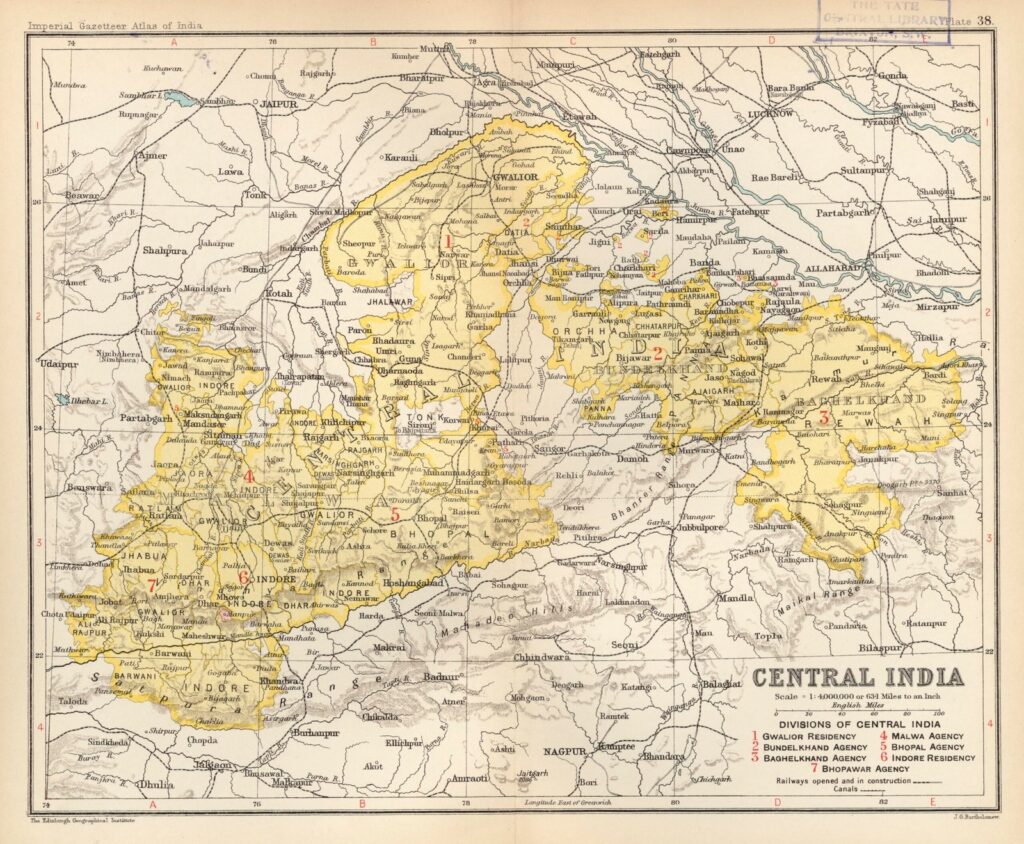
- [17] “Central India,” plate 38, The Imperial Gazetteer of India, vol. XXVI: Atlas, new edition (Oxford: Clarendon Press, 1909), J. G. Bartholomew / The Edinburgh Geographical Institute.
- Evert Klaseboer, online Indian States catalogue: Orchha, visible stamp illustrations and identification notes (consulted 31 October 2026).
- StampWorld, Orchha, first and redrawn arms groups.
Notes 0
Add what you know: a cover or stamp in your collection, a date or source, a correction or a question.
No notes yet.
Sign in to add a note.
Notes show straight away. Keep them kind and about the article; anyone can report one that isn't. House rules
