
Patiala Overprints from Edward VII to George VI, 1903–1947: Supplies, Settings and Bases
The Edward VII supplies of 1903 and their sheet flaws, a doubtful chalky paper, the George V stamps seen in 1913 and their Indian bases, Nasik from 1926, and the George VI ordinary and official formats.
Updated May 17, 2026
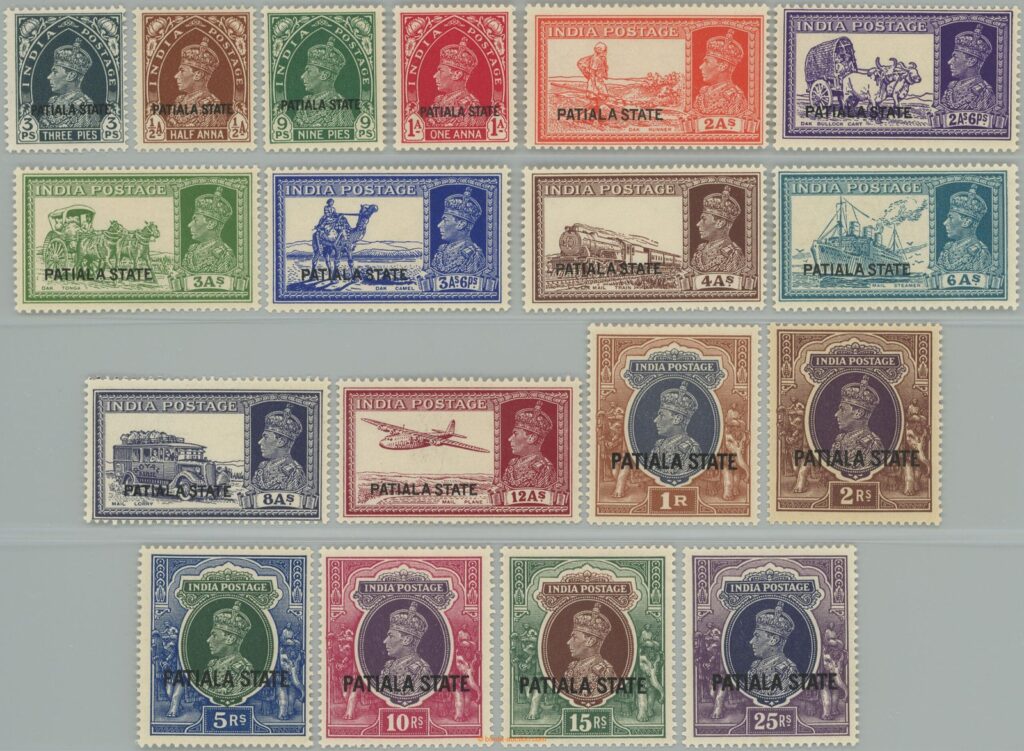
In this article
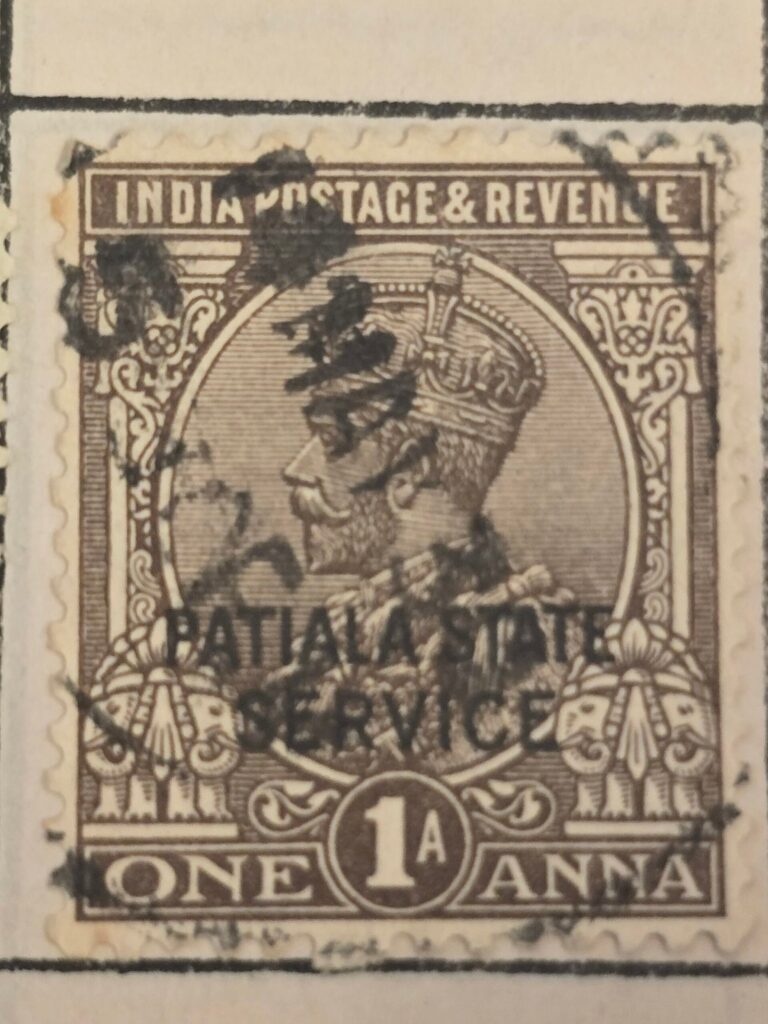
Edward VII, George V and George VI stamps carried the State name on, and George VI brought new ordinary and official groups. The one-anna official surcharge is on a George V base and should not be moved to George VI because its catalogue date falls in his reign. Keep the base design, the overprint and the catalogue attribution apart.[18][19]
The Edward VII supplies of 1903
The new portrait did not bring one self-contained printing. On 30 May 1903 the Stanley Gibbons Monthly Journal reported five Edward VII values with PATIALA STATE: three pies grey, half anna pea-green, one anna carmine, two annas purple and three annas orange-brown. The next month it relayed The Philatelic Journal of India’s figures for supplies sent about the middle of March, and Ewen’s Weekly Stamp News later printed separate columns for March and May.[27][26]
| Value | March 1903 | May 1903 |
|---|---|---|
| 3 pies (¼ anna) | 60,000 | 240,000 |
| ½ anna | 60,000 | 240,000 |
| 1 anna | 1,200 | — (printed as a dash) |
| 2 annas | 1,200 | 4,800 |
| 3 annas | 1,200 | 4,000 |
Ewen’s June notice itself queried the small March quantities of 1,200. Both journals drew on the same Indian report, so their agreement is not two independent records, and the dash is left as printed rather than read as nought.[26][27]
A setting seen across several values
In June 1903 Ewen’s journal described sheets of 240 of the Edward half anna shown by the Colonial Stamp Market. It placed a short stem and a detached dot in the first T of STATE at position 194, and a slightly smaller first A of PATIALA, with a top bar or serif, at position 208. Its August report found the same features on the quarter-anna, one-anna, two-anna and three-anna sheets, and also listed a small A in STATE at position 124. These describe the sheets examined, not every later printing.[26]
The dealer supplied the sheets for inspection and was not the printer, and the notices name no compositor or press operator. Keep positional blocks and margins before using a recurring letter flaw to rebuild a setting.[26]
A paper report that stayed a question
The Monthly Journal of 31 March 1906 repeated a report in Mekeel’s Weekly that Patiala’s three pies and four annas Edward VII had appeared on chalk-surfaced paper. The editor was not convinced: news of the unoverprinted Indian stamps on that paper would have been expected first. It is a question of the time, not an established variety. In a separate sentence the journal reported Yvert & Tellier’s listing of the one rupee carmine and green with SERVICE; neither notice names a printer or a first use.[29]
George V: the Indian base and the Patiala addition
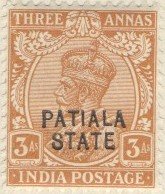
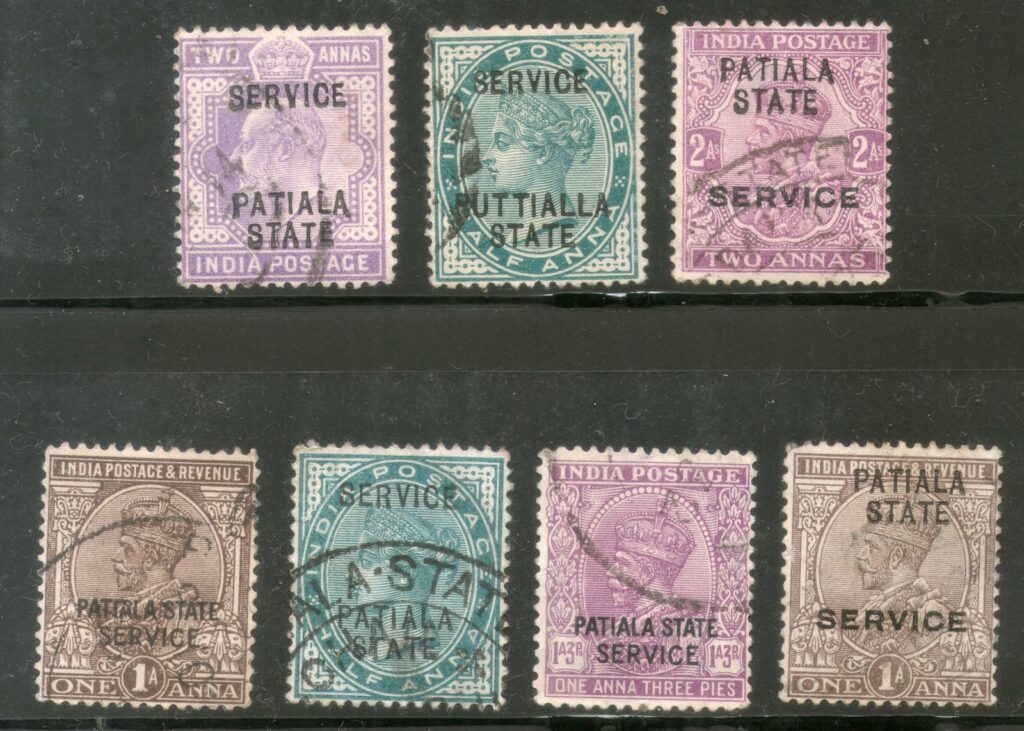
On 20 January 1913 The Philatelic Journal of Great Britain reported six George V values overprinted for Patiala: three pies, half anna, one, two, three and six annas. That shows they existed by then. The notice does not mention SERVICE, and so cannot settle whether the official group began in 1912 or 1913: the album-based list begins it in 1913, StampWorld labels it 1912–1926, and the 1912 in the Commons image titles is an attribution, not evidence of use.[28][17][6]
The Postage Stamp of 30 December 1911 described the Indian George V one anna as based on one of Bertram Mackennal’s models, named De La Rue as supplier of that value and of the two and three annas, and gave its paper as white wove, watermarked Star, perforated 14. That is the Indian base, not Patiala’s overprint, and it does not apply automatically to every value.[32]
The official centenary account of 1954 dates the move of Indian stamp printing from De La Rue to the Security Printing Press at Nasik to 1926: the same dies, now on Multiple Star watermarked paper. An unchanged face does not mean unchanged manufacture, and the passage gives no Patiala delivery date or new perforation.[33]
For the George VI transport designs the same account explains the choice of mail-transport subjects and their wartime replacement because of a paper shortage. T. I. Archer may be named as the artist of the Indian base designs, with the qualification in Monteiro’s discussion of conflicting initials. No source credits him, or anyone, with Patiala’s added lettering.[33][34]
George VI: ordinary and official formats
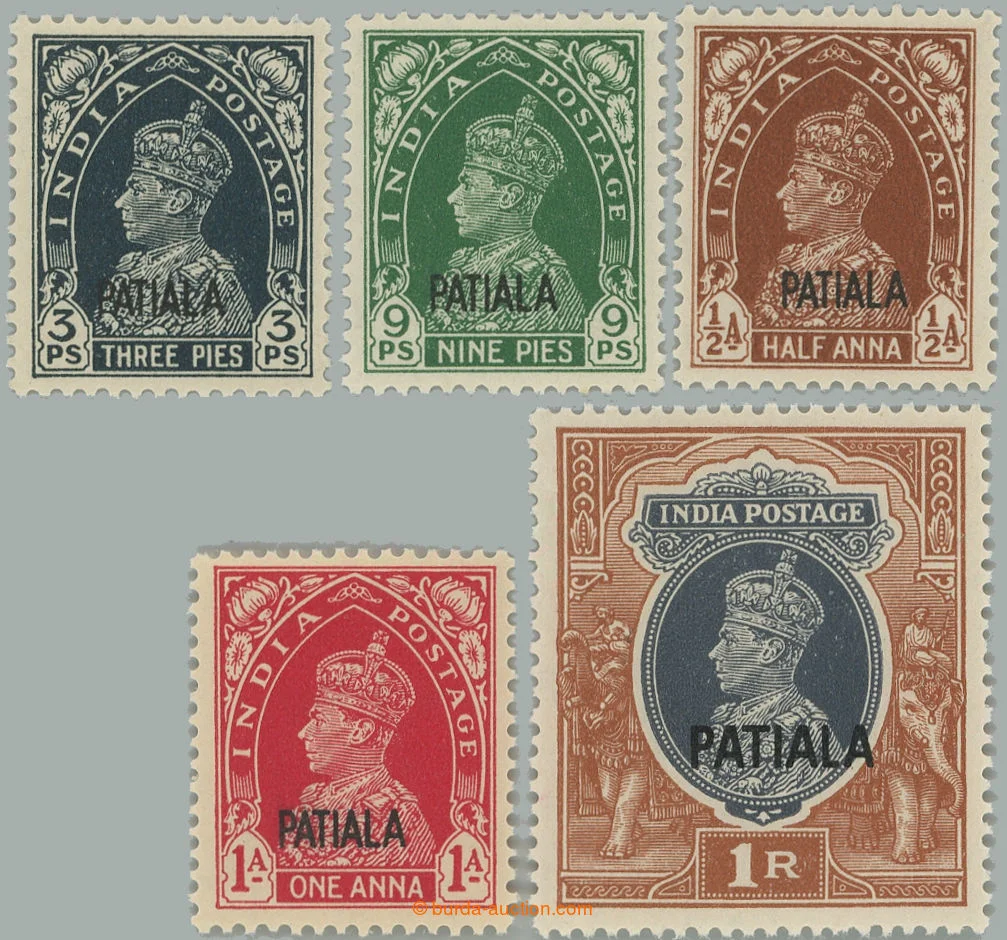
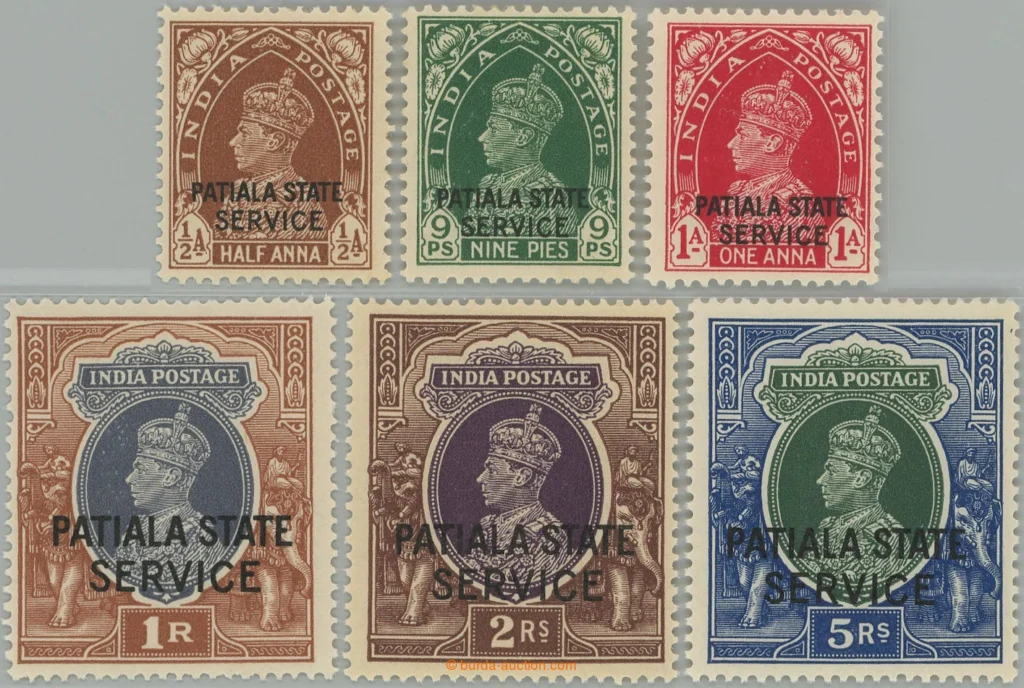
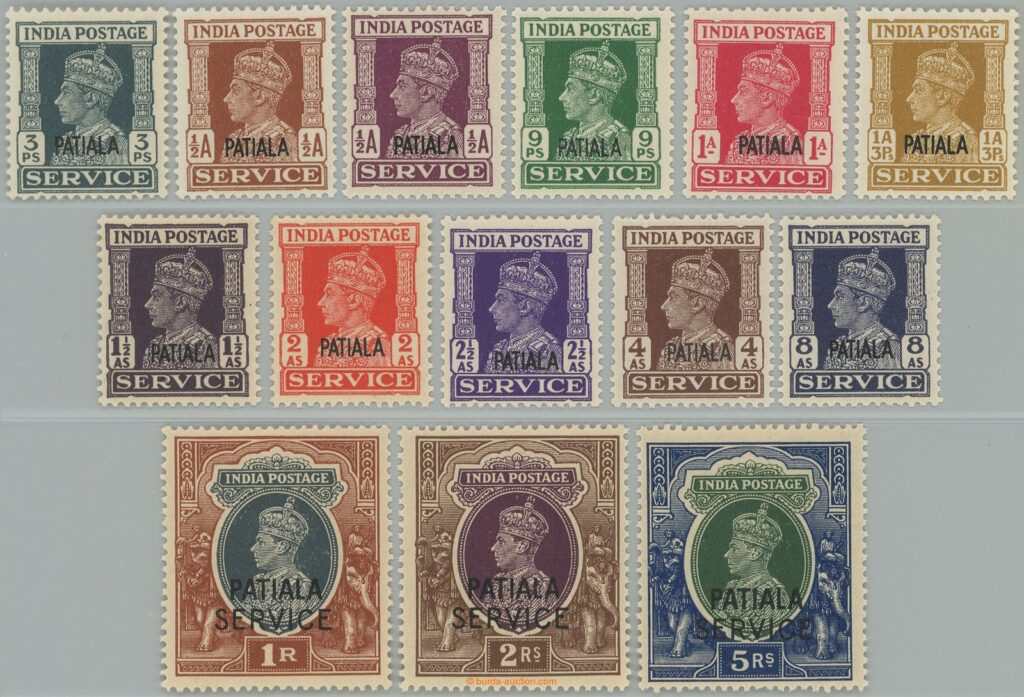
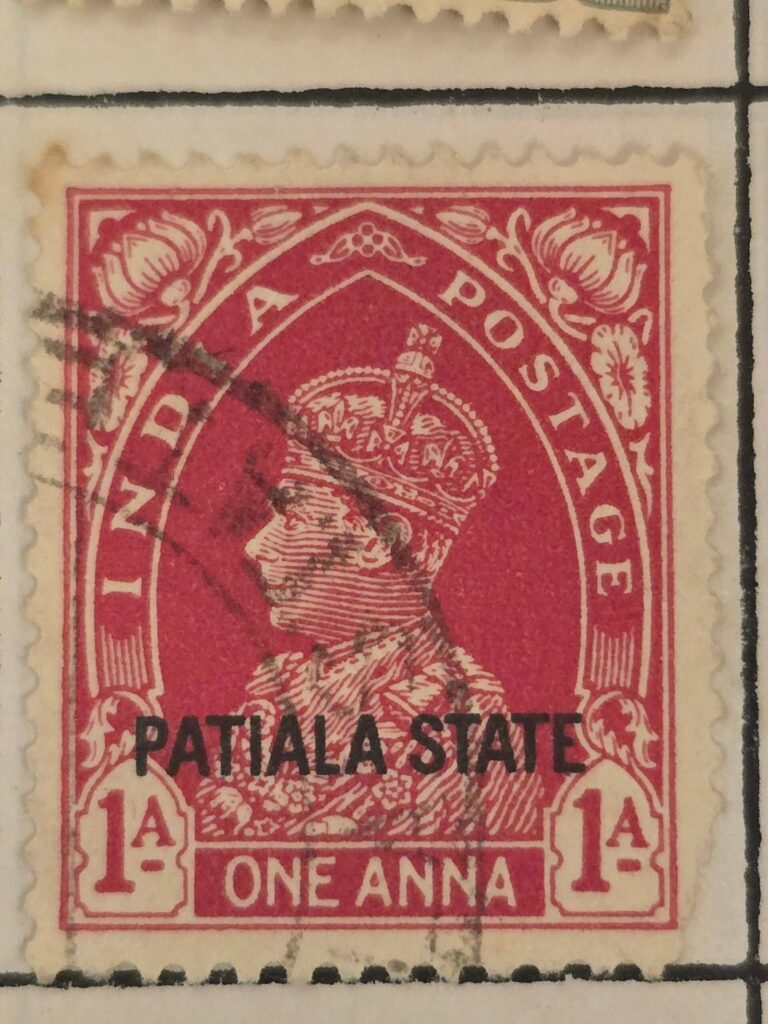
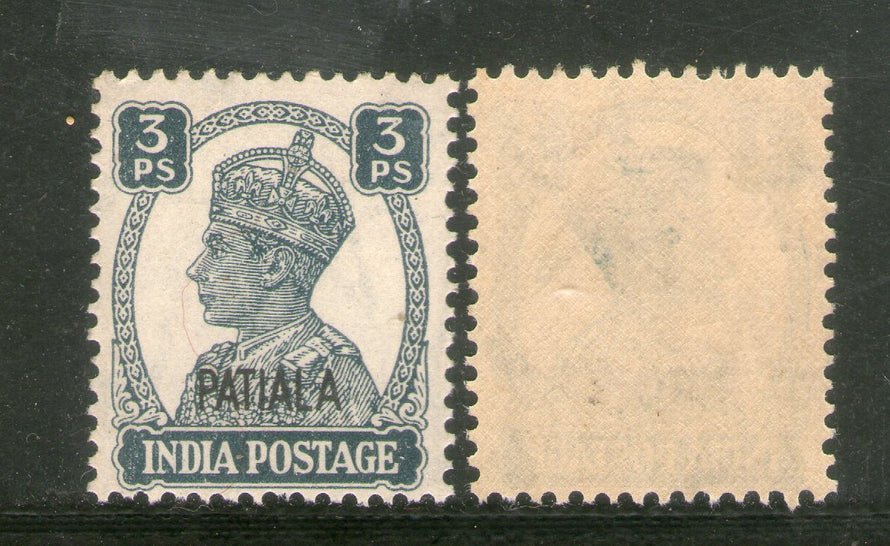
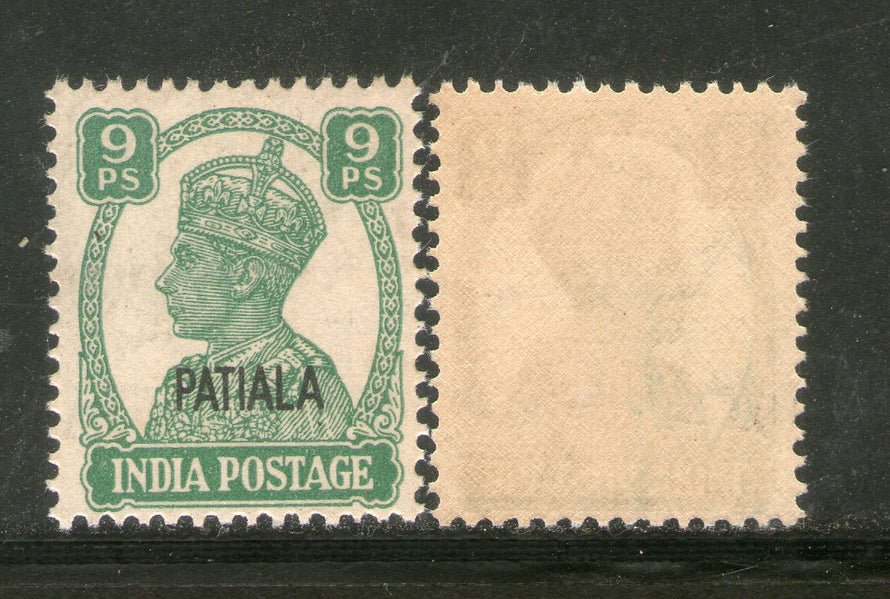
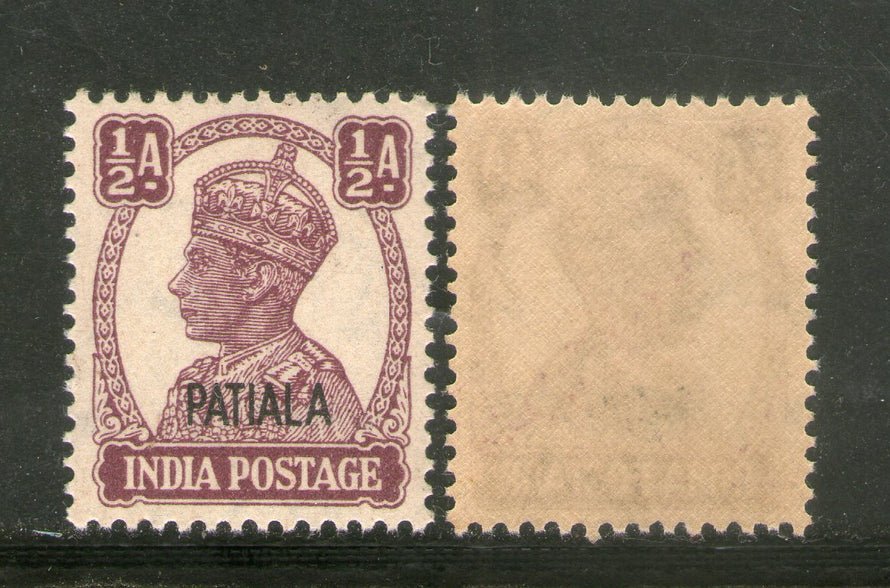
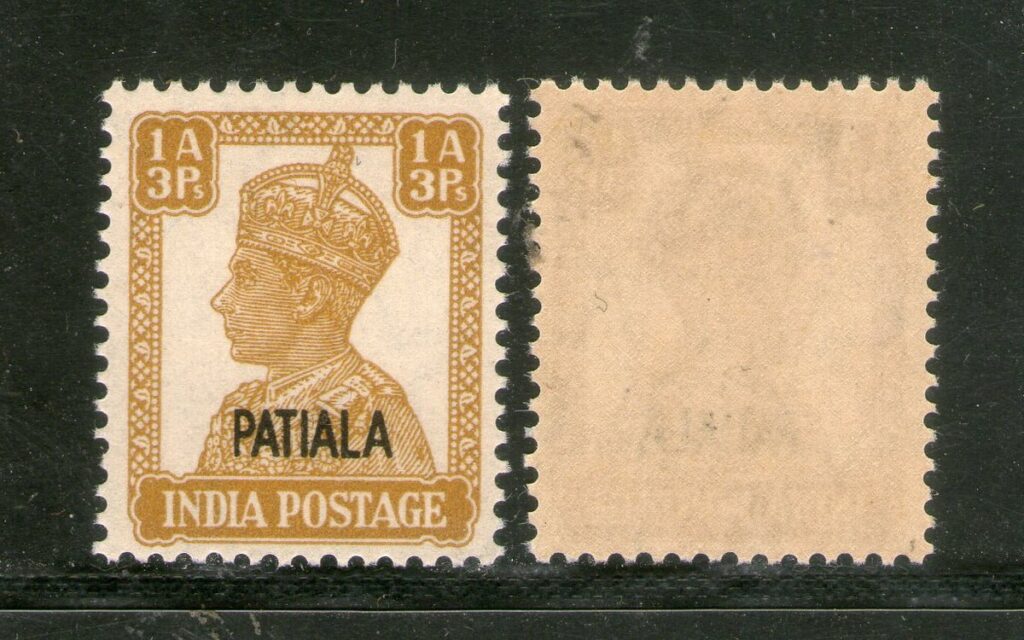
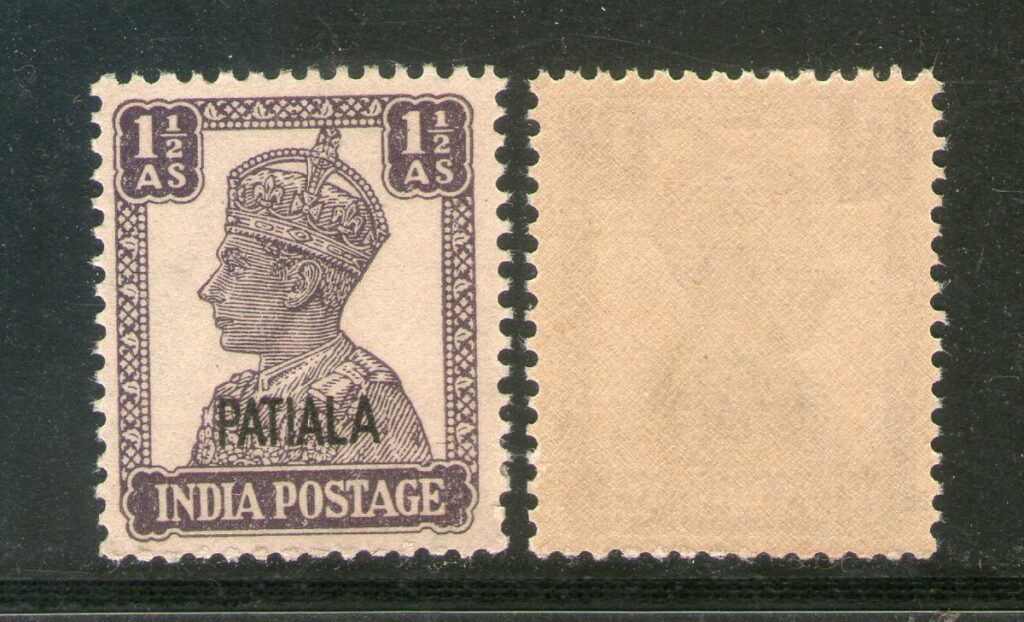
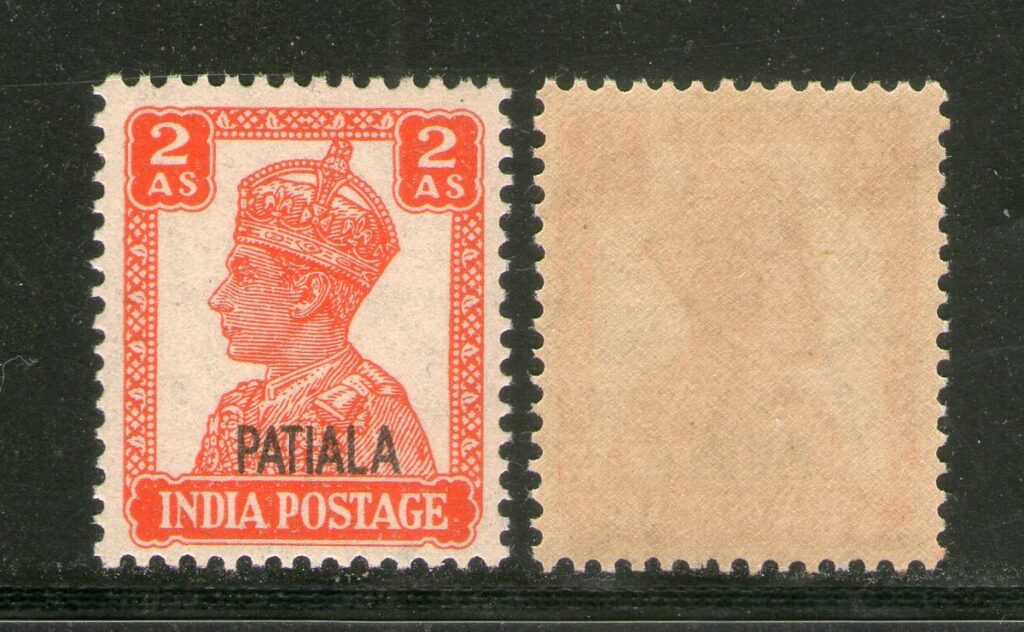
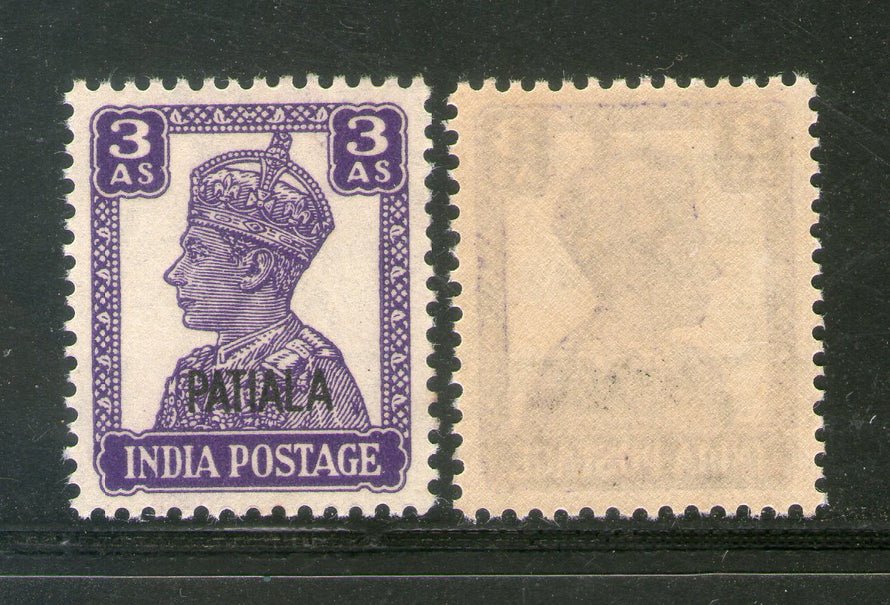
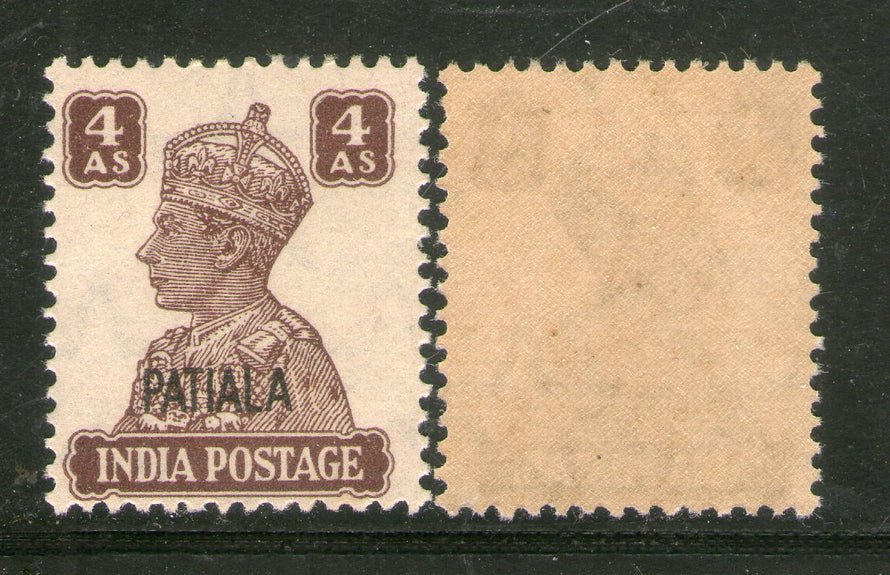
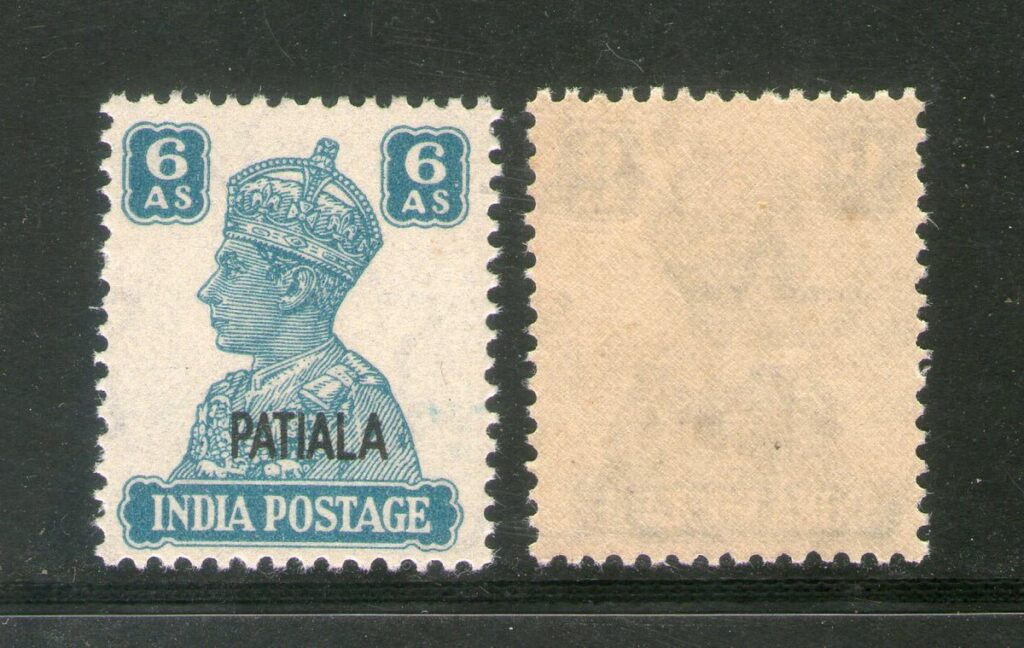
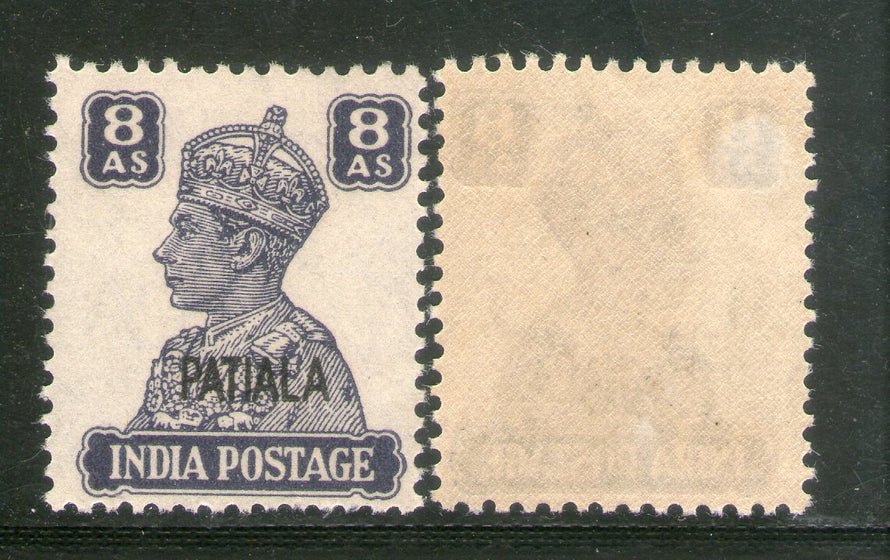
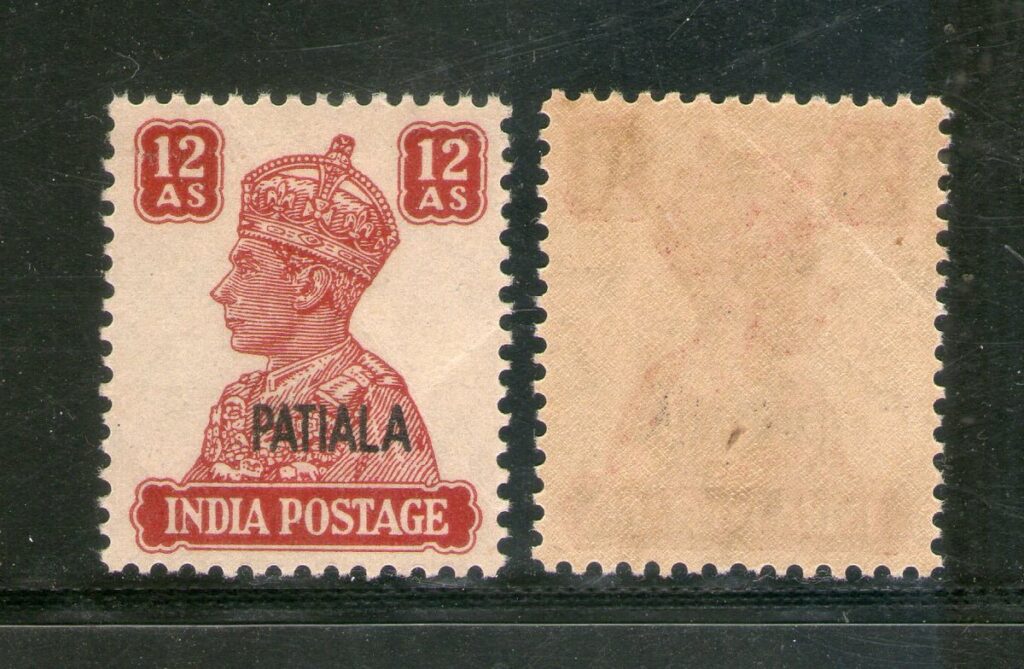
The first George VI series reads PATIALA STATE. The shorter PATIALA appears on the earlier portrait bases, including the one rupee, and should be told from the later low-value designs with white backgrounds. Among the officials, PATIALA STATE SERVICE on ordinary stamps differs from PATIALA on Indian stamps already inscribed SERVICE; the rupee officials illustrated carry PATIALA SERVICE.[13]
StampWorld dates the shortened PATIALA group on the earlier bases to 1941, the album places the low values under 1942–1943, and Kelleher’s sale 695 describes a short-overprint one-rupee block as 1947, Scott 115. These labels do not show whether the differences are of introduction, later printing or catalogue grouping.[20][6][21]
A note of 30 May 1968 associated with M. W. Muscott recorded only upright watermarks on the Patiala fifteen rupees examined, SG 96. It stressed how few stocks were available and proposed, without demonstrating, that two printings of the Indian base explained them. It is a piece of research history, not proof that an inverted watermark cannot exist.[30]
Covers of the period
Spink’s sale 25016, lot 1240, records an envelope of 1908 to Bombay franked with two half-anna and one two-anna Edward VII stamps, three annas in all as the auction describes it. The posting office, weight, services and tariff need the whole cover and a dated Postal Guide.
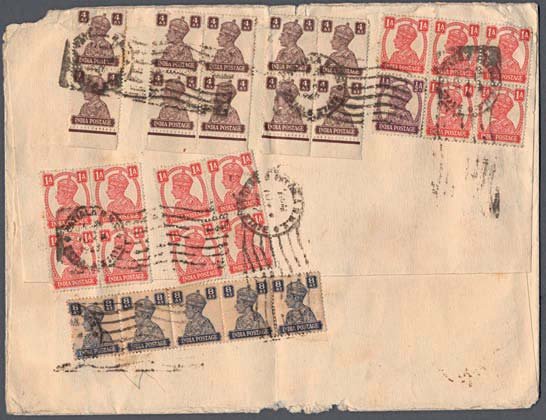
An airmail cover of 1947 catalogued as Patiala to Mexico, with no day or month, shows why an official sender and a State SERVICE stamp must be kept apart. Its stamps are Indian George VI definitives without a Patiala overprint, as the convention of 1900 required for foreign mail; that explains the franking without establishing the airmail tariff or the weight.[7][11]
Sources
- [6] William E. Steiner, India—Convention States, album pages, StampAlbums.com, pp. 47–56.
- [7] C. U. Aitchison, A Collection of Treaties, Engagements and Sanads Relating to India and Neighbouring Countries, vol. I, The Punjab, the Punjab States and Delhi, revised to 1929: Patiala, including the postal conventions of 1884 and 1900.
- [11] Christoph Gärtner, 17th auction, 7 March 2011, Patiala lots 1443–1445, plates pp.83–84.
- [13] Burda Auction, Public Auction 74, Patiala lots 247512, 249211, 249210 and 247513.
- [17] StampWorld, Patiala, Service, page 1: the single-star George V group headed 1912–1926, nos. 29–39.
- [18] Christoph Gärtner, 31st auction, Asia singles, Patiala George V official surcharge settings.
- [19] StampWorld, Patiala Service catalogue, p. 2, late George V and George VI groups.
- [20] StampWorld, Patiala ordinary catalogue, pp. 1–2, Edward VII through George VI.
- [21] Daniel F. Kelleher, Sale 695, lot 2294, short-overprint one-rupee multiple.
- [26] Ewen’s Weekly Stamp News, no. 196, 27 June 1903, p. 518, and August 1903, p. 537 and p. 562.
- [27] Stanley Gibbons Monthly Journal, 30 May 1903, p. 236, and June 1903, p. 260.
- [28] The Philatelic Journal of Great Britain, 20 January 1913, p. 3.
- [29] Stanley Gibbons Monthly Journal, 31 March 1906, p. 172.
- [30] “K.G. VI Head 15 Rupee India and Overprints”, Stamp Collecting, 30 May 1968, p. 799.
- [32] The Postage Stamp, 30 December 1911, p. 166.
- [33] Indian Postage Stamp Centenary 1854–1954, souvenir album, explanatory pp. 2–3.
- [34] Joseph Monteiro, “The Early Pictorials 1929–1949”, The Canadian Philatelist, May–June 2015, p. 169.
- Spink, Sale 25016, lot 1240, 1908 Bombay cover.
Notes 0
Add what you know: a cover or stamp in your collection, a date or source, a correction or a question.
No notes yet.
Sign in to add a note.
Notes show straight away. Keep them kind and about the article; anyone can report one that isn't. House rules
