
Patiala Postcards, Envelopes, Fiscal Stamps and Local Presses
Overprinted postcards and envelopes under the conventions, Gledhill’s possible local overprints, the nine-pie cards and HALF ANNA handstamps of 1946, Patiala’s fiscal stamps made in the Fort, and the presses that did not print postage.
Updated October 30, 2026
In this article
Stationery belongs beside the stamps
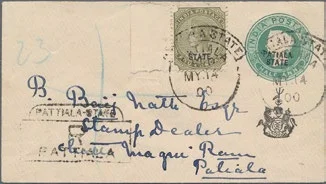
Postcards and embossed envelopes were part of the convention supply. The text of 1900 required ordinary Patiala-overprinted stationery to be supplied on indent by the Government of India at cost and sold at its marked value, with SERVICE forms for State letters. That establishes the kinds of stationery allowed; values, dies, papers and overprint settings still need the cards themselves or a specialist catalogue. Keep the whole card or envelope: address, message, impressed stamp, added stamps and the marks on both sides answer different questions.[7]
A local postcard overprint, proposed but not proved
A short notice in The Philatelist records A. C. Gledhill’s comparison of two used Patiala reply-card halves, a quarter-anna outward half (CP 17) and a half-anna reply half (CP 19). He gave PATIALA 10 mm, STATE 7¼ mm and 32 mm from the top of the T to the foot of the arms, against 11, 8 and 31 mm on normal cards, and the workmanship looked poor. He asked whether local overprinting during a shortage could explain them. The notice names no printer and reproduces no order; the CP numbers belong to the old Encyclopaedia, not a modern catalogue.[35]
The same page quotes a former owner’s note that an Indian half-anna green card (CP 27) was printed temporarily at the Government Press in Calcutta in September 1925, before Nasik could supply cards around Christmas. That is a lead about the Indian card, not an official record and not proof of local Patiala overprinting.[35]
Nine-pie cards and the HALF ANNA handstamps
Gledhill’s study of December 1966 separates nine-pie cards with solid and with white backgrounds, and illustrates Patiala solid-background cards both with and without STATE, so a missing STATE is not automatically an error. He reported used single and reply cards. His dates of 15 April 1939 and 3 October 1941 come from Jal Cooper’s catalogue of 1959, and his idea that the white background saved ink was tentative.[36]
He links HALF ANNA handstamps on nine-pie cards to the cut in the inland postcard rate early in 1946, printing the date as “1.1.46?”, question mark and all. He describes instructions for black ink at Nasik and purple elsewhere, but no Patiala order has been found. His Patiala list has single and reply cards with two purple handstamps, one with serifs and one in tall sans-serif letters, each about 30 mm wide: the cards he found, not every setting. His suggestion that black State-overprinted cards were surcharged before leaving Nasik is, in his words, a guess.[36]
Gledhill preferred dated used cards as evidence and warned about mint ones; a cancellation helps but does not prove the surcharge genuine. He also reports that the half-anna rate lasted until 31 March 1949 and nine pies returned on 1 April 1949, a dated lead after independence rather than the tariff order itself.[36]
Fiscal stamps: production and custody
Patiala kept a fiscal-stamp organisation separate from its convention postage. The Gazetteer describes the transfer of the Stamp Department to the Accountant-General on deputation in Sambat 1959, given in the margin as 1902, who reorganised the issue. The Treasury Officer held the stock and issued it to the nizamat treasuries on quarterly indents, and twenty-five licensed vendors sold it. That is fiscal custody, not the postal stock system.[15]
From 1 Magh Sambat 1960 (1903 in the margin), the same account records fiscal stamps on watermarked paper, court-fee stamps differing from general stamps. The Bengal Paper Mills Company, contractors to the Government of India, supplied the paper, and the stamps were made in the Fort at Patiala. The Gazetteer then sends readers to its postal section for postage stamps: the Fort was a place of fiscal manufacture, and neither it nor the paper supplier is evidence of a local postage printer.[15]
Local presses and what they printed
The Gazetteer names the Rajindar Press at Patiala as publisher of the weekly vernacular Patiala Akhbar and printer of some of the State’s official English and Urdu work, though most official printing was done outside the State. Its proprietor, Sayyid Rajab Ali Shah, had managed the paper since 1895; Munshi Newal Kishor had founded it in 1872 with the State’s sanction. None of this connects the press with postage.[15]
The census report of 1931 says its forms, registers and other printed material were bought from the printers to the Punjab Census Department: printing at the State Press had been required, but proved impracticable, and the Finance Minister approved an exemption. The report of 1941 carries the imprint of the Bhupindra State Press, Patiala, and excludes the cost of directories payable to the State Press from its expenditure; Lt. Col. Sukhdev Singh is its author and Superintendent of Census Operations, not its printer. A named State printer, then, but no postage-stamp work.[22][23]
| Person or body | Documented role | Not established |
|---|---|---|
| Council of Regency and its unnamed President | Asked for the wording “Patiala State”, 9 August 1883 | Design or engraving |
| Rai Daulat Ram Bahadur (Daulatram) | Imperial negotiator; co-proposer of the side-of-portrait design; as Superintendent of Mails and Post Offices, Simla Division, forwarded the AUTTIALLA complaint, 17 September 1885 | Printing or engraving |
| P. Sheridan | Deputy Director-General of the Post Office; allowed the AUTTIALLA stamps to be used, 29 September 1885 | |
| W. H. Ryland | Superintendent of Stamps; reported the type form corrected, 30 September 1885 | That he set the type himself |
| De La Rue | Printer of Indian base stamps; attributed maker of the PUTTIALA essays of February 1885 | The issued Patiala overprints |
| Bertram Mackennal | Portrait model behind the Indian one anna of 1911 | Patiala’s lettering |
| Security Printing Press, Nasik | Indian base stamps from 1926 | Any dated Patiala overprint run |
| T. I. Archer | Attributed artist of the George VI transport bases | Patiala’s lettering |
| Bengal Paper Mills Company; Patiala Fort | Paper for fiscal stamps; place of fiscal manufacture | Postage |
| Rajindar Press; Bhupindra State Press | Newspaper and official printing; census report of 1941 | Postage |
| Overprint compositor or press operator | Not identified | Do not substitute a ruler, base artist or dealer |
Sources
- [1] C. Stewart-Wilson, British Indian Adhesive Stamps Surcharged for Native States, Part II, Calcutta: Philatelic Society of India, 1898, Patiala chapter, pp. 63–79, and Official Documents XIV–XV, pp. 134–136.
- [7] C. U. Aitchison, A Collection of Treaties, Engagements and Sanads Relating to India and Neighbouring Countries, vol. I, The Punjab, the Punjab States and Delhi, revised to 1929: Patiala, including the postal conventions of 1884 and 1900.
- [15] Punjab States Gazetteers, vol. XVII A, Phulkian States: Patiala, Jind and Nabha, 1904, Lahore: Punjab Government Press, 1909, Part A, pp. 132, 136, 152–153, 167–168 and 182.
- [22] Sirdar Arjan Shah Singh, Census Report of Patiala State, 1931, Lahore: Civil and Military Gazette, pp. v and xii.
- [23] Lt. Col. Sukhdev Singh, Census Report 1941, Patiala State, Patiala: Bhupindra State Press, pp. xxvi and 34.
- [25] B. Gordon Jones, “The Puttilla Error”, Philatelic Journal of Great Britain, 20 April 1911, pp.64–65; letter dated London, 25 March 1911.
- [32] The Postage Stamp, 30 December 1911, p. 166.
- [33] Indian Postage Stamp Centenary 1854–1954, souvenir album, explanatory pp. 2–3.
- [34] Joseph Monteiro, “The Early Pictorials 1929–1949”, The Canadian Philatelist, May–June 2015, p. 169.
- [35] “Local Overprint on Postcards of Patiala State”, The Philatelist, vol. 25, p. 276.
- [36] A. C. Gledhill, “The K.G. VI 9pies Postal Cards of India and the Indian Convention States”, The Philatelist, December 1966, pp.87–89.
- [37] John B. Marriott, “India and the Indian Convention States”, The London Philatelist 103, March 1994, pp.51–65.
Notes 0
Add what you know: a cover or stamp in your collection, a date or source, a correction or a question.
No notes yet.
Sign in to add a note.
Notes show straight away. Keep them kind and about the article; anyone can report one that isn't. House rules
