
Rajpipla Letter Sheets, Fiscals and the Portrait Essay
The four paisa letter sheets of 1879 on DORLING & GREGORY paper, the eight-anna report of 1884, the one-anna fiscals mistaken for postage, and the portrait essay that was never issued.
Updated May 15, 2026
In this article
The letter sheets of 1879
The Philatelic Record of April 1879 described four letter-sheet forms from Mrs. Tebay’s specimens, without being able to read their values. In November it identified them as 1, 2, 3 and 4 paisas, all printed together, and reported, without a source, that they were issued in 1875. The stamps and inscriptions are lithographed in black on thin white or greyish wove paper. They are stationery, not four more sword stamps.[14][8]
Padgham’s earlier account treated the sheets as essays or proposals and knew no accepted genuine postal use. In his follow-up of May 2001 he changed his view: he now thought they were issued, though little used. A sheet addressed to London travelled with Indian stamps while its impressed Rajpipla stamp was left uncancelled, and the stamp and cancellation on a reported local entire were questioned; carrying a sheet does not prove its impressed stamp paid the postage. A “Made in Germany” cancellation noted in the earlier account is bogus. All four values are listed as stationery of disputed postal status.[1][10]
Paper, embossing and dividing lines
Evans identifies the watermark of the sheets as DORLING & GREGORY in large outline capitals, correcting an early reading of Dorlington. The journal of October 1879 reads the embossed date on the paper as 1874, as Evans did; Padgham’s reproduction prints 1847. Neither is an issue date.[8][1][14]
Padgham’s correction of 2001 replaces the “guide cross” of earlier writers with continuous dividing lines crossing at the centre. He also questions Deschl’s idea of four stones locked together in a forme, asking how the unbroken lines would then have been printed. That the four values were printed together is documented; how is disputed. Evans’s single two paisa on yellow paper was presumed a trial.[8][10]
An eight annas that may be a fiscal
An eight-anna stamp was reported in May 1884, said to be in the two-anna design and the four-anna colour. Evans found no later confirmation and suggested that, if it existed, it might be a fiscal. It is not a fourth postage value.[8]
One anna fiscals mistaken for postage
A group reported as postal in 1889 was later recognised as fiscal. Its orange-red, blue and green stamps had been described as one anna, one anna and two annas, but Evans found One Anna on all three colours. He described them as typographed on white wove paper, perforated 12. Padgham calls the early fiscal group lithographed and perforated 11½, a disagreement that only the stamps can settle. They stand outside the sword postage series; a green fiscal is not a two-anna postage stamp.[8][10]
The portrait essay
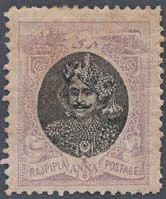
Two proposed one-anna portrait impressions show a Rajput prince in black within an ornate frame, one in ultramarine and the other pale lime-green, with a steamship and a railway train in the upper frame. The report of November 1977 describes two-colour typography on unwatermarked wove paper, fully gummed, perforated 11, with SPECIMEN diagonally in green on the back; Padgham later quotes a dealer’s description of 1994 as lithography, perforated 11½. Maker, date and sitter are unknown.[4][10]
An origin around 1886, a date around 1900, and a possible identification of the sitter as Chhatra Singhji are all proposals. The Imperial takeover documented in 1884–85 also rules out using a supposed takeover of 1886 to date them. Robbins discussed the essay in 2001. None of this makes it a fourth issued stamp.[4][10][11][13]
What is still to be found
Still unknown: the instructions for the takeover and the last day of validity of the native stamps; the first-use and printing dates; the designer, engraver and printer of the sword stamps; the original letters of 1882–1883, staff records and runner routes; whether every letter-sheet value was used for postage; and the true process and perforation of the portrait essay and the fiscals.
Sources
- [1] David Padgham, “Rajpipla State Post”, pp. 25–28.
- [4] “An Hitherto Unreported Essay for the State of Rajpipla”, The Collectors Club Philatelist, November 1977, pp. 359 and 376.
- [8] E. B. Evans, “The Stamps of some of the Native States of India: Rajpeepla”, Gibbons Stamp Weekly, 15 January 1910, pp. 60–64.
- [10] David Padgham, “Rajpipla State Post – A Follow-up”, India Post 148, vol. 35 no. 2, May 2001, pp. 38–44.
- [11] Kenneth X. Robbins, “Unissued essays for Rajpipla postage stamps”, India Post 147, vol. 35 no. 1, February 2001, p. 19.
- [13] Report on the Administration of the Bombay Presidency for the Year 1884–85 (Bombay: Government Central Press, 1885), p. 140; British Library IOR/V/10/296, f.99 v.
- [14] The Philatelic Record, vol. I (1879), April no.3, “India”, p.20; October no.9, “Nandode, or Rajpeepla”, p.84; November no.10, “Rajpeepla”, p.96.
Notes 0
Add what you know: a cover or stamp in your collection, a date or source, a correction or a question.
No notes yet.
Sign in to add a note.
Notes show straight away. Keep them kind and about the article; anyone can report one that isn't. House rules
