
Rajpipla’s State Post: Nandod, the Chandod Exchange and the Imperial Takeover
Rajpipla’s offices at Nandod and Jhagadia, the state-paid clerk at Chandod, the charges of 1882, the Imperial takeover at the end of 1884–85 and the stock destroyed by December 1886.
Updated September 29, 2026
In this article
Rajpipla lay in the hilly Rewa Kantha country south of the Narmada. Its capital, Nandod, stood on the Karjan river, and Nandod is the name most likely to appear on Rajpipla postal material. A state service and an Indian office have to be kept apart throughout its history.[1][3]
Two postal stories at one capital
The opening of the state post is not securely dated. The Bombay Gazetteer of 1880 records an office kept by the chief at Nandod; its count of six offices is for the whole agency, not for Rajpipla. Letter sheets were noticed in 1879 and the one-paiso stamp in 1880. Imperial management is documented in the official report for 1884–85, and a notice of December 1886 reports government stamps in use and the old stock destroyed. These are separate events, not alternative closing dates.[12][14][15][13][16]
For the setting, plate 36 of the Imperial Gazetteer atlas of 1909, “Bombay (Northern Section) with Sind and portions of Baroda”, shows Nandod and Chandod near its lower edge. The map is later than the native stamps and shows the country, not the runner routes.[7]
The clerk at Chandod
Pandya’s account of the correspondence of 1882 identifies state offices at Nandod and Jhagadia and a clerk, paid by the state, who managed the exchange at Chandod; insured parcels had to be collected there. He names Rao Saheb Pitambardas Jethabhai and Rao Saheb Lallubhai Kasandasji in the correspondence of 1882–1883; the Chandod clerk himself is unnamed, and none of them is known to have had anything to do with making the stamps. The December 1880 journal credits a State Postmaster, also unnamed, with reporting the denominations.[2][15]
The charges below follow Pandya’s account. They are not a complete tariff.[2]
| Service | Charge |
|---|---|
| Paid letter | ¼ anna up to 5 tolas, and ¼ anna for each further 5 tolas |
| Unpaid letter | Double the paid charge |
| Registration | 2 annas in addition to postage |
| Parcel | 1 anna per 20 tolas, and 1 anna for each further 20 tolas |
| Money order for 100 rupees within the state | 8 annas |
A cancellation is only part of a journey
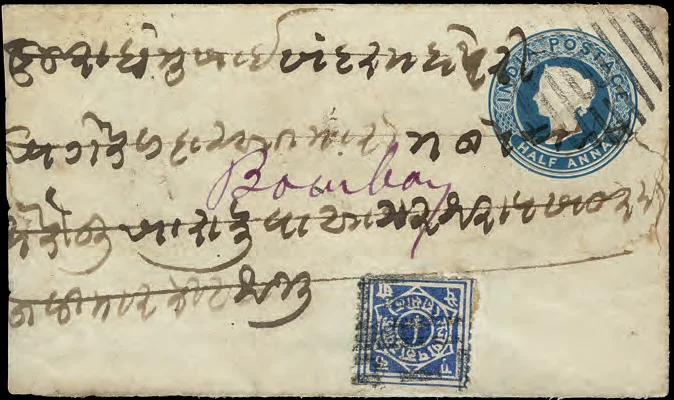
A six-bar Nagari obliterator is documented on the native stamps. A one-paiso cover on Indian postal stationery, exchanged through Chandod, shows how a local journey joined the wider network: the Indian imprint and the state stamp did different jobs. The higher values were not known on cover to the author of the earlier Padgham account, a limit of that study rather than proof that none exists. A favour-cancelled piece is no proof of a commercial rate, and Nandod squared-circle dates of 1895 or 1900 belong to the continuing Indian office, not to any late validity of Rajpipla stamps.[1][13][16]
The Imperial takeover
The official Bombay administration report for 1884–85 records three new offices opened in Rajpipla, which was “for the first time brought under the management of the Imperial Post Office at the end of the year”. It names no offices and gives no day of transfer and no last date of validity for the native stamps.[13]
The Philatelic Record of December 1886 says, on unnamed official information, that government stamps were then used throughout the State and the remaining stock of the 1880 issue had been destroyed. That reports the end of the native stamps’ supply; it does not mean Imperial management began in 1886. The usual span of 1880–1886 is a stamp period, and the last day of validity is still unknown.[16][8]
Sources
- [1] David Padgham, “Rajpipla State Post”, pp. 25–28.
- [2] Prashant Pandya, “Rajpipla State Post”, reproduced by V. Singhi, 25 February 2014.
- [3] Encyclopædia Britannica, 11th edition (1911), “Rajpipla”, historical geographical entry.
- [7] Imperial Gazetteer Atlas of India, Oxford: Clarendon Press,1909, plate 36, “Bombay (Northern Section) with Sind and portions of Baroda”; Digital South Asia Library, University of Chicago.
- [8] E. B. Evans, “The Stamps of some of the Native States of India: Rajpeepla”, Gibbons Stamp Weekly, 15 January 1910, pp. 60–64.
- [12] Gazetteer of the Bombay Presidency, vol. VI: Rewa Kantha, Narukot, Cambay, and Surat States (Bombay: Government Central Press, 1880), pp. 51 and 109.
- [13] Report on the Administration of the Bombay Presidency for the Year 1884–85 (Bombay: Government Central Press, 1885), p. 140; British Library IOR/V/10/296, f.99 v.
- [14] The Philatelic Record, vol. I (1879), April no.3, “India”, p.20; October no.9, “Nandode, or Rajpeepla”, p.84; November no.10, “Rajpeepla”, p.96.
- [15] The Philatelic Record, vol. II (1880), November no.22, “Rajpeepla”, p.135; December no.23, “Rajpeepla”, pp.146–147.
- [16] The Philatelic Record, vol. VIII, no. 95 (December 1886), “Rajpeepla”, p. 194.
Notes 0
Add what you know: a cover or stamp in your collection, a date or source, a correction or a question.
No notes yet.
Sign in to add a note.
Notes show straight away. Keep them kind and about the article; anyone can report one that isn't. House rules
