
Travancore-Cochin, 1949: Old Designs, New Values
Travancore stamps surcharged in pies and annas: who designed and printed them, the dates of 1 July and 5 August 1949, the inherited Cochin stamps, mixed perforations, repaired sheets, papers and errors such as HALF NANA.
Updated August 30, 2026
In this article
Old designs, new values
Travancore stamps received surcharges in pies and annas, and official stocks received the same new values; SERVICE-overprinted material is a separate category. Describe a stamp by its original design, its original value, its new value and any official inscription, not just as a “1949 overprint”.[2]
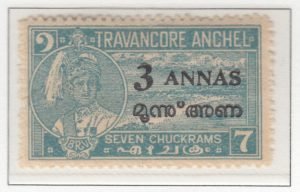
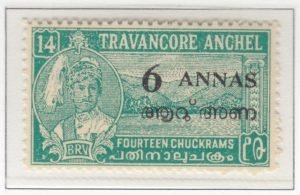
An inherited design had more than one maker
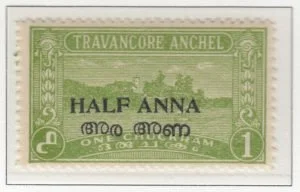
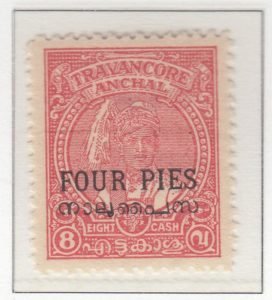
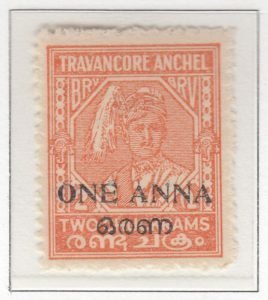
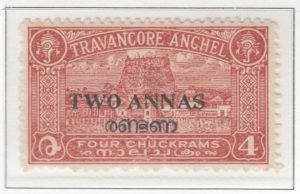
The surcharges did not give the Travancore stamps new pictures. Cowen and Devasya credit Nilakanta Pellai, Superintendent of the Government Mint and Stamps, with the designs of 1939–46 chosen for conversion. They separate three jobs: Pellai prepared the designs, the Security Press at Nasik made chromium-faced typographic plates, and the Government Stamp Manufactory at Trivandrum printed the stamps by letterpress. This credits the inherited bases; the United State commissioned no new design for them. The five views and portraits of 1939 and their official colours come from Pellai’s letter to Devasya of 23 October 1939, cited by the authors.[13][5][4]
A correction at the end of the study matters. Where the earlier text had confused the Government Press and the Stamp Manufactory, the authors specify that all stamp printing and overprinting at Trivandrum was the Stamp Manufactory’s work, with the Government Press helping to prepare the forms. That does not change the separate work at Ernakulam. For the later inherited Cochin stamps, the study names Associated Printers, Madras, as lithographic printer, and calls the local service and value overprinting at Ernakulam only probable.[13][5][4]
People and institutions
Design, tooling, manufacture, administration and research are different roles, and a job title or a portrait does not prove that a person cut a die.
| Person or institution | Role | Not established |
|---|---|---|
| Nilakanta Pellai | Superintendent, Government Mint and Stamps; designer of the selected Travancore bases of 1939–46 | A new union design, or cutting the Nasik plates himself |
| O. Krishnan Assari | Travancore-Cochin Government artist and engraver; designer of the permanent union stationery and the Nasik stamps and stationery | Personally cutting a particular die or plate |
| Government Stamp Manufactory, Trivandrum | Letterpress printer of the Travancore bases; all stamp printing and overprinting at Trivandrum | That the Government Press printed stamps |
| Government Press, Trivandrum | Helped prepare the stamp forms | Printer of the stamps |
| Security Press, Nasik | Made the chromium-faced plates for the inherited bases; printed the 1950 agency stamps by offset lithography | Printer of the finished Travancore bases |
| Associated Printers, Madras | Lithographic printer of the later inherited Cochin stamps | Printer of the union surcharges or the Nasik series |
| Former Cochin State Press / Government Press, Ernakulam | Larger provisional stationery surcharges; probably the service and value overprints on inherited Cochin stamps | Certainty for every overprint |
| C. I. Abraham | Finance Secretary; signed the stationery paper notices | Any part in design or printing |
| Frank M. Cowen | Co-author of the study; a research chemist | An official role in stamp production |
| J. Devasya | Collector and co-author; said to have urged pictorial subjects on the Maharaja | Designer or commissioned artist |
| R. F. Stoney | Researcher and correspondent of the time | Printer, or source of an order fixing validity |
| Harry N. Burgess; Claude Scott; P. Wells | Philatelic authors and checklist compilers | |
| John Samuel | Superintendent at the time of the union | Dates of appointment; any stamp design |
| T. R. Velunney | Successor to John Samuel; last head of the state postal system | Spelling and dates confirmed elsewhere |
| S. R. Krishnamurthy | Director, Foreign Post, Bombay; author of an account of the merger | A dated order or annual return |
| N. S. Mooss | Author on covers, cancellations and privileged mail | Author of the original orders |
The inherited Cochin stamps remained part of the post
The union did not need every usable Cochin stamp to be overprinted with a new state name. Cowen and Devasya describe the Cochin portrait issues from their Raja I series of 1911–23 onwards as valid for Anchal purposes across Travancore-Cochin, and keep the Cochin changes of value of 1949 with the Cochin series. A Cochin stamp used in the united state is not a new Travancore-Cochin issue; and Travancore surcharges and the Nasik stamps reached former Cochin offices as the old stocks ran down. Their footnote warns that most or all of those Cochin changes of value may have appeared before 1 July 1949.[5]
A 1949 heading does not give every stamp the same birthday
Cowen and Devasya date the ordinary two pies, four pies, half anna, one anna and two annas to 1 July 1949; for many of the matching officials, the same day is believed or presumed, not proved. The three annas and six annas belong to a notice of 5 August 1949 and appeared soon after; the date of the notice is not a proved first day of sale.[13][14]
The two-pies surcharge was red and the other surcharges on Travancore stamps black, in the Royal Red and Raven Black inks and the type prescribed by notification Fin:7251 of 30 June 1949. Ordinary sheets were gummed and official sheets ungummed.[13]
Sheets and the fourteen surcharge forms
The large pictorial stamps, and their surcharge plates, had 112 subjects in two panes of 56 (four by fourteen); the smaller eight-cash and two-chuckram portraits had 168 in two panes of 84 (seven by twelve), on sheets about 15⅝ × 15½ inches. Cowen and Devasya distinguish fourteen currency-overprint forms, I–XIV, from two block-capital SERVICE forms. Consistent spacing and recurring flaws led them to reconstruct hand-set forms copied as stereos or electroplates, without settling which. The form numbers are their own labels, not government plate numbers.[13][14]
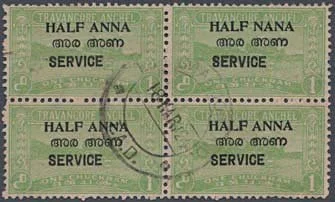
Among the ordinary forms they note a wrong third Malayalam character at 54 R on the two pies, later corrected (Form I); a progressively broken R at 77 R on the four pies that can look like FOUP (Form II); and HALF NANA at 11 L on the half anna (Form V). On the one anna (Form VII) a double printing may be printer’s waste rather than a proof. The three-anna form uses the numeral 3, not the word, with prominent flaws in the 3 at 28 R and 48 R.[13][14]
Constant lettering and a displaced impression are different things
Scott found a dropped o in TWO on the second stamp of the seventh row of the two pies on six cash, and HALF NANA on the third stamp of the third row of an early half-anna printing, with raised spacing material between the words. A repeatable positional defect belongs to a setting; it is not a second strike. His one anna on two chuckrams examples include misplaced and double surcharges, one impression diagonal. Scott said he had not found the catalogued FOUB for FOUR, though he knew a wrong-fount R.[6]
That remark concerns the ordinary four pies, SG 2. Cowen and Devasya separate it from the officials: the broken R at 77 R in ordinary Form II could give FOUP, while FOUB at 10 L belongs to official Form III and its successor Form IV, and was corrected in later printings. The accounts are about different settings, so they do not contradict each other.[6][13][14]
A mixed perforation can record an unfinished sheet
Mixed perforations need not mean that a stamp was tampered with. Burgess describes sheets begun on one machine and finished on another: part of a sheet in one gauge, later rows in another, with a transitional row perforated differently on opposite sides. In one example a differently perforated left margin produced several combinations in the same column. A large block or sheet showing the change is the evidence; a single with rough teeth cannot reconstruct it.[6]
Guillotine machines gauging 11, 12 and 12½ gave line perforations, and a late 13½ × 13½ comb was set up for the small portraits only. The authors list comb perforation on the four pies on eight cash with Roman SERVICE, the ordinary one anna on two chuckrams on conch paper, and the one anna on two chuckrams with Roman SERVICE on Cochin Arms paper. Missing lines, extra marginal lines, imperforate sheets and compound perforations are separate features, and none alone makes a proof.[13]
Scott adds that sheets of the two pies on six cash service stamp could contain inserted pieces held by gummed paper strips on the back, salvaged, he thought, after defective printing was cut out. A sheet can therefore mix shades and perforations; that does not authenticate every repaired block offered today. Keep the back, joins and margins with the face.[6]
Paper and watermark
The Travancore paper had 120 conch-shell watermarks in ten rows of twelve; guide lines and irregular cutting could leave a stamp with no part of a watermark. The authors questioned catalogue listings of wholly unwatermarked paper and asked for sheets or large multiples as evidence.[13]
As Travancore stocks ran low, Cochin Arms paper was used, cut to the Travancore sheet size and carrying about four large arms watermarks; notification FIN(E)5-29236/50 of 5 December 1950 first announced some printings on it. That is the date of the notice, not the first use of every value. The large Cochin watermark also leaves gaps between its elements, so a stamp with no visible watermark is not proof of unwatermarked paper.[13][6]
Sources
- [1] Frank M. Cowen and J. Devasya, “Travancore-Cochin: Its Postage Stamps and Postal History”, The Collectors Club Philatelist, vol. 32, no. 6 (1953), pp. 287–302.
- [2] William E. Steiner, India Feudatory States album, Travancore-Cochin pages, ordinary and official sections.
- [4] Frank M. Cowen and J. Devasya, “Travancore-Cochin”, The Collectors Club Philatelist, vol. 33, no. 4 (1954), pp. 201–218: permanent and agency issues, and addenda.
- [5] Frank M. Cowen and J. Devasya, “The Cochin Overprints, 1949”, The Collectors Club Philatelist, vol. 33, no. 2 (1954), pp. 100–104.
- [6] Harry N. Burgess, “The Travancore-Cochin Overprints of 1949–50”, with Claude Scott, “Notes on S.G. Nos. 1 to 7”, Stamp Collecting, 5 June 1953, pp. 415, 417.
- [7] P. Wells, Travancore-Cochin Postal Stationery, India Study Circle typescript checklist, 1966, pp. 27–31.
- [8] Christoph Gärtner, 17th auction, 7 March 2011, Travancore-Cochin lots 1642–1652, pp. 104 and 106.
- [13] Frank M. Cowen and J. Devasya, “Travancore-Cochin: Its Postage Stamps and Postal History”, The Collectors Club Philatelist, vol. 33, no. 1 (1954), pp. 9–26 (manufacture, pp. 16–26).
- [14] Frank M. Cowen and J. Devasya, “Travancore-Cochin”, The Collectors Club Philatelist, vol. 33, no. 2 (1954), pp. 89–99.
- [15] R. F. Stoney, “Travancore-Cochin”, The Philatelic Journal of India, pp. 82–83, and “The United States of Travancore & Cochin”, pp. 118–119.
- [16] S. R. Krishnamurthy, Director, Foreign Post, Bombay, “The Development of Postal System in Travancore Cochin”, The Philatelic Journal of India, pp. 9–10.
- [17] N. S. Mooss, “Travancore-Cochin Combination Covers”, The Philatelist, July 1963, pp. 296–297.
- [18] N. S. Mooss, “The Privileged Mails of Travancore-Cochin”, The Philatelic Journal of India, April 1966, pp. 65–68.
- [19] N. S. Mooss, “Indian Post Office Cancellations on Travancore-Cochin Stamps and Vice Versa”, Ind Dak, July–August 1986, p. 151.
- [20] N. S. Mooss, “Privileged Mails of Travancore-Cochin”, Ind Dak, September 1986, p. 183.
Notes 0
Add what you know: a cover or stamp in your collection, a date or source, a correction or a question.
No notes yet.
Sign in to add a note.
Notes show straight away. Keep them kind and about the article; anyone can report one that isn't. House rules
