
SERVICE and ON C G S: Travancore-Cochin’s Official Stamps
How the converted official stamps were made: new values on block SERVICE, the later Roman SERVICE forms, the FOUB error, the Cochin ON C G S stamps with new values, and SERVICE on Cochin paper.
Updated August 16, 2026
In this article
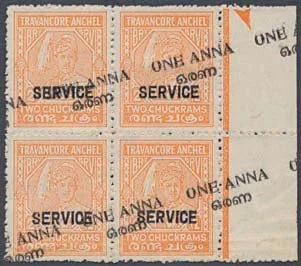
The official stamps carry an old value, a new value and an official inscription. Early forms added the new value to a stamp already overprinted SERVICE; later Roman-letter settings printed SERVICE and the new value together.
Converted values on official stamps
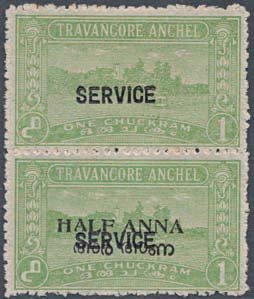
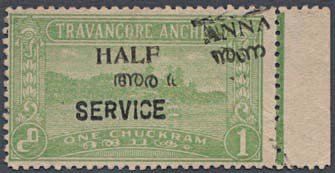
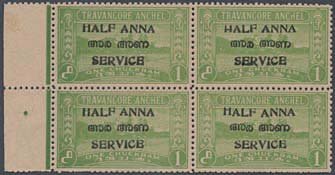
Recorded official examples include two pies on six cash, four pies on eight cash, half anna on one chuckram, one anna on two chuckrams, two annas on four chuckrams, three annas on seven chuckrams and six annas on fourteen chuckrams. That does not mean every ordinary surcharge has an identical official partner.[2]
The value and SERVICE did not always come from one operation
Early officials generally received the same currency forme as ordinary stamps, on a base already carrying block SERVICE in black. The four pies on eight cash needed its own arrangement, Form III, with a wider English fount placed to avoid the existing SERVICE and the portrait; its FOUB error at 10 L was carried into Form IV, which printed Roman SERVICE and the value together, and was then corrected. Form IV is known comb perforated. Cowen and Devasya date Form IV only to late 1949 or early 1950.[13][14]
For the half anna, Form VI with Roman SERVICE has AANA at 49 R, corrected in a later resetting on Cochin paper that also shifted a line at 25 L. For the one anna, Form VIII uses the same fount as the ordinary Form VII, which does not prove it was derived from it, and shows progressive wear of SERVICE at 71 R–75 R; on the official, the Form VII forme was shifted upward. For the two annas, the printing on Cochin paper still used two operations even after the one-operation Form X existed, for reasons only guessed at; the authors had not seen complete sheets of Form X.[13][14]
The three annas Form XII, probably of 1950, was derived from Form XI with the numeral defects removed but reversed and inverted SERVICE letters introduced, and a patched sheet is described. On the six annas a missing small Malayalam character at 52 R is reported on Form XIII, and Form XIV, derived from it on limited material, has several positions with missing characters, an inverted S and a cracked 6. These positions come from a study of its time, not a modern authentication.[13][14]
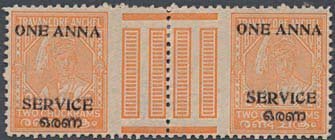
SERVICE did not supply an exact date by itself
The later SERVICE settings are dated only loosely, often to late 1949, early 1950 or simply 1950. A catalogue’s year, a production form and a cover’s cancellation answer different questions.[13][14]
Read the Cochin service marking before the new value
The Cochin official marking reads ON C G S, On Cochin Government Service. The study separates its forms by the portrait underneath: CA on its Raja V first type, CB on the second type and CC on Raja VI. These are the authors’ labels, not royal numbers.[5]
On the six pies on three pies Raja VI and the nine pies on four pies Raja VI, the official marking was already there before the value was changed. The nine-pies surcharge has two Malayalam forms: characters about 2 mm high in a line of 22 mm, and about 1½ mm high in a line of about 17½–18 mm, two settings of the same new value. Some authorities read the familiar C for G at position 4 as a damaged G; the study separates flat-backed G forms at positions 5 and 16 and a damaged C at position 15. Record the actual defect and its position.[5]
The three pies on nine pies Raja VI has a separate three-line form: THREE PIES at the top, its Malayalam equivalent below the portrait and SERVICE at the foot, different from a new value added to a stamp already marked ON C G S. The authors thought the change to SERVICE supported listing it under the united state, but only if it could be shown to have appeared on or after 1 July 1949. They could not confirm a catalogue claim of two Malayalam sizes for this form.[5]
A later printing can keep the earlier SERVICE lettering
Using Cochin paper did not always bring a new SERVICE type. The study records the two pies on six cash and the two annas on four chuckrams on Cochin Arms paper with block SERVICE, and the half anna and one anna with Roman SERVICE; no unsurcharged stamps on that paper were known to the authors. The notice of 5 December 1950 dates the paper, not the first use of each value.[13]
The converted officials in a collection
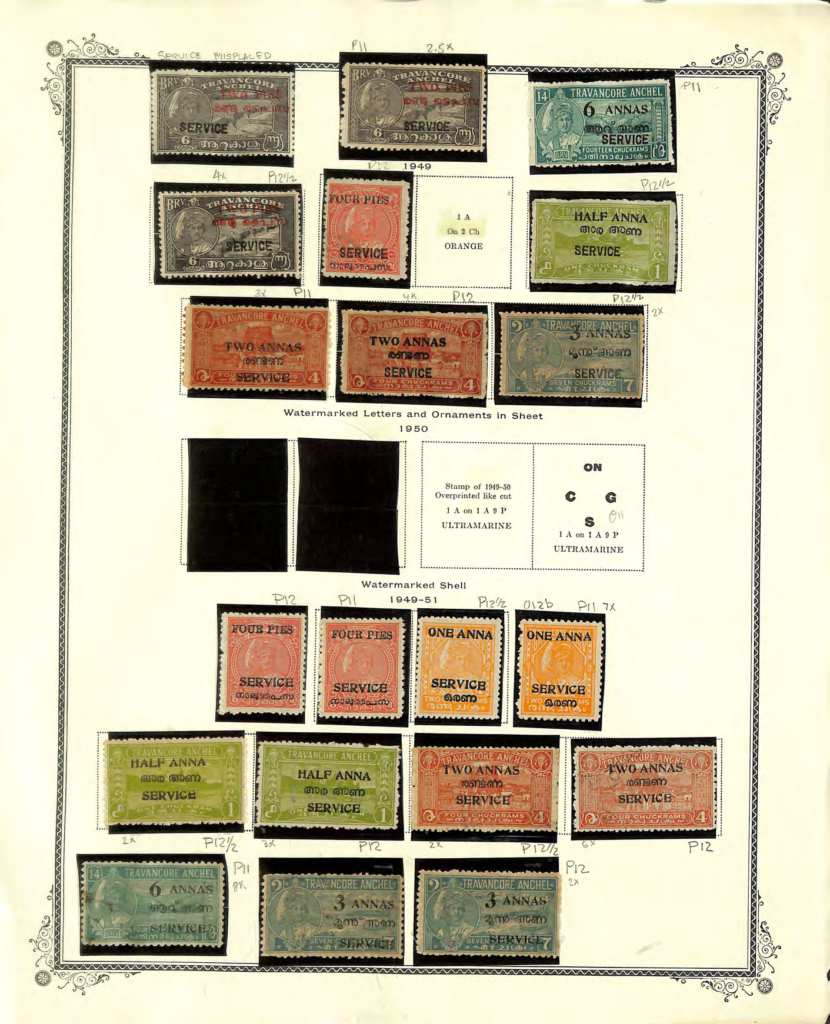
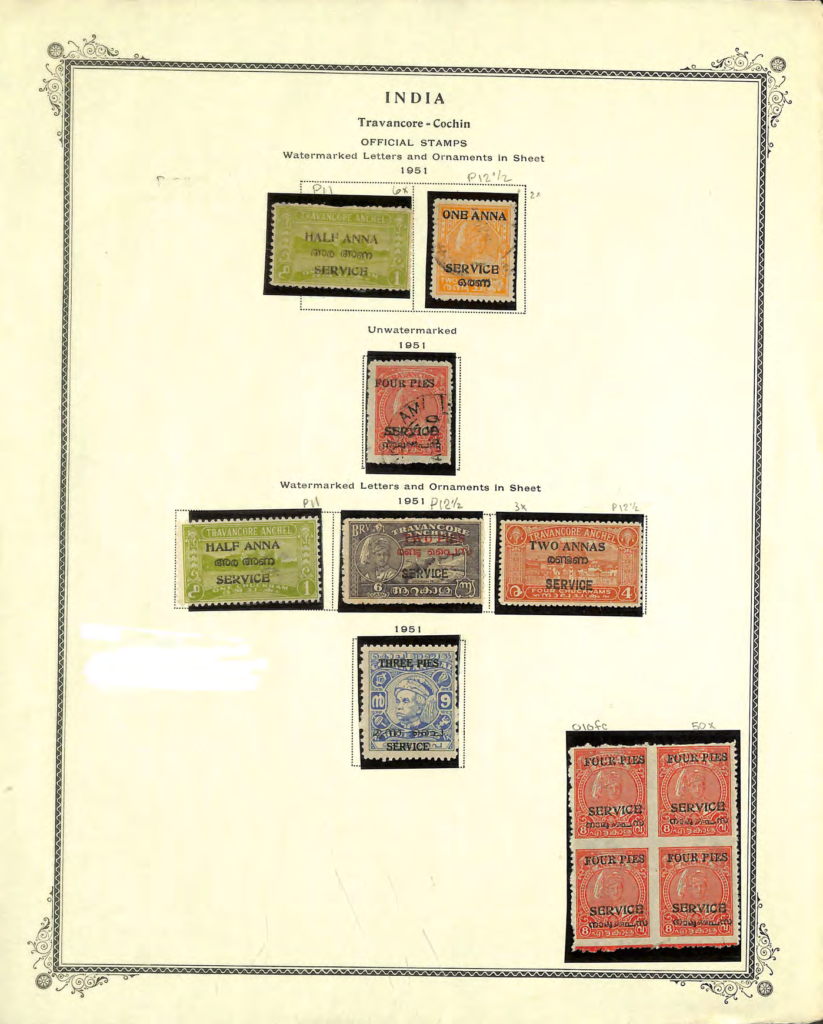
Two pages of a collection show the first Travancore-based official group beside the later applications, including the two pies on six cash and the three pies on nine pies on a Cochin base. The handwritten notes of perforation and watermark are the collector’s, not verified findings.[10]
Sources
- [2] William E. Steiner, India Feudatory States album, Travancore-Cochin pages, ordinary and official sections.
- [5] Frank M. Cowen and J. Devasya, “The Cochin Overprints, 1949”, The Collectors Club Philatelist, vol. 33, no. 2 (1954), pp. 100–104.
- [8] Christoph Gärtner, 17th auction, 7 March 2011, Travancore-Cochin lots 1642–1652, pp. 104 and 106.
- [10] Daniel F. Kelleher Auctions, sale 789, illustrated collection 876882.
- [13] Frank M. Cowen and J. Devasya, “Travancore-Cochin: Its Postage Stamps and Postal History”, The Collectors Club Philatelist, vol. 33, no. 1 (1954), pp. 9–26 (manufacture, pp. 16–26).
- [14] Frank M. Cowen and J. Devasya, “Travancore-Cochin”, The Collectors Club Philatelist, vol. 33, no. 2 (1954), pp. 89–99.
Notes 0
Add what you know: a cover or stamp in your collection, a date or source, a correction or a question.
No notes yet.
Sign in to add a note.
Notes show straight away. Keep them kind and about the article; anyone can report one that isn't. House rules
