
Centenary of Satish Gujaral
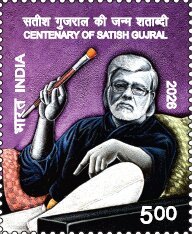
A Distinguished Creative Visionary
Satish Gujral was one of India’s most distinguished creative personalities—an acclaimed painter, sculptor, muralist, architect, and writer whose extraordinary body of work helped shape the artistic landscape of post-Independence India.
Born on 25 December 1925 in Jhelum, Punjab, British India (now in Pakistan), Satish Gujral belonged to a prominent Punjabi family. His father, Avtar Narain Gujral, held a high government position, while his elder brother, Inder Kumar Gujral, later served as the 12th Prime Minister of India. A severe hearing impairment during childhood limited his access to conventional education, leading him to turn to art as both a refuge and a powerful means of expression.
Artistic Journey
Gujral began his artistic training at the Mayo School of Arts, Lahore, in 1939, where he initially focused on applied arts. He subsequently studied at the Sir J.J. School of Art, Bombay. In 1952, he was awarded a scholarship to study at the Palacio de Bellas Artes in Mexico City. His experiences under renowned Mexican muralists had a profound influence on the development of his artistic vision.
Over a career spanning more than seven decades, Satish Gujral explored themes of displacement, suffering, resilience, and human endurance, drawing deeply from the trauma and experiences of the Partition of India. His remarkable body of work encompassed paintings, monumental sculptures, murals, public installations, and architecture.
His works were exhibited in major cities across the world, including New Delhi, Mumbai, London, Paris, New York, Tokyo, and several other international venues, establishing him as one of the foremost figures of modern Indian art.
Architecture and Legacy
Among his architectural masterpieces, the Embassy of Belgium in New Delhi stands as an internationally acclaimed landmark of twentieth-century modern architecture. The building exemplifies Gujral’s ability to seamlessly integrate art, architecture, and sculpture.
In recognition of his exceptional contribution to Indian art and culture, Satish Gujral received numerous national and international honours, including the Padma Vibhushan in 1999. His life and creative journey were further documented through books and retrospectives, most notably A Brush with Life, his acclaimed autobiography.
A Lasting Inspiration
A symbol of extraordinary resilience, imagination, and creative excellence, Satish Gujral transformed personal adversity into a universal artistic language that continues to inspire generations. His emotionally profound, socially conscious, and architecturally significant legacy remains an enduring contribution to India’s cultural heritage.
Centenary Commemoration
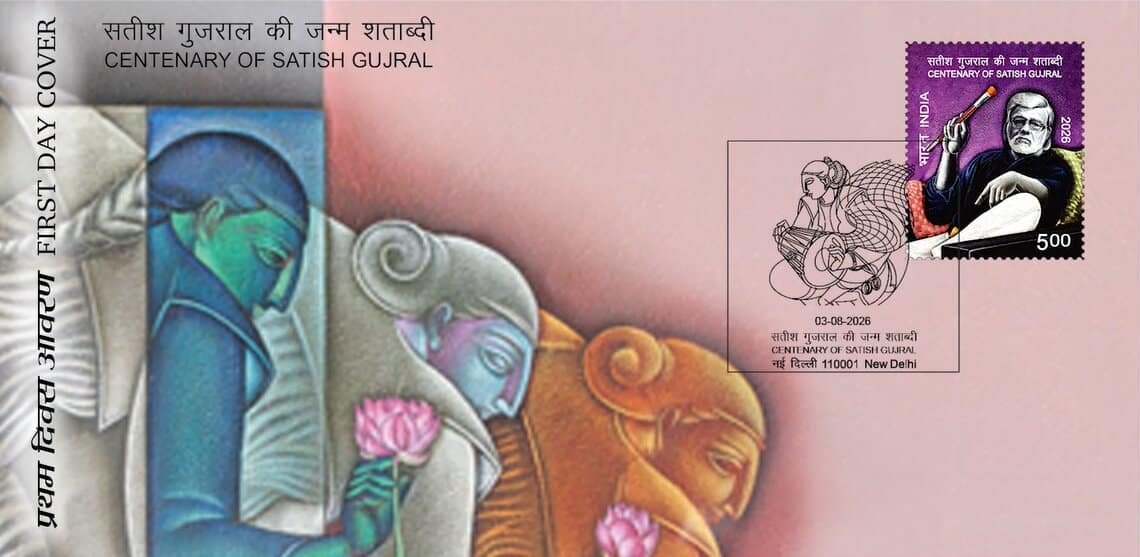
The Department of Posts is proud to issue a Commemorative Postage Stamp on the Centenary of Satish Gujral, celebrating the life, achievements, and enduring legacy of one of India’s greatest artists, architects, and cultural visionaries.
First Day Cover
Leave a Comment
You must be logged in to post a comment.