About this stamp
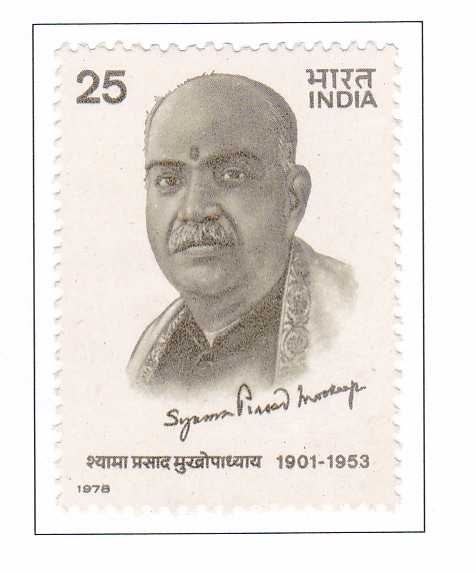
Born in Calcutta on July 6, 1901, Dr. Syama Prasad Mookerjee inherited a rich tradition of erudite scholarship, fervent nationalism, and fearlessness from his illustrious father, Sir Asutosh Mookerjee. Syama Prasad had a brilliant academic record and, though called to the Bar in 1927 from Lincoln’s Inn, he never practiced law. Instead, he became the youngest Vice-Chancellor of Calcutta University in 1934, a position he held until 1938. During this time, Calcutta University conferred upon him a D.Litt., and Banaras Hindu University awarded him an LL.D. in 1938.
Mookerjee began his political career in 1929 when he was elected to the Bengal Legislative Council. He became acting President of the All India Hindu Mahasabha in 1939 and served as the Finance Minister of Bengal in 1941. Despite being part of the government, he actively opposed British policies and resigned from the Bengal Ministry in 1942 in protest against the British government’s actions, particularly during the mass arrests of Congress leaders.
The Bengal famine of 1943 highlighted Mookerjee’s humanitarian efforts as he organized relief work on a massive scale. Although he was against the partition of India, when it became inevitable, he played a crucial role in ensuring that parts of Bengal and Punjab remained within India. On the invitation of Mahatma Gandhi, Mookerjee joined the first national government in August 1947. However, he resigned from the Central Cabinet in April 1950, disagreeing with the Nehru-Liaquat Pact of 1950, which outlined the treatment of minorities in both India and Pakistan.
After India’s independence, Mookerjee did not support the continuation of the Hindu Mahasabha in politics. When his views were not accepted, he resigned from the party’s executive committee. In October 1951, he founded a new political party, the Bharatiya Jana Sangh, and became its first president, dedicating the rest of his life to building the party.
Syama Prasad Mookerjee championed the cause of integrating Jammu and Kashmir with the rest of India. He was arrested in Srinagar and died in custody on June 23, 1953. His funeral in Calcutta saw an unprecedented outpouring of grief. Mookerjee’s life motto was “Country comes first,” and he lived up to this ideal, dying a martyr for the cause of his nation.
His death created a void in public life that was deeply felt, particularly in West Bengal, at a time when his leadership could have significantly impacted the region’s post-partition challenges. His legacy continues to influence India’s political, cultural, and educational spheres. The Post and Telegraphs Department feels privileged to issue a commemorative stamp in honor of this great son of India.
For More Information
Read more here: