About this stamp
On the Stamp
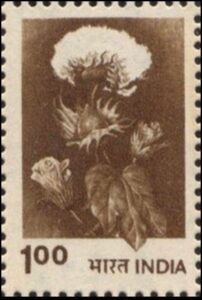
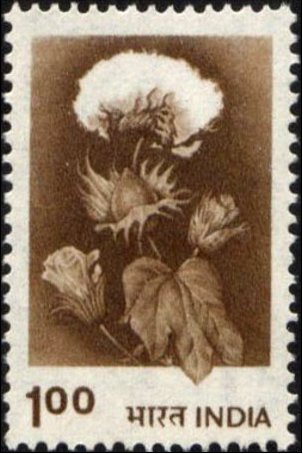
A cotton plant with an open boll of white fibre, a flower and a closed boll among the leaves, printed in dark brown, on a ₹1 stamp.
Hybrid Cotton
This ₹1 definitive stamp was issued on 17 June 1980, in the series of everyday stamps on rural India. It was printed by photogravure at the Security Printing Press, Nashik.
The word hybrid in its title points to a turning point in Indian farming. In 1970 Chandrakant T. Patel, a cotton breeder at Surat in Gujarat, released Hybrid-4, or H-4, the first cotton hybrid grown on a commercial scale. He bred it by crossing the Indian variety Gujarat-67 with an American nectariless cotton. H-4 gave more than twice the yield of Gujarat-67, with fibre of good quality, and was taken up by farmers in Gujarat and Maharashtra. Patel is remembered as the father of hybrid cotton.
Cotton has been grown in the region for thousands of years. Cotton thread found at Mehrgarh, in present-day Pakistan, goes back to the sixth millennium BC, and pieces of cotton cloth and spindle whorls have been found at Mohenjo-daro and other sites of the Indus Valley civilisation. India is now the largest producer of cotton in the world.
For More Information
Read more here: