
Patiala’s Post from the Runner Lines of 1860 to the Conventions of 1884 and 1900
The public runner post of 1860 and its Mansuri-paisa charges, the contractor Ganga Ram, the 1870 seal, the convention of 1884, Umballa and the accounts, the revised convention of 1900, the State offices of 1907 and the dated tariff.
Updated November 6, 2026
In this article
Before the overprinted stamp: the public post of 1860
The official Phulkian Gazetteer places an important change in Patiala’s post in Sambat 1917, which it gives as 1860, in the reign of Maharaja Narindar Singh. Until then the post had carried only official letters, taken by sowars and harkaras attached to the central offices. The reorganised service came under the munshikhana, described as the Foreign Office, and runner lines linked the thanas, where the public could now post private letters.[15]
The Gazetteer gives the charge as two Mansuri paisas a letter prepaid, or four unpaid, with no steps of weight or distance. The amounts stay in their own currency; turning them into annas would need other evidence. This is the Gazetteer’s later account of the service of 1860, not the original tariff or evidence for a particular cover.[15]
C. Stewart-Wilson describes an earlier contracted exchange: letters for British India were collected at Patiala and taken to the Imperial office at Rajpura. Negotiations for better exchange and money-order arrangements led to the convention system, so the overprint of 1884 was part of an administrative redesign, not a decoration added to an Indian stamp.[1]
The contractor and the link with British India
The Gazetteer names Ganga Ram as the contractor who appointed the runners and their sarbarahs, or overseers, with a salaried munsarim in charge. The runners answered to the Deputy Superintendents of Police, who collected the postage and sent it monthly to the treasury; after the State’s share under the contract had been taken, the rest went to the contractor. Postage was paid with British stamps bought at face value and sold by the contractor, and stamps used on public service were recorded and credited to him.[15]
Letters for British India went through Rajpura, where a clerk handed the stamped letters to the British post office and paid the usual rates; a clerk at Narnaul dispatched letters from British territory. These are reported connections, without a full route schedule or dates for each. Money orders, insurance and the other branches did not yet exist. A cover’s own transit marks are still needed to show its journey.[15]
The telegraph was a separate agreement
The Gazetteer records an agreement of 14 August 1872 for the British Government to build a single telegraph wire from Ambala through Rajpura to Patiala, estimated at Rs. 15,500. The Maharaja was to pay the actual cost of building and maintaining it, including the Patiala office, and the receipts were to be credited to the State under clause 6. That is the agreement, not the opening date of the line, and it says nothing about the route of any letter.[15]
The seal before the adhesive
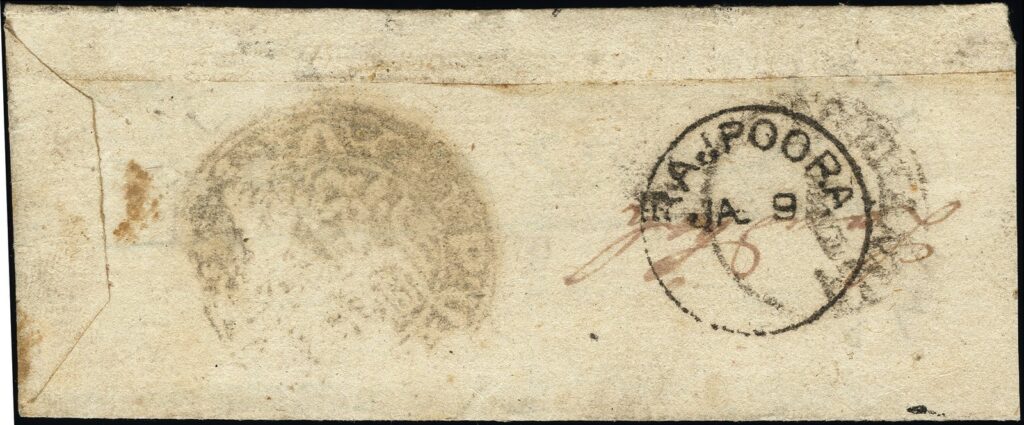
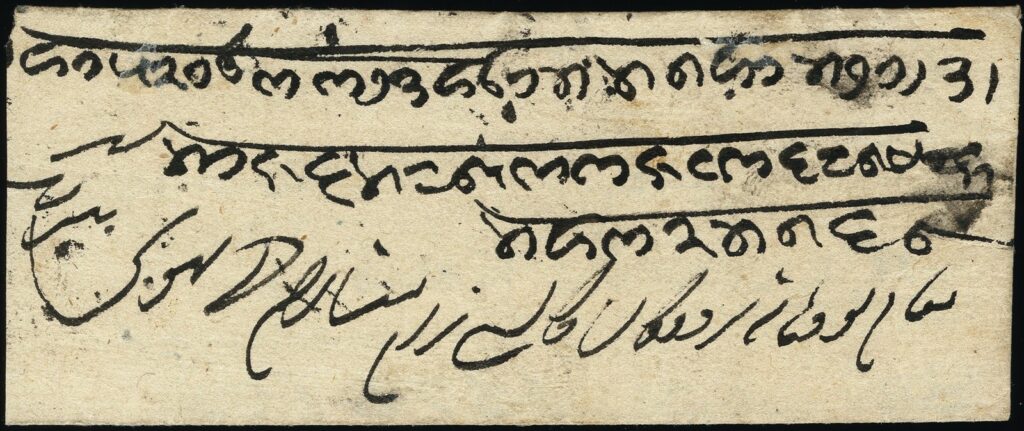
A cover to Amritsar dated December 1870 in Padgham’s study carries a Patiala postal seal. Its clearer impression corrected an older reconstruction: what had been read as a floral ornament is the English year 1870, and the Samvat year is 1927, not 1920. The centre inscription identifies the seal of the Patiala post office.[9][12]
An unclear strike had once been reconstructed as a device of 1863, and the reconstruction was copied into later books. The photograph of the 1870 cover shows an actual strike; the clean tracing beside it is an interpretation, and the older drawn block is described as inaccurate. Neither drawing is an original impression, and the year cut in the device is not the date of a later cover bearing it.[9][12]
Staffing the convention service
The Gazetteer records that Lala Hukam Chand and Lala Gaurishankar, both of the Punjab Postal Department, were lent to Patiala as Postmaster-General and Postmaster of Patiala to reorganise the State post when the convention was signed. Lala Raghbir Chand succeeded Hukam Chand as Postmaster-General in Sambat 1951, given as 1894. These are years for administrative changes, not dates of new stamps.[15]
The convention of 1884: Umballa, accounts and inland validity
The convention was signed for the Imperial post and Patiala on 15 September 1884 and ratified by the Viceroy on 3 October; neither date is the day the stamps were prepared or first used. A footnote records the ratification of similar conventions for Nabha on 23 March 1885, Jind on 3 June 1885, Faridkot on 30 November 1886 and Chamba on 4 December 1886.[7]
Articles 1–5 named the Imperial Post Office at Umballa (Ambala) and the Patiala State Office as the two exchange offices, the only ones allowed to handle articles that gave rise to accounts. Ordinary letters could move through the connected network, but money orders, parcels and other accountable business needed a traceable channel. The Government of India supplied the overprinted stamps and stationery at cost.[7]
Articles 9–12 treat fully paid and underpaid inland mail differently. Fully prepaid State mail was delivered in British India without further postage; unpaid or underpaid items were charged under the ordinary inland rules, the receiving post keeping the amount specified. The State could charge no more than the Imperial post. The convention sets the framework but prints no complete tariff, and the ceiling does not show what was paid on a particular letter.[7]
For foreign mail posted in the State, Article 15 required Imperial stamps without the Patiala overprint, and Article 20 required foreign parcels to be prepaid in cash. A foreign destination with a State stamp therefore needs explaining; inland validity did not extend worldwide. The convention limited the official stamps to State-service letters posted in Patiala, and the Imperial post’s recognition of State franking to inland mail posted within Patiala.[7]
Money orders, postal notes and the monthly settlement
Under the agreement of 1884 the issuing post kept the money-order commission, while the destination paid the full face value. The Government of India supplied postal notes stamped for the State, and monthly lists and the paid notes served as the accounts. The Imperial exchange office at Umballa drew up an account of credits and debits, and whichever post owed the balance paid it.[7]
The convention of 1900
The convention of 1900 again brought registered, insured and value-payable articles into the exchange, under the current Indian Postal Guide; the agreement of 1884 had already named these services in Article 1. Under the new Article 2, selected offices could exchange registered and unregistered letters and ordinary parcels, while insured and value-payable articles and money orders went through designated Offices of Exchange, which also kept the money-order accounts. Articles 22–23 name Delhi, Ferozepore and Umballa on the Imperial side, and print the State’s list as “Bazar, Narnaul, Govindgarh, Patiala”; that wording is kept as printed, not taken as a full list of offices.[7]
Article 24 required the post that took the sender’s money to account to the paying post for each month’s orders, plus half per cent of the monthly total. That is a settlement between administrations, not a half-per-cent fee to the public. Article 25 names Umballa for the monthly account current, separately from the exchange offices of Articles 22–23.[7]
The Patiala signatures, by members of the Administrative Committee acting for Maharaja Rajendra Singh, are dated 26 March 1900; the Director-General signed on 31 July, and the Government of India approved and confirmed the convention on 15 August. These are stages of the agreement, not new stamps or first days of operation.[7]
SERVICE stamps and a postal-service frank
Article 3 of the convention of 1900 specifies Indian stamps, postcards and embossed envelopes overprinted Patiala State, with SERVICE added for State business, the service forms to prepay State-service letters posted within Patiala. Article 4 ties recognition of the State overprint to inland mail posted inside the State. A government address alone does not identify the stamp or show that a letter qualified.[7]
A different rule applied to the posts’ own business. Article 7 let articles marked On Postal Service, franked with an officer’s signature and designation, pass free. A signed postal-service frank, a SERVICE stamp and an official letter paid with ordinary stamps are three different arrangements.[7]
The State offices in October 1907
The Indian Postal Guide of October 1907 is a check on office names. Its list of offices in Native States and foreign settlements includes Patiala, Patiala City and Patiala Ry. Stn., Barnala and Barnala R.S. separately, Chail, Dhuri, Narnaul and Rajpura Darbar Office, all described as outside the control of the Imperial Post. An asterisk means that an Imperial post office also existed at the place; Govindgarh, Dharmpur and Kot Fatta are Patiala examples.[16]
Names need checking against territory too. The same directory refers Bathinda to Govindgarh in Patiala State, while listing Mandi Gobindgarh under Nabha: these are not one office, and Bathinda is not an extra Patiala office. The directory gives the names current in that edition, not their opening dates, the attribution of a postmark or the route of a letter.[16]
| Printed name | State and kind of entry | Imperial office also there |
|---|---|---|
| Barnala | Patiala; office | Not marked |
| Barnala R. S. | Patiala; office | Not marked |
| Chail | Patiala; office | Not marked |
| Dhuri | Patiala; office | Not marked |
| Govindgarh | Patiala; office | Yes (asterisk) |
| Dharmpur | Patiala; office | Yes (asterisk) |
| Kot Fatta | Patiala; office | Yes (asterisk) |
| Bathinda | Patiala; cross-reference to Govindgarh | Not marked |
| Mandi Gobindgarh | Nabha; for comparison, not Patiala | Not marked |
| Patiala | Patiala; office | Not marked |
| Patiala City | Patiala; office | Not marked |
| Patiala Ry. Stn. | Patiala; office | Not marked |
| Narnaul | Patiala; office | Not marked |
| Rajpura Darbar Office | Patiala; office | Not marked |
A dated tariff: October 1907
The Guide of October 1907 names Patiala among the convention States. Clause 335 applies the inland rates and rules to letters and parcels exchanged either way between Imperial and State offices. For an inland letter, clause 51 sets half an anna up to one tola, one anna above one and up to ten tolas, and one anna more for every further ten tolas or part. Registration adds two annas (clause 107), and a special acknowledgement of delivery for an ordinary registered article normally one anna more (clause 112). These are the rates of that edition, not the dates they were introduced, nor a full tariff for every Patiala service.[16]
Where a letter was posted mattered as much as the rate. Clause 336 allows the State-overprinted stamps, cards and envelopes for mail posted within the State for delivery in British India, but refuses them when posted in an Imperial office or letter box. The directory’s distinction between State and Imperial offices is therefore essential when reading a cancellation, even where both posts served the same town.[16]
Money orders had their own scale. Clause 337 puts exchanges with State offices under the inland rules, and clause 257 limits a single order on Patiala to Rs. 500, not the general Rs. 600. The commission table in clause 258 charges one anna up to Rs. 5 and two annas above Rs. 5 up to Rs. 10; an order for exactly Rs. 100 costs Rs. 1. These public charges are separate from the settlement percentage between administrations in the convention of 1900.[16]
| Service or weight | Charge | Note |
|---|---|---|
| Letter up to 1 tola | ½ anna | Clause 51 |
| Above 1 and up to 10 tolas | 1 anna | Clause 51; the weight must be known |
| Each further 10 tolas or part | 1 anna more | Clause 51 |
| Registration | 2 annas more | Clause 107; postage still payable |
| Special acknowledgement of delivery | Normally 1 anna more | Clause 112 |
| Money order on Patiala | Rs. 500 at most | Clause 257, not the general Rs. 600 |
Postal revenue and the land-revenue cess
The Gazetteer also records a postal cess in Patiala’s land revenue, of one rupee in every hundred rupees of mal (pure revenue), dated Sambat 1949, with 1893 in the margin; its table gives Rs. 34,783 under Post. This was a cess collected with the land revenue, not a surcharge on letters, a money-order commission or the post office’s income.[15]
Sources
- [1] C. Stewart-Wilson, British Indian Adhesive Stamps Surcharged for Native States, Part II, Calcutta: Philatelic Society of India, 1898, Patiala chapter, pp. 63–79, and Official Documents XIV–XV, pp. 134–136.
- [7] C. U. Aitchison, A Collection of Treaties, Engagements and Sanads Relating to India and Neighbouring Countries, vol. I, The Punjab, the Punjab States and Delhi, revised to 1929: Patiala, including the postal conventions of 1884 and 1900.
- [9] D. C. Padgham, “Patiala—The Pre-Adhesive Seal”, Handbook of Indian Philately, India Study Circle, March 1970, reprinted 1982, leaves Patiala/1–2.
- [12] Heinrich Köhler, sale 384, Patiala lots 1665–1666.
- [15] Punjab States Gazetteers, vol. XVII A, Phulkian States: Patiala, Jind and Nabha, 1904, Lahore: Punjab Government Press, 1909, Part A, pp. 132, 136, 152–153, 167–168 and 182.
- [16] Indian Postal Guide, October 1907, Calcutta: Superintendent of Government Printing, 1907, pp. 21, 32–33, 162, 196 and 334–335.
Notes 0
Add what you know: a cover or stamp in your collection, a date or source, a correction or a question.
No notes yet.
Sign in to add a note.
Notes show straight away. Keep them kind and about the article; anyone can report one that isn't. House rules
