
Alwar’s Dagger Stamps of 1877: First Reports, the Design and a Legend
The blue quarter anna and brown one anna with a dagger, reported in Le Timbre-Poste in 1877, a mistaken nine-anna reading, the katar legend of 1905, and an alleged official and postcard.
Updated July 20, 2026
In this article
Two values for a local post
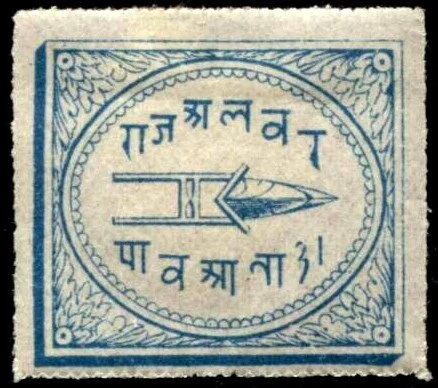
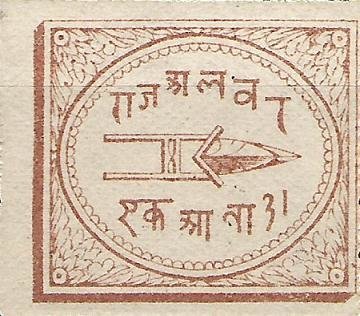
At first sight Alwar seems complete after two stamps: a blue quarter anna and a brown one anna, each with a dagger. Both original values show the dagger inside an inscribed oval with floral corners. The quarter anna reads PAO ANA and the one anna EK ANA. L. E. Dawson treats the small signs at the end of the inscription as part of the wording; they should not be read as an issue year.[1]
A notice is not an issue order
The blue dagger stamp was reported in Le Timbre-Poste in February 1877, without its value being identified. Dawson thought the one anna probably issued at the same time, and the brown value was reported by May 1877. These are dates of publication, not first days of issue. The rulers’ dates, the first notices and the end of the State post are three separate things.[1][A11]
The first reports, and their corrections
The February notice shows the blue stamp but does not identify its value. The editor thanks M. de Ferrari for the specimen and puts off reading the inscriptions. February 1877 is a well-documented report, not a proven first day, and not evidence that Ferrari made the stamp.[A11]
The next reports show how poorly the stamp was understood abroad. In March, de Rosny tentatively read the value as nine annas, and the journal printed the illustration turned on its side. By May it had corrected the blue value to a quarter anna and reported a brown one-anna companion. The nine-anna reading was a mistake, not another Alwar value.[A11]
In December the journal reported the meeting of the French philatelic society on 10 November 1877, at which Dr Legrand, following Maury, identified the dagger as Indian and confirmed the two values. These men interpreted the design; none is named as its designer, engraver or printer.[A11]
The February notice called the blue stamp percé en arc; the May report described both values as percés en lignes. These are descriptions of the time, not measurements, and without matching stamps they cannot show a change of equipment.[A11][A7]
The dagger and a later legend
The dagger can be identified from the stamp itself and from the early discussion. A more elaborate explanation went round in 1905: the Stanley Gibbons Monthly Journal and C. A. Howes repeated a legend, credited to The Philatelic Journal of India, in which Mairaj used a katar in an escape involving Kalodar Jhala. The same story repeated twice is one source, not two, and it explains the design as people later told it, not why an artist chose it.[A17][A20][1][A7]
Howes also read the signs at the end of the inscription as numerals and linked them with Samvat 1931, or 1875. Dawson and R. J. Benns later read them as words connected with the value. The early reading is superseded and gives no reason to date a stamp or the post to 1875.[A20][1][A7]
Catalogue numbers belong to their catalogues
The early dagger quarter anna reads PAO ANA and is identified as a quarter anna by Evans and Nankivell. The Stanley Gibbons family SG 1 lists steel-blue (SG 1), bright greenish-blue (SG 1a), ultramarine (SG 1b) and grey-blue shades (SG 1c). StampWorld shows its number 1 as a half anna, which conflicts with the inscription and is not followed. StampWorld 2, 3, 4, 5 and 5a and SG 4 are used for the later types.[A8][A9][7]
An oval seal reported as an official stamp
In October 1880 impressions of a small oval Alwar handstamp, set crosswise, were reported as official stamps. Moens also catalogued the device on envelopes and as an overprint on the quarter anna. Evans rejected this in 1898: he had ordinary stamps of both values cancelled by the same oval device, and regarded the loose impressions as curiosities made with a postal obliterator.[A8]
A loose seal impression, a handstamp cancelling a stamp and a printed stationery stamp are different objects. The black and blue impressions do not make an official issue, and no official stamps are added to the checklist.[A8]
The supposed postcard of 1878
Evans also discussed a supposed Alwar postcard sent to Le Timbre-Poste by Alwin Nieske in January 1878. It had a circular device at the upper right instead of a printed postcard heading, and Evans dismissed it as a fancy production. It belongs to the history of spurious stationery, not among Alwar postal cards. It should not be confused with Indian postal cards that passed through the State and received a genuine Alwar delivery or postage-due mark, described in the chapter on postmarks.[A8][A7]
Sources
- [1] L. E. Dawson, “Alwar: This Indian Feudatory State’s Postage Stamps”, The Collectors Club Philatelist, vol. 39, no. 3, May 1960, pp. 111–115 and 120.
- [7] StampWorld, Alwar, catalogue entries 2, 3, 4, 5 and 5a, checked 31 October 2026.
- [A7] R. J. Benns, Alwar, Handbook of Indian Philately, India Study Circle, August 1972, revised 1982.
- [A8] E. B. Evans, “The Stamps of Some of the Native States of India: Alwar”, Stanley Gibbons Monthly Journal, 30 November 1898, pp. 77–78.
- [A9] E. J. Nankivell, “The Countries of the World: Alwar”, Gibbons Stamp Weekly, 8 July 1905, p. 17.
- [A11] Le Timbre-Poste, 15th year (1877): February, no. 170, p. 9; March, no. 171, p. 21; May, no. 173, pp. 35–36; December, no. 180, p. 96.
- [A17] Stanley Gibbons Monthly Journal, 31 January 1905, p. 140, “Indian Native States: Alwar”.
- [A20] C. A. Howes, “Some Stamp Designs: Alwar”, American Journal of Philately, 28 November 1905, p. 390.
Notes 0
Add what you know: a cover or stamp in your collection, a date or source, a correction or a question.
No notes yet.
Sign in to add a note.
Notes show straight away. Keep them kind and about the article; anyone can report one that isn't. House rules
