
Who Ran Alwar’s Post: Councillors, the Reform of 1896 and the Stamp Dealers of Ulwur
Alwar’s Regency Council, the experimental reform of the Raj Dak in 1896 and Imperial criticism of it, the postmasters named in 1897, and Ram Gopal & Co., stamp dealers of Ulwur from 1891.
Updated October 28, 2026
In this article
The people named in Alwar’s records are mostly rulers, councillors and Imperial officials. None is known to have designed or made the stamps, and the men who ran the post day to day are almost all unnamed.
Rulers and councillors
The first stamps belong to Mangal Singh’s reign, but that does not tell us who ordered or drew them. Powlett records the Political Agent as president of the Council and names its members in September 1876. Thakur Mangal Singh of Garhi, a councillor, is not the ruler Mangal Singh of Thana. The redrawn stamps and the change of 1902 fell in Jai Singh’s minority; the Imperial Gazetteer dates his ruling powers to December 1903.[A13][A15]
| Person or institution | Role |
|---|---|
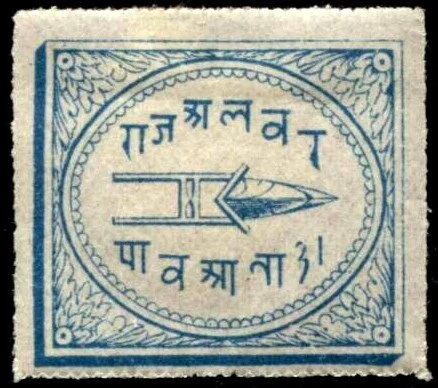
| M. de Ferrari | Sent the blue stamp to Le Timbre-Poste, February 1877 |
| M. de Rosny | Offered the mistaken nine-anna reading, March 1877 |
| Dr Legrand and Maury | Identified the dagger and the values, November 1877 |
| Major Thomas Cadell | Political Agent and president of the Council under the arrangement of December 1870 |
| P. W. Powlett | Settlement officer and author of the Gazetteer; acted for Cadell, April 1874–December 1875 |
| Pundit Rupnarain; Thakur Mangal Singh of Garhi; Thakur Baldeo Singh of Srichandpura; Rao Gopal Singh of Pal | Councillors in September 1876 (Rao Gopal Singh is not the later firm Ram Gopal & Co.) |
| Pandit Manphul | Guardian to the young ruler from March 1876 |
| Maharaja Mangal Singh of Thana | Chosen November 1874, seated 14 December; ruling powers 1877 |
| Maharaja Jai Singh | Succeeded 1892; ruling powers December 1903 |
| Munshi Kanji Mal | Inspector of schools; compiled a list of literature |
| Raj Press | Lithographed the poem Sheodan Bakht Bilas; no known stamp work |
| The Darbar | Accepted Imperial postal unity in 1902 |
The reform of 1896
On 14 May 1897 G. Barton Groves, Deputy Postmaster General, Rajputana, reported that he had discussed extending the Imperial post in Ulwar with Major Jennings, the Political Agent, and Rai Bahadur Balmokand Das, Chief Member of the State Council. Shortly before his visit a revision of the Raj Dak had been sanctioned as an experiment for one year, and further action was put off until its results were known. Groves criticised both the internal working of the Raj Dak and its connections.[A29]
The Imperial review for 1897–98 dates the reform more firmly. On 17 May 1898 the Deputy Postmaster-General reported that the Regency Council had introduced experimental measures to improve the Raj Dak in 1896, and had recently extended them for a limited time. He complained that Imperial articles handed to the Raj Dak for delivery were often delayed or mis-sent, and that many came back undelivered: his assessment of the link between the two posts, not of the whole State service.[A38]
A year later, in his review dated 10 May 1899, Groves wrote that there had been no improvement in the Raj Dak’s connection with the Imperial post. He did not say the experiment had ended. The review of 10 May 1900, on famine and postal unity, names Bikaner, Kotah, Kishangarh, Jhalawar and Dhar, but not Alwar. The Council’s orders, the terms of the reform and its outcome have not been found.[A38]
Rao Bahadur Munshi Balmokand Das compiled the State report for 1896 as a member of the State Council; it was printed at the Pioneer Press, Allahabad, which tells us nothing about who printed the stamps.[A28]
Imperial officials, not Alwar postmasters
W. T. van Someren, Deputy Postmaster-General, Rajputana, wrote the postal review of 1902–03. Stewart-Wilson was the informant behind The Philatelic Record’s notice of September 1902. Elliot Graham Colvin was officiating Postmaster-General of Bengal from July 1890 and Political Agent at Ulwar from November 1896, two different appointments. None of them is known as an Alwar postmaster or signed Alwar’s postal agreement.[A33][A34][A39]
Other names that turn up in searches belong to other work: Captain L. Impey (Political Agent in 1901), Lt.-Col. H. N. V. Harington (medical charge), Lieutenant R. L. Ricketts (guardian to the Maharaja), and the settlement officers M. F. O’Dwyer and the Munshis Gauri Shankar, Amar Singh and Ralla Ram.[A39][A40]
Three postal names in 1897
Thacker’s Directory for 1897 names, under Ulwar, a postmaster whose name reads Baghubur or Raghubur Dyal, a city postmaster Durga Shank…r (the end of the name is unclear) and a head clerk, Kanwar Sen. The figure 50 follows the postmaster’s name, without currency or period. They are listed under Government Offices, separate from State Officers, and the entry does not say whether they served the Raj Dak or the Imperial post. The directory’s list of post offices of the Rajputana circle includes Ulwur and Ulwur City.[A48]
The same page lists Rao Munshi Balmokand Dass Bahadur on the Council of Regency and Major R. H. Jennings as Political Agent, and G. Barton Groves appears elsewhere in the directory as Deputy Postmaster-General, Rajputana.[A48]
Ram Gopal & Co., stamp dealers of Ulwur
The 1897 directory lists, under Commercial, a firm whose name reads Rumgopal & Co., dealers in stamps and coins and commission agents, with Lala Balmukund as proprietor. The similar names do not make him the councillor Balmokand Das, and the reading Rumgopal is not certain.[A48]
Six years earlier, the International Philatelic Union’s September report, printed in The Philatelic Journal of Great Britain on 1 October 1891, lists Messrs. Ram, Gopal & Co. of Ulwur as candidate 221, proposed by S. F. Bickers, the Union’s secretary and treasurer, of 5 Hill View, Clifton, Bristol. Candidates had to be over eighteen, give two satisfactory references and pass fourteen days without objection; the page records the proposal, not the firm’s admission.[A50]
Peter Congreve’s study of 2026 reconstructs the firm’s correspondence from 1894 to 1949. The January 1905 Stanley Gibbons Monthly Journal records Ram Gopal & Co. showing the editor a one-anna pair (described in the chapter on printing).[A49][A17]
Where the staff records may be
No list of the State post’s runners, peons, Sudder postmaster or superintendent, and no payroll, has been found. The Rajasthan State Archives describes records in English and Rajasthani at its Alwar district office covering 1872–1965, the place to look for establishment returns, pay bills or appointment orders.[A41]
Sources
- [A11] Le Timbre-Poste, 15th year (1877): February, no. 170, p. 9; March, no. 171, p. 21; May, no. 173, pp. 35–36; December, no. 180, p. 96.
- [A13] P. W. Powlett, Gazetteer of Ulwur (1878), pp. 25–26, 74, 100–101, 114.
- [A15] Imperial Gazetteer of India, new edition, vol. V (1908), Alwar, pp. 259, 263–265.
- [A17] Stanley Gibbons Monthly Journal, 31 January 1905, p. 140, “Indian Native States: Alwar”.
- [A28] Rao Bahadur Munshi Balmokand Das, Report on the Administration of the Ulwar State for 1896 (Allahabad: Pioneer Press, 1897), pp. 9, 81.
- [A29] Report on the Political Administration of the Rajputana States for 1896–97, postal review No. 418-C, dated 14 May 1897, pp. 134–135, 141.
- [A33] Report on the Political Administration of the Rajputana States and Ajmer-Merwara for 1902–1903, Foreign Department Selections No. CCCCX, serial no. 145 (Calcutta, 1904), postal report pp. 38–40.
- [A34] “The Imperial Post of India”, The Philatelic Record, vol. 24, no. 9, September 1902, p. 195.
- [A38] Reports on the Political Administration of the Rajputana States for 1897–98, 1898–99 and 1899–1900 (Calcutta, 1898–1900): postal reviews dated 17 May 1898, 10 May 1899 and 10 May 1900.
- [A39] The India List and India Office List for 1901 (London: Harrison and Sons, 1901), pp. 33–34, 410.
- [A40] M. F. O’Dwyer, Assessment Report of Tahsils Tijara, Bahror, Mandawar, Rajgarh and Katumbar, Alwar State (1898–99) (Calcutta, 1905).
- [A41] Rajasthan State Archives, District Archives office Alwar: records of 1872–1965.
- [A48] Thacker’s Directory (1897), Ulwar, Rajputana, p. 1049, and the list of Indian post offices.
- [A49] Peter Congreve, “From Alwar to the World: Reconstructing the Network of Ram Gopal & Co., 1894–1949”, History in the Mail, 5 April 2026.
- [A50] The Philatelic Journal of Great Britain, 1 October 1891, p. 152: International Philatelic Union, September report.
Notes 0
Add what you know: a cover or stamp in your collection, a date or source, a correction or a question.
No notes yet.
Sign in to add a note.
Notes show straight away. Keep them kind and about the article; anyone can report one that isn't. House rules
