
Orchha’s State Post: Tikamgarh, Police Stations and Runners
How Orchha’s Darbar post worked from 1895: offices at the police stations, a runner line to Nowgong, seventeen State offices, and a schoolmaster who was postmaster for two posts.
Updated August 25, 2026
In this article
The capital behind the postmark
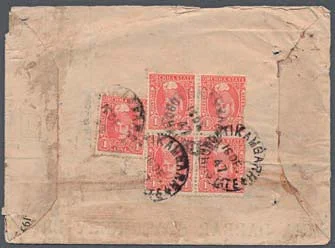
Tikamgarh is the town to look for on many Orchha covers. The old capital, Orchha on the Betwa, gave the state its name, but the postal administration of the early twentieth century was centred on Tikamgarh. The place in a cancellation and the state named on a stamp need not be the same.[1][3]
Regular post offices from 1895
Captain C. E. Luard’s Eastern States Gazetteer of 1907 dates the opening of regular Darbar post offices to 1895. Postal centres were set up at the police stations and runners were appointed. The Gazetteer counts sixteen State offices, alongside Imperial offices at Tikamgarh, Jatara and Baldeogarh. This is the date of an administrative arrangement, not of the issue or first use of any Orchha stamp.[11]
Two postal systems in 1906
The Philatelic Journal of India of October 1906 describes the two systems at work. Imperial postmen delivered through Tikamgarh, Buldeogarh and Jatara. State offices accepted and delivered ordinary unregistered letters posted within the State for delivery inside it, and Darbar correspondence went free. A State runner line connected Tikamgarh with Nowgong.[12]
The journal lists seventeen State offices, given below as printed. The Gazetteer’s total of sixteen differs, and neither source explains why; a closure, a new office or a different way of counting cannot safely be assumed.[12][11]
| No. | Office |
|---|---|
| 1 | Orchha |
| 2 | Buldeogarh |
| 3 | Jatara |
| 4 | Manjna |
| 5 | Lidhora |
| 6 | Digora |
| 7 | Pirthipur |
| 8 | Mohangarh |
| 9 | Banihori |
| 10 | Tahrauli |
| 11 | Palera |
| 12 | Chuli |
| 13 | Bajna |
| 14 | Baragaon |
| 15 | Partapganj |
| 16 | Newari |
| 17 | Malpitta |
This is an administrative list, not a census of seventeen cancelling devices. Tikamgarh is not among the seventeen, although the runner route started there and its Imperial office is named; it should not be added quietly as an eighteenth State office.[12]
Schoolmasters and police in the postal network
Local staff could serve more than one institution. At Baldeogarh the schoolmaster also did the postmaster’s work for both the Imperial and the State offices. The Gazetteer lists State offices at Baldeogarh, Baragaon and Majna. In Orchha tahsil, where it records no Imperial office, the State dak was managed by the police. Postal work was spread among existing local officials, though not necessarily in the same way at every office.[11]
No tariff is known
No Orchha postage, registration or parcel rate has been found in figures in these sources. The rates of neighbouring Bhopal and Bikanir belong to those states and should not be borrowed. A franking of four or five annas cannot by itself identify an Orchha rate: a dated cover needs both its sides, its weight and the regulations of its day before its stamps can be called a rate.
The 1906 source connects Tikamgarh and Nowgong by a State runner line. The roads and railways in the Gazetteer do not by themselves give every mail route, so keep the exact dates and both faces of each cover.[12][11]
Sources
- [1] H. D. S. Haverbeck, “The Postage Stamps of Orchha,” The Congress Book 1964, 30th American Philatelic Congress (1964), pp. 33–42.
- [3] Encyclopædia Britannica, 11th edition (1911), “Orchha”, historical geographical entry.
- [11] Captain C. E. Luard, Eastern States (Bundelkhand) Gazetteer, vol. VI-A: Text, Central India State Gazetteer Series. Lucknow: Newul Kishore Press, 1907.
- [12] “Notes on the Postal Arrangements in some of the Native States”, The Philatelic Journal of India, vol. X, no. 10, October 1906, pp. 218–227 (Orchha, pp. 219–220).
Notes 0
Add what you know: a cover or stamp in your collection, a date or source, a correction or a question.
No notes yet.
Sign in to add a note.
Notes show straight away. Keep them kind and about the article; anyone can report one that isn't. House rules
