
King George VI: The High Values, One to Twenty-Five Rupees
Six two-colour rupee values with the new portrait in the elephant design, and the small missing-pearl faults found under several countries’ overprints.
Updated June 15, 2026
In this article
The elephant design continues
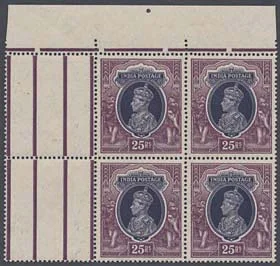
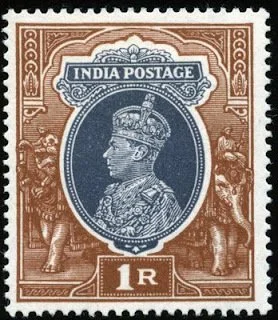
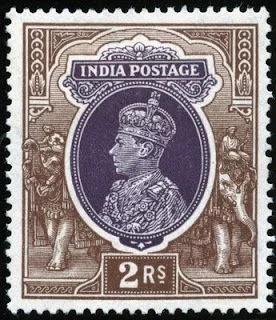
George VI’s rupee definitives kept the upright elephant format that had set the previous reign’s high values apart. The new crowned portrait faces left under a canopy-like inscription, with elephants on either side of the oval and a large value tablet below. This deliberate continuity contrasts with the striking redesign of the middle values.[1][2][5]
The official album of 1954 shows 1, 2, 5, 10, 15 and 25 rupees as one group. Meik’s preview of July 1937 says the high-value designs were being sent for royal approval and would have richer colour pairs; it is a preview, not proof that all six were on sale when it was published. The album gives the finished set; individual first days are not known from these sources.[1][2][5]
The six two-colour stamps
Printing in two colours separates the King’s head from the ornament around it, while the value tablet stays prominent. The 1 rupee is generally a grey portrait in a reddish-brown frame, the 2 rupees purple and brown, the 5 rupees green and blue, and the 10 rupees purple and claret. The 15 and 25 rupees complete the series in contrasting brown and green, and violet shades.[1][3][6][7]
Old descriptions do not always give the colours in the same order: some put the frame first, others the portrait. The table names the parts, so that reversed wording does not turn into an apparent new shade. A colour picture shows the broad scheme and the value, but not small differences of ink or chemical change in a single stamp.[1][3][6][7]
| Value | Portrait and frame | Recorded in |
|---|---|---|
| 1 rupee | Grey and reddish brown | The March 1938 report |
| 2 rupees | Purple and brown | The March 1938 report |
| 5 rupees | Green and blue | The March 1938 report |
| 10 rupees | Purple and claret | The March 1938 report |
| 15 rupees | Brown and green | The full plate of the official album |
| 25 rupees | Dark purple and violet | The full plate of the official album |
A snapshot from 1938
The South African Philatelist of March 1938 lists the 1, 2, 5 and 10 rupees with the new George VI portrait, typographed, on multiple-star paper, perforated 14, describing them as the earlier high-value design with the new head. That supports the main features shown in the official album.[3][1]
The four-value snapshot does not mean the 15 and 25 rupees never existed, and the six-value album should not be read back into the 1938 report: the two sources work at different dates. A collection page can show the early report separately from the finished family and leave first days blank where they are not known.[3][1]
The two rupees with missing pearls
Richard Lockyer, writing in 2001, describes two recurring missing pearls around the value tablet of the 2 rupees. One is at the centre of the upper row, between the 2 and Rs; the other is the second pearl from the left in the lower row. They are local faults in the ornament, not missing parts of the portrait or an error of value.[4]
Lockyer quotes a report of 31 March 1945 listing the affected positions in the sheet of six panes, each of four rows of five. Several positions are affected, so “missing pearl” does not point to one unique position. The positions below are from Lockyer’s account of that report.[4]
Where the missing pearls were reported
Each pane has four rows of five stamps. The positions below are row and column within the named pane, not one numbering across the whole sheet of 120 stamps, which matters when matching a marginal block. There are seven reported positions for the upper-centre pearl and six for the lower-row pearl; always keep the pane name with a position, since R 3/4 alone would point to more than one stamp.[4]
| Missing pearl | Pane | Positions in the pane |
|---|---|---|
| Upper row, centre | Top right | R 3/4 |
| Upper row, centre | Centre right | R 1/4; R 3/4 |
| Upper row, centre | Bottom right | R 2/3; R 2/5; R 4/3; R 4/4 |
| Lower row, second from left | Top left | R 3/4; R 4/5 |
| Lower row, second from left | Top right | R 3/2 |
| Lower row, second from left | Centre left | R 1/2; R 2/2 |
| Lower row, second from left | Bottom right | R 4/1 |
The same fault under other names
Lockyer reports the missing pearls on stamps overprinted for Bahrain, Muscat, Pakistan and Patiala as well. That is a lesson in the order of production: a territorial or official overprint could be printed on an Indian stamp that was already flawed. The overprint makes a new administrative form, but does not mend the pearl underneath.[4]
Comparing across territories can therefore help: a clear value tablet on a well-kept overprinted stamp may settle the same feature on an Indian one. The overprint still has to be authenticated on its own, and a genuine plate fault does not make a doubtful country name genuine.[4]
Use, condition and the limits
These high values also exist with the SERVICE overprint for government use, though the official range should not be assumed to match the six ordinary values. A high value could pay large combined postal charges or other authorised transactions, and its face value alone does not say which. Complete mail with an official endorsement, registration or other markings keeps the evidence a loose stamp loses.[1][4][3]
Every paper, overprint and proof state, covers with the 15 and 25 rupees, and study of whole sheets are still to be done.[1][4][3]
Sources
- [1] Indian Posts and Telegraphs Department, India Postage Stamp Centenary 1854–1954: Souvenir Album (1 October 1954), plates 7–17 and printed commentary pp.2–4.
- [2] D. C. Meik, “Introduction to the New Indian Stamps”, Stamp Collecting, 31 July 1937, pp.629–630.
- [3] The South African Philatelist, January 1938 pp.12–13, March 1938 p.45 and May 1938 p.68.
- [4] Richard Lockyer, “King George VI Varieties, Part 62—More Odds and Ends”, Gibbons Stamp Monthly, November 2001.
- [5] Auktionshaus Christoph Gärtner, India: Park Collection, 7 March 2011, lots 207 and 209.
- [6] Wikimedia Commons, Post of India stamp scan: George VI 1 rupee elephant definitive.
- [7] Wikimedia Commons, Post of India stamp scan: George VI 2 rupees elephant definitive.
Notes 0
Add what you know: a cover or stamp in your collection, a date or source, a correction or a question.
No notes yet.
Sign in to add a note.
Notes show straight away. Keep them kind and about the article; anyone can report one that isn't. House rules
