
King George V: The Elephant High Values, One to Twenty-Five Rupees
Elephant supporters, six two-colour rupee values from 1913, and the difference between an impressive high value and evidence of postal use.
Updated June 26, 2026
In this article
A design apart
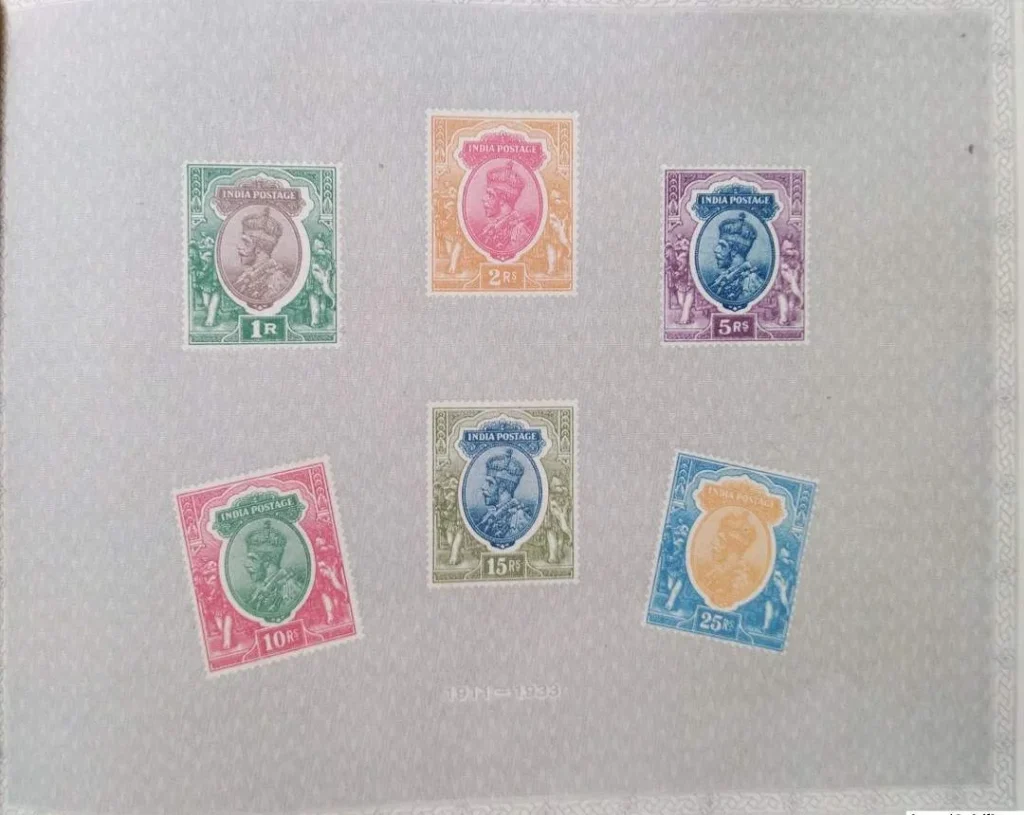
The George V rupee stamps were designed to stand apart from the everyday annas. A larger upright format surrounds the crowned imperial portrait with elephant supporters, an ornamental canopy and a large value tablet below. They continue the tradition of the high values with a new head and a carefully balanced frame; Clarke, writing in 1921, singled out the elephant design for praise.[1][2][3]
The six values, from 1 rupee to 25 rupees, were issued from 1913. The low values’ first appearance in 1911 is not the date of this group, and the official album’s broad label of 1911–1933 places them in the reign’s sequence without making every value, paper and overprinted form contemporary.[1][2][3]
Six values and their colours
The ordinary high values are 1, 2, 5, 10, 15 and 25 rupees. There is no need to fill the gaps with supposed George V 3 or 4 rupee stamps: the values cover the range of higher charges, not every step. All six are printed in two colours, which sets the portrait apart from the frame of architecture and elephants.[1][3]
The official album makes a useful comparison of the group. The colours in a scan are approximate, but the pairings can be read. The table gives the broad appearance, portrait colour first where it is clear; it does not claim every named shade or an exact ink.[1][3]
| Value | Portrait and frame | Value tablet |
|---|---|---|
| 1 rupee | Brownish portrait; green frame | 1 R |
| 2 rupees | Rose portrait; orange or brown frame | 2 RS |
| 5 rupees | Blue portrait; violet frame | 5 RS |
| 10 rupees | Green portrait; rose or red frame | 10 RS |
| 15 rupees | Blue portrait; olive frame | 15 RS |
| 25 rupees | Orange portrait; blue frame | 25 RS |
London and Nasik papers
The high values also crossed from London to Nasik, and the same design can be found on different watermarked papers. The official centenary account says the single-star paper gave way to multiple-star paper when Indian printing began. Describe the paper; do not guess the printer from the frame.[1][4]
A large stamp can make a partial watermark easier to read, but mounts, heavy hinges and backing paper can still hide it. Note the orientation and the part you can see. First issue, later printing and late use are three different dates, and an early paper on a late letter is quite compatible with stock remaining on sale.[1][4]
Postage and telegrams
A high face value does not mean a high postal rate. Clarke explains that the 10, 15 and 25 rupees had first been added in Edward VII’s reign, when postage stamps began to be used to pay for telegrams. George V inherited a system in which postage stamps paid charges far beyond the letter post, so a cancellation or pen mark must be understood before a stamp is called postally used.[2][1]
A complete cover can support a postal reading through its address, registration or insurance marks and how all its stamps add up to the charge. A loose high value may keep only part of the story. This matters in an exhibit that sets out to explain use rather than show an expensive-looking set.[2][1]
SERVICE values and the reductions of 1925
The elephant designs were also used for official stamps. Giles explains that a policy decision capped the new SERVICE range at 10 rupees, leaving large stocks of higher official values to be reduced to lower values. His study of 1962 follows the proposed and adopted One Rupee and Two Rupees surcharges, including those on the George V 15 and 25 rupees. These were part of managing the official stock, not a new ordinary series.[5]
Record the ordinary stamp, the SERVICE overprint and any surcharge as separate layers. A 15 rupees overprinted One Rupee has a new value; a plain SERVICE overprint changes who may use the stamp without changing its value. This keeps the look-alike elephant stamps from being classified by the original tablet alone.[5]
Proofs, and what is still to be done
Keppel shows or discusses design and colour proofs, including trials in the placing of the elephants, which explain how the final design developed. A colour unlike the issued stamp is not enough to identify an essay, though: fiscal staining, fading and chemical change can alter an issued stamp too. Provenance matters most for trial colours and proofs on paper or with a finish unlike the postal stock.[3][1]
High-value postal covers, every trial colour, and the full list of plate and watermark combinations would carry this study further.[3][1]
Sources
- [1] Indian Posts and Telegraphs Department, India Postage Stamp Centenary 1854–1954: Souvenir Album (1 October 1954), plates 7–17 and printed commentary pp.2–4.
- [2] Geoffrey Clarke, The Post Office of India and Its Story (London, 1921), chapter XIX, “Indian Postage Stamps”, pp. 183–184.
- [3] Adrian Keppel, “Emperor of India: India 1910–36”, Stamp Magazine, June 2010, pp.42–47.
- [4] Ian Lawrence and W. H. Northam, “India: A Study of the Nasik Printings”, The Stamp Magazine, July 1942, pp.206–207.
- [5] D. Hammond Giles, Essays of the India Provisionals of 1925, Philatelic Society of India, Bombay, 1962.
Notes 0
Add what you know: a cover or stamp in your collection, a date or source, a correction or a question.
No notes yet.
Sign in to add a note.
Notes show straight away. Keep them kind and about the article; anyone can report one that isn't. House rules
