
British India’s Railway, Travelling and Sea Post Offices
Mail guards and closed bags, the first travelling post offices of 1863–64, sorting at sea between Bombay and Suez from 1868, and the move ashore in August 1914.
Updated November 1, 2026
In this article
A mail guard did not necessarily sort the letters
Clarke (chapter VI, pp. 58–70) explains the first arrangement on the railways: closed packets and bags travelled with the guard or a separate mail guard, and every office had to make up packets for many offices down the line. As traffic grew, the number of packets and the delays at the exchange stations became unmanageable.[1][2]
Shenoi (pp. 100–101) describes the railway mail guards from 1854 on, and explains that they were mainly custodians. His illustrations include the marks of mail agents and railway offices. A railway handstamp must therefore be read for what it records: carrying, sorting and receipt at an office are different activities.[1][2]
Two dates worth keeping
Clarke says a sorting section was set up between Allahabad and Cawnpore in 1863. Shenoi gives 1 May 1864 for the first travelling post office on that route, and explains the letters AC as Allahabad–Cawnpore. The two may describe different stages of an experimental and then an organised service; the sources do not settle it.[1][2]
Clarke dates the regular organisation of the travelling post offices to 1870 and records later changes of supervision. Shenoi (p. 102) says the East Indian Railway’s TPO was given the distinguishing letter T in 1873. An office code, a route and a date tell much more together than an abbreviation read without its period.[1][2]
The Bombay–Suez sorting office
Clarke (chapter XIV, pp. 127–136) records the experimental Indian sea-sorting staff of 1868: six sets, each of a head sorter, a sorter and two packers, for fifty-two voyages a year in each direction between Bombay and Suez. The report of 1870 led to the service being made permanent. Mail that arrived ready sorted avoided about six hours’ delay at Bombay — sometimes the difference between catching and missing a day’s onward connection.[1]
In 1890 the run was shortened to Aden–Bombay, because the shipping arrangements included transhipment at Aden every other week. A Sea Post Office strike therefore needs its date and the working arrangement of its time; the words alone do not show a journey between Bombay and Suez throughout the period.[1]
A sea-office mark can look like a land-office type
Danby (p. 113) records squared-circle forms used by the Bombay–Karachi Sea Post Office and discusses a divided Bombay/Karachi place-name, using the size of the circle and the divider between the two names as evidence. Classifying by the general outline alone would miss the difference in how the office worked.[3][1][2]
For a cover, copy the exact route wording and date, compare the transit marks beside it, and keep the identification of the device apart from any claim about a particular train or ship. What is known here is the published organisation and some examples of marks, not a full dictionary of RMS section codes or a calendar of sailings.[3][1][2]
| Operation | What it did, and where | Caution |
|---|---|---|
| Railway carriage in closed bags | Custody and exchange | Does not show sorting on the way |
| Travelling post office | Sorting while travelling | Read the route code and the date together |
| Sea sorting, experiment of 1868 | Bombay–Suez | Six sets working in turn, as Clarke reports |
| Sea sorting after the change of 1890 | Aden–Bombay | Do not project the earlier run onto all later mail |
A travelling section worked in rotating sets
Shenoi (pp. 103–104) stresses that the early TPOs were sorting offices on the move, not just ordinary post offices on wheels. He describes sections of about 200 miles, with sets of sorters who could work outward one day, return the next and rest on the third. A set identifier can therefore refer to the crew or its turn of duty within a section.[2]
He also illustrates a range of T, RMS and travelling-office forms. A letter or numeral on such a mark belongs to its own scheme and need not be the train’s public timetable number; codes could change while the route stayed the same. Keeping the whole impression and its date is more useful than expanding an abbreviation from memory.[2]
Late fees belong to the time of posting
Shenoi explains how growing volumes of mail led to stationary transit and sorting offices that supported the TPOs. Mail reaching the sorters just before departure caused a bottleneck, so a late fee was charged, and a letter whose fee was not paid was held for the next mail. That is a separate part of the service from ordinary postage by distance or weight.[2][3]
Danby’s later correction of a supposed Howrah late-fee cancellation shows the danger of treating any suggestive fragment as proof of the charge. A late fee should be read from the mark itself, the rule that applied and, where possible, the franking — not assumed because a cover went by a fast train.[2][3]
August 1914 moved the work ashore
Clarke gives two exact dates: sorting of homeward mail on shore began on 15 August 1914, and the last inward mail sorted on board reached Bombay on 27 August. Irregular wartime sailings and the loss of space for the sorters forced the change, so not every sea-related mark of the war years stands for sorting on board.[1]
He describes the later arrangement at Ballard Pier, where about 150 sorters opened and made up the mails for special trains. The sea journey went on, but the way its mail was sorted changed: the history of a route and the history of the office handling its mail are related, but not the same.[1]
The back of a letter shows a stage on the way
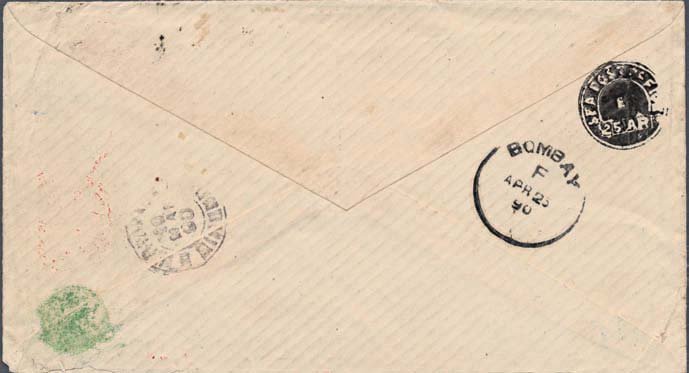
Gärtner’s lot 406 is described as a letter of April 1890 from Calcutta to Bordeaux, with a pair of one anna six pies and a Calcutta squared circle on the front. The photograph of the back shown here has a Bombay transit and an intaglio SEA POST OFFICE mark, which the catalogue reads as E, 25 April; the catalogue also describes a later Paris transit or arrival mark.[4]
Only the back is shown, so the franking and the dispatch mark are as described by the catalogue. The letter shows how a sea-office mark belongs to a stage in the middle of the journey, beside a transit mark on shore, rather than replacing the letter’s origin or destination.[4]
Sorting at sea included accounts and postage due
Clarke’s account of 1908 puts about 150,000 ordinary articles, 7,000 registered items and 6,000 unpaid articles through each Aden–Bombay voyage. The unpaid articles had to be examined and charged. Sorting at sea was more than grouping letters by town: registration and postage-due accounts could leave their own marks and notes.[1]
He says that by 1908 the three sets had grown to 29 men each: an assistant mail officer, 15 sorters and 13 packers. Those figures describe that organisation in that year, not every ship or the earlier staff of six sets. They help explain why an apparent transit strike may come with an accounting mark, and why the eventual move ashore answered a real problem of capacity.[1]
Sources
- [1] Geoffrey Clarke, The Post Office of India and Its Story, John Lane/The Bodley Head, London, 1921, chapter VI, pp. 58–70, and chapter XIV, pp. 127–136.
- [2] Col. L. G. Shenoi, “Travelling Post Offices”, India-80, pp. 99–104.
- [3] G. C. Danby, “The Indian ‘Squared Circle’ Cancellation”, India’s Stamp Journal, April–September 1960, pp. 79, 81, 111, 113, 141, 143, 151, 153 and 213 (with the September corrections).
- [4] Auktionshaus Christoph Gärtner, India: Park Collection, auction catalogue, 7 March 2011, lot 406 (photograph of the back p. 51, description p. 81).
Notes 0
Add what you know: a cover or stamp in your collection, a date or source, a correction or a question.
No notes yet.
Sign in to add a note.
Notes show straight away. Keep them kind and about the article; anyone can report one that isn't. House rules
