
Reading a British India Cover: The Journey and the Franking
Read an envelope as a series of postal actions, then test that series against the stamps: origin and transit, registration fees paid in cash, and censor labels.
Updated July 10, 2026
In this article
Where a letter was posted and where it passed through
The address gives the intended destination; the dispatch cancellation shows that the post accepted or handled the letter; a transit mark records a stage on the way; a delivery mark records another. Any of them can be on either side. A clear town name on the back is not necessarily the place where the sender posted the letter.[3]
Shenoi’s article on travelling post offices (p. 102) shows the back of a cover with a Lucknow mark of 29 July 1873 and a travelling-office strike. It is a good lesson: how the marks relate to each other matters more than picking the most prominent town as the origin. The front and the franking cannot be worked out from that picture of the back alone.[3]
A registered cover of 1857 without four annas in stamps
Nuttall (REGISTRATION/4) describes a Kurachee cover of 7 January 1857, registration number 20, with a one-anna stamp and a red boxed mark reading “Registration Fee. Paid 4 annas”. The point is not a total of five annas in stamps: the cover itself separates the registration fee from the stamp on it.[2][1]
Nuttall reproduces the instruction of the 1854–1858 Manual that the four-anna registration fee was paid in money. Clarke separately describes the early rule of payment in cash and its replacement by prepayment in stamps in 1866. The missing four-anna stamp therefore fits the service of the time.[2][1]
A careful reconstruction
Start by copying every date, numeral, fee note and route instruction, and keep any uncertain reading marked as uncertain. Put the dates in order, and separate written instructions from marks actually struck on the way. Convert all the stamps to one unit and add any printed or embossed stationery value; fees paid in cash go in a separate column.[1][2][3]
Then ask whether the date, destination, service and a likely weight explain the total. If two explanations fit, keep both until a regulation, an enclosure or a clearer mark decides between them. A later transit date proves the letter was handled there, but does not name the ship or train. A cover without an arrival mark can still be genuine; it simply tells you less about its last stage.[1][2][3]
| Evidence | What it supports | Its limit |
|---|---|---|
| Address | The intended destination | Does not prove the letter was delivered |
| Stamps or a printed stamp | The amount visibly prepaid | May leave out a fee paid in cash |
| Registration handstamp and number | Recorded special handling | Compare with the fee rules of its date |
| Transit or travelling-office mark | Handling on the way | Do not take it for the origin |
| Arrival or delivery mark | A later stage | The sequence of dates must be possible |
Fold, seal and writing
A folded letter may carry its address on one panel and the message inside; an envelope may keep its enclosure or have lost it. Note which form survives before taking a handwritten date as the postal date. A message written on one day may have been posted later, and a filing note may have been added after the letter arrived.[2][3]
The Kurachee registration cover shows why a written or struck note of the fee matters as much as the stamp; the travelling-office back illustrated by Shenoi shows why the back matters for the journey. Neither lets you assume anything about enclosures you cannot see, but both reward keeping the item whole rather than taking off its attractive stamp.[2][3]
The way a seal or flap sits can also show how an envelope was closed and opened. A later cut made to open it may remove part of a transit strike: record that as a loss, not as proof that the missing stage never happened.[2][3]
A total that matches is only the beginning
Four annas can be made up of several ordinary or special-service combinations at different dates. An explanation is stronger when the class and service can be seen on the item: a registration number, a declared value, a printed stationery value, a route instruction or a clear note of weight. The amount alone does not choose between them.[1][2]
If the proposed rate needs an overseas destination but the address is inland, or a fee paid in cash has been counted twice, a matching figure is hiding a wrong reading. Work from the destination and service you can see to the right table, then compare the payment — the reverse of the unhelpful habit of finding any tariff that happens to equal the stamps.[1][2]
A sorting office can explain a fast connection
Clarke reports that inward mail sorted at sea reached Bombay ready to be sent on, avoiding a delay of about six hours, which could otherwise cost a whole day for some destinations. A short gap between arrival at the port and the inland transit mark is therefore consistent with organised sorting in advance, not a sign that a date is false.[1]
A long gap, on the other hand, may come from a missed connection, redirection, wartime transport or a letter posted late. No complete railway and shipping timetable exists for every date, so leave a particular train or ship unnamed unless something confirms it. A documented sequence of offices is already a useful postal journey, even when the carrier is unknown.[1]
Reading a Southampton-route cover in layers
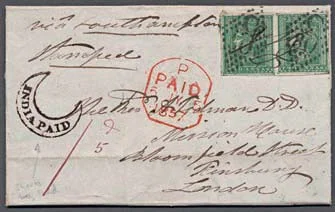
Gärtner’s lot 106 is described as posted at Vizagapatam on 3 May 1857 for London, with two two-anna stamps cancelled C/80, a manuscript instruction “via Southampton”, an INDIA PAID mark, a TOO LATE mark and a red London arrival strike. The pair makes four annas. The catalogue gives more of the readings than can be made out with confidence in the small photograph.[4]
The route instruction, the postage and the marks of time are separate pieces of evidence. TOO LATE can explain a delay without changing the destination; the London mark shows a later stage. Without the dated overseas tariff and the original weight, the four annas should not be forced into a complete rate calculation. Any marks on the back, or full dates that cannot be read in this view of the front, are as reported by the catalogue.[4]
What a censor’s label may hide
The introduction to Baker and Entwistle’s catalogue of Indian censorship notes that stamps were sometimes stuck across the envelope flap and could then be covered by a censor’s sealing label. It records a window deliberately cut in a label to show that postage had been paid. An opening in a label that looks like damage may therefore have a purpose; it is not necessarily the work of a later collector.[5]
Check whether the cut shows a stamp underneath, whether the label bridges the original opening, and whether its handstamps belong with the rest of the envelope. The recorded example shows the practice existed; it does not authenticate every other cut label. Peeling off a label to look for a hidden stamp would destroy the layers that make the postal sequence readable.[5]
Sources
- [1] Geoffrey Clarke, The Post Office of India and Its Story, John Lane/The Bodley Head, London, 1921, chapter III, pp. 26–37, and chapter XIV, pp. 127–136.
- [2] R. S. Nuttall, India—Registration Markings, Handbook of Indian Philately (India Study Circle), loose-leaf, REGISTRATION/1–4, with revisions of December 1973.
- [3] Col. L. G. Shenoi, “Travelling Post Offices”, India-80, pp. 99–104.
- [4] Auktionshaus Christoph Gärtner, India: Park Collection, auction catalogue, 7 March 2011, lot 106 (photograph p. 18, description p. 69).
- [5] A. Baker and C. Entwistle, Catalogue of Indian Censorship 1914–20, 1994, pp. 3–11.
Notes 0
Add what you know: a cover or stamp in your collection, a date or source, a correction or a question.
No notes yet.
Sign in to add a note.
Notes show straight away. Keep them kind and about the article; anyone can report one that isn't. House rules
