
Idar’s Booklet Stamps: the Kothari Half Anna and the Mehta Portrait Issue, 1932–1944
The half-anna booklet panes printed by M. N. Kothari of Bombay, the four-value portrait issue printed by P. G. Mehta of Himatnagar, the Joshi statement and how panes were cut from sheets.
Updated June 16, 2026
In this article
Every Idar stamp was sold in booklets of small panes. That one fact explains most of what collectors find: straight edges, partial perforations, odd pairs and the panes and wrappers that survive.
The booklet post
Idar’s official State post existed well before the booklet stamps. The exact introduction of the first half-anna stamp is still disputed: 1932 is the usual catalogue grouping, not the date of a recovered first-day notice. The postal service, the opening of the post to the public and the introduction of stamps are separate questions.[10][17][21]
David Feldman describes the half anna as the only ordinary postage value for the first dozen years of the stamps. Early registered letters carry six half-anna stamps, often a pane of four and a pair, three annas in all. That is a pattern found on surviving letters, not proof that every registered letter at every date needed six stamps. The later four-value group is dated 21 October 1944 in the catalogue and in the statement reproduced by de Sousa; the original issue order has not been found.[2][22][19]
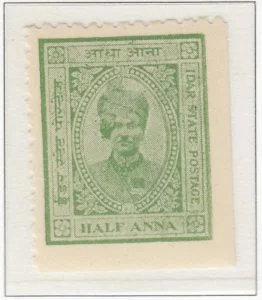
Two early half-anna settings, not one replacing the other
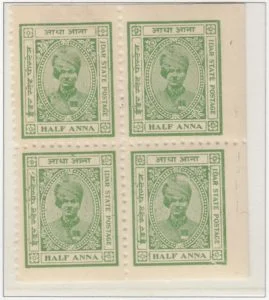
The early half anna was printed by M. N. Kothari & Co. of Bombay in panes of four. Its open and fully shaded backgrounds are a useful first division, but they should not be taken as one issue following the other. Congreve found that both settings stayed in use together; without a run of dated covers, nobody can say how long they overlapped.
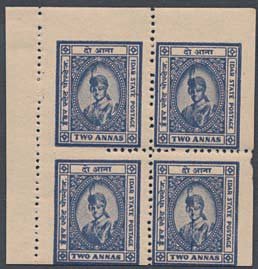
The four positions in the pane were arranged a, b above d, c. The partly perforated edges help place a loose stamp in the pane, and the well-known JDAR lettering flaw belongs to position a of the open-background setting. Some smaller flaws changed in later printings, so they are less reliable than the whole combination of design and perforated edges.
For the open-background setting Congreve recorded bright grass green, first seen in March 1941, pale yellow green in May 1941 and emerald green in February 1943, followed by another green printing. These are the dates he saw them, not first days of issue. His fully shaded setting also came in bright grass green, emerald green and green. A pale yellow green fully shaded printing was a possibility he asked readers to look for, not a confirmed stamp.
A printer’s imprint and two names
The early white-panel half-anna stamps were typographed and sold in booklet panes of four. A booklet back reproduced by W. Danforth Walker carries the imprint “M. N. Kothari & Co., BOMBAY 2.” Quote the imprint from the object. Walker’s own text calls the firm “M. N. Kothari & Sons”, which is also the form in the statement reproduced by Major Fred B. de Sousa in 1953. Whether this was a change of trading name or a mistake is not known. Neither the imprint nor the portrait tells us who designed or engraved the stamp.[21][22]
Measuring the white-panel stamps
Walker sorted the white-panel half anna by margins, perforation and paper as well as colour. He measured line perforations of about 11.3 and 10.8, not a single rounded “11”. The earlier group usually has broad margins, the emerald group intermediate margins, and the narrow-margined groups usually gauge 10.8. He defined thick paper as about 0.10 mm, against the usual 0.06–0.08 mm, sometimes 0.05 mm. These are his measurements and his proposed groups, not the printer’s specifications.[21]
Walker’s sample was 76 items: 47 covers and 29 off cover, a pair, block, pane or part booklet counting as one item. Only two off-cover items were confirmed as thick paper, because paper on a cover cannot be measured reliably. That is neither 76 stamps nor a census of all that survive, and for most groups colour alone was not enough.[21]
How the booklets were made, and what went wrong
Walker describes booklets held by a single staple. He illustrates an incomplete one with six panes of four, two short of the expected eight, with the interleaving stuck to the backs of the panes. He records both incompletely punched perforations and missing holes, and they are not the same thing: a hole never punched because a pin was missing is different from a blind or badly cleared perforation. The gum of the later white-panel groups is smooth, shiny and faintly tan, sometimes with close diagonal lines; for the earliest group he did not know the gum.[21]
Because that booklet was two panes short, it does not show that six panes was the normal format. Straight outer edges are a normal result of making booklets, and a gutter pair has to be compared with the original pane before anyone calls it an error.[21]
A new portrait and a new printer
The later small-format portrait series had four values: ½, 1, 2 and 4 annas. A smaller portrait and extra shading round the oval separate it from the first design. Its booklet covers name P. G. Mehta of Himatnagar in place of the Bombay printer of the earlier stamps. Eight panes of four made a booklet of 32 stamps, and the half-anna cover priced that at one rupee.
Congreve describes unwatermarked white meshed paper and perforations of 11¾–12. His first colour group was pale grass green for the ½ anna, violet for the 1 anna, blue for the 2 annas and scarlet for the 4 annas. A second group had dark green, bright violet and ultramarine for the first three values. He found only one printing of the 4 annas, so a second scarlet printing should not be assumed by analogy.
A State press is not necessarily the stamp printer
The 1934–35 administration report names the Himat–Vijay Printing Press at Himatnagar, which did the State’s printing and work for the public. That shows Idar had a local press. It does not say which stamps the press printed, that P. G. Mehta owned it, or anything to replace the booklet imprints and reported contracts.[14]
M. S. Joshi, Revenue and Stamp Officer
De Sousa’s article of 1953 prints a “Statement Showing the Postal Issues of Idar State”, signed “M. S. Joshi, Revenue and Stamp Officer, Idar State.” It gives the earlier half-anna printings to M. N. Kothari & Sons, Bombay, and the half, one, two and four annas of 1944 to P. G. Mehta & Co., Himmatnagar. So a named official stands behind the statement, but the signed original, its date and Joshi’s time in office are not known. The article tells us what was reported, not what a State printing register shows.[22]
The State’s own reports offer a lead. They name Mohanlal S. Joshi as Treasury Officer in 1934–35, 1936–37, 1937–38 and 1942–43, and as Treasury Officer and Accountant General in 1943–44. His initials match the official in de Sousa’s statement, but the reports do not call him Revenue and Stamp Officer or link him to the statement, so the identification is only provisional.[14][29][30][31][15]
Printing years, reported issue dates and covers
The statement separates the year of printing from the issue date it claims. For its first half-anna entry it gives printing in 1938 and issue on 21 February 1939, then 6 June 1940, 2 July 1941 and 1 March 1943, and 21 October 1944 for all four later values. These are useful reported dates, but not a full first-issue chronology, because earlier covers have since been recorded. Röver proposed 1 October 1932, the start of the official year, from the covers he knew, while allowing 1 October 1931. Walker later illustrated markings apparently from earlier in 1932, but warned that a datestamp whose year slug was never changed could mislead. The first day is still unproved.[22][17][18][21]
The statement also disagrees with itself: its text gives 100,000 for the first printing where its table gives 50,000, and P. J. Mehta where the table has P. G. Mehta. The later half-anna quantity in the table is 60,000; a 1944 contract mentioned elsewhere has not been seen and cannot settle it. Read the table as reported figures, not as the master chronology of the issues.[22]
| Value | Printing year | Reported issue date | Reported quantity | Printer in table |
|---|---|---|---|---|
| ½ anna | 1938 | 21 February 1939 | 50,000 | M. N. Kothari & Sons, Bombay |
| ½ anna | 1940 | 6 June 1940 | 100,000 | M. N. Kothari & Sons, Bombay |
| ½ anna | 1941 | 2 July 1941 | 100,000 | M. N. Kothari & Sons, Bombay |
| ½ anna | 1943 | 1 March 1943 | 100,000 | M. N. Kothari & Sons, Bombay |
| ½ anna | 1944 | 21 October 1944 | 60,000 | P. G. Mehta & Co., Himmatnagar |
| 1 anna | 1944 | 21 October 1944 | 150,000 | P. G. Mehta & Co., Himmatnagar |
| 2 annas | 1944 | 21 October 1944 | 25,000 | P. G. Mehta & Co., Himmatnagar |
| 4 annas | 1944 | 21 October 1944 | 50,000 | P. G. Mehta & Co., Himmatnagar |
Printer’s sheets, booklet panes and misleading pairs
A finished booklet pane is only part of the printing story. Congreve examined full sheets of the later half anna and found nine blocks of four, arranged three by three, with wide spaces between them so the sheet could be cut into panes with margins for binding. He had not seen full sheets of the 1, 2 and 4 annas; a similar layout for those values was his reconstruction from smaller pieces.
That matters when buying an imperforate-between pair. Congreve recorded a 2-anna blue vertical pair caused by displaced perforation, and a 2-anna ultramarine horizontal pair without the normal vertical perforation. But a pair cut across the unperforated space between two booklet blocks can look like an error. Normal spacing inside the small-format blocks was about 3 mm, so a much wider gutter means the whole piece and how it was cut need examining.
He also recorded displaced perforation running through the design of the pale grass-green half anna, and doubted whether some abnormal material was ever sold to the public for postage. A printing variety, a leftover from a printer’s sheet and an error sold over the counter each need their own description.
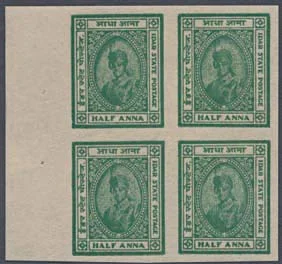
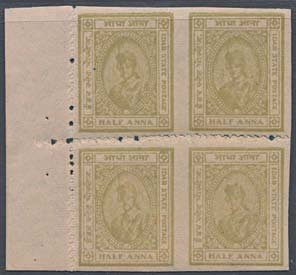
A red trial is still a two-annas design
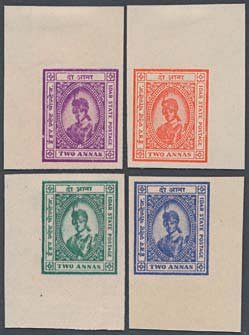
The four colour trials all carry the same TWO ANNAS lettering in different inks. The red one is useful for comparing colour experiments with the issued stamps, but it is not a four-annas stamp. The two-annas pane also keeps perforation and margin evidence that a loose single loses.
Sources
- [2] David Feldman SA, Indian Princely States: A Selection from the Dan Walker Collection, 8 December 2017, p. 60, Idar introduction and lot 82162.
- [10] Idar State administration reports, bound run: 1901–02, pp. 1–2 and 30 (installation and State post); 1902–03, p. 1, paragraph 3 (the headquarters move); year ending 31 March 1908, pp. 1 and 25, paragraphs 74–75 (Darbar and Government postal arrangements).
- [14] Administration Report of the Idar State, 1934–35, p. 5, paragraph 9, p. 72, paragraph 184, and p. 109.
- [15] Administration Report of the Idar State, 1943–44, p. 53, paragraph 209, p. 74, paragraph 292, and pp. 84–85, Appendix A.
- [17] Peter Röver, “Idar State: ½ Anna SG1 & 2: The Story Behind the Stamps,” part 1, India Post 33, no. 140 (April–June 1999), pp. 59–64.
- [18] Peter Röver, “Idar State: ½ Anna SG1 & 2: The Story Behind the Stamps,” part 2, India Post 33, no. 141 (July–September 1999), pp. 106–111. Especially pp. 106, 109, Appendix B.
- [19] Peter Röver, “Idar State: ½ Anna SG1 & 2: The Story Behind the Stamps,” part 3, India Post 33, no. 142 (October–December 1999), pp. 124–125.
- [21] W. Danforth Walker FRPSL, “The First Stamp of Idar – Half Anna Green with White Panels,” India Post 46, no. 186 (July–September 2012), pp. 147–156.
- [22] Major Fred B. de Sousa, “The Stamps of Idar State,” India’s Stamp Journal (October 1953), pp. 225, 227.
- [29] Administration Report of the Idar State, 1936–37, pp. 64–65, paragraph 213.
- [30] Administration Report of the Idar State, 1937–38, p. 62, paragraph 227, and Appendix XXII, Heads of Expenditure.
- [31] Administration Report of the Idar State, 1942–43, p. 48, paragraph 190.
- Indian Feudatory States Stamps online exhibition, Idar.
Notes 0
Add what you know: a cover or stamp in your collection, a date or source, a correction or a question.
No notes yet.
Sign in to add a note.
Notes show straight away. Keep them kind and about the article; anyone can report one that isn't. House rules
