
Idar: the Darbar Post, the Booklet Stamps and the Disputed Fiscals
Idar, in Gujarat’s Mahi Kantha, ran a Darbar post by 1900 and issued booklet stamps from about 1932 to 1944: the rulers, the chronology and the stamps.
Updated October 12, 2026
In this article
The state behind the stamp
Idar belonged to the Mahi Kantha agency in Gujarat and was ruled by a Rathor house. The report for 1902–03 records the headquarters moving from Idar to Ahmednagar; later reports call the town Himatnagar (Himmatnagar). That move is not a confirmed date for the renaming, so keep the spelling of the time on postal material.[3][10]
The State’s own reports show an internal postal service working long before the booklet stamps. They also keep the Darbar’s arrangements apart from the Government post offices, and the two networks should not be added into one count of offices.[10]
The rulers
A ruler’s reign and the dates a stamp was issued or valid are different kinds of evidence.[10][14][6]
| Reign | Ruler | Note |
|---|---|---|
| February 1902 – May 1911 | Maharaja Pratap (Pertab) Singh | Installed February 1902 (the 1901–02 report gives both 12 and 13 February); abdicated May 1911 |
| May 1911 – 14 April 1931 | Maharaja Daulat (Dowlat) Singh | Adopted son of Pratap; died at Bombay on 14 April 1931; did not reign in the stamp period |
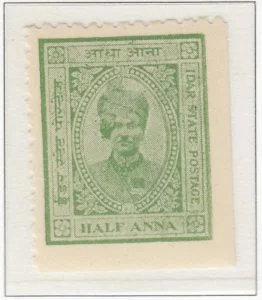
| from April 1931 | Maharaja Himmat Singh (Himatsinhji) | Succeeded his father; the ruler on the stamps, as the Smithsonian identifies the portrait |
The booklet stamps
For about twelve years Idar’s only ordinary stamp was a half anna, printed by M. N. Kothari of Bombay and sold in booklets of panes of four. A smaller portrait in four values, ½, 1, 2 and 4 annas, followed, printed by P. G. Mehta of Himatnagar and reported as issued on 21 October 1944. The first day of the first stamp is still unproved: 1932 is the catalogue grouping, Röver proposed 1 October 1932, and a statement reproduced in 1953 gives later dates for particular printings.[2][17][22]
A larger green 1¼-anna portrait stamp, perhaps of 1945, has a disputed postal status, and Idar’s violet one-anna fiscals were accepted on registered letters. The chapters of this section tell each part in full.[1][4][23]
Chronology
| Date | Event |
|---|---|
| 1889–90 and December 1890 | Insured parcels robbed between Parantij and Idar (Bombay postal reports) |
| 1897 | Railway from Ahmedabad through Parantij to Himatnagar opened in three stages |
| 1900–01 and 1901–02 | The State Postal Department at work: 141,557 and 133,556 articles |
| February 1902 | Pratap Singh installed |
| 1902–03 | Headquarters moved from Idar to Ahmednagar (later Himatnagar) |
| 1907–08 | Government post offices increased from ten to twelve; a separate Darbar official service |
| October–November 1911 | Perkins Bacon die and plate for a one-anna receipt stamp |
| 1927–28 | The Darbar post carried 71,299 items; eighteen Government post offices |
| 14 April 1931 | Death of Daulat Singh; Himmat Singh succeeds |
| 1932 (catalogue period) | The first half-anna booklet stamp; the exact first day is unresolved |
| 17 April 1941 | Registered cover with four one-anna fiscal stamps (manuscript date) |
| 1943–44 | Official mail from Himatnagar reached the remotest parts in two or three days |
| 21 October 1944 (reported) | The four-value portrait issue |
| about 1945 | The larger green 1¼ anna (tentative date; postal status disputed) |
| 4 November 1948 | Idar’s free grant of Indian service stamps recorded at Rs 550 a year |
The stamps
The issues and their values, from the research checklist. Official stamps, and the shades, papers, settings and varieties of each issue, are not listed.
| Period | Issue | Values |
|---|---|---|
| 1932–1943 catalogue period | Early half-anna booklet families | ½ anna |
| 21 October 1944, reported | Later portrait issue | ½ anna, 1 anna, 2 annas, 4 annas |
| Circa 1945; date uncertain | Larger portrait, disputed postal status (disputed status) | 1¼ annas, green |
| 1936 catalogue attribution | Star-frame portrait fiscal (postal fiscal) | 1 anna green/reddish lilac |
| 1940s; use documented 1941 | Plainer violet fiscal designs (postal fiscal) | 1 anna |
| 1940 catalogue attribution | Value surcharge on fiscal design (postal fiscal surcharge) | 1 ¼ anna |
| 1945 catalogue attribution | Later fiscal family (postal fiscal) | 1¼ annas, yellow-green, 1¼ annas, blue-green |
Sources
- [1] H. D. S. Haverbeck, “The Mystery Stamp of Idar,” pp. 82–87.
- [2] David Feldman SA, Indian Princely States: A Selection from the Dan Walker Collection, 8 December 2017, p. 60, Idar introduction and lot 82162.
- [3] Encyclopædia Britannica, 11th edition (1911), “Idar”: Mahi Kantha and the historical capital.
- [4] Christoph Gärtner, 17th auction, Indian States, 7 March 2011, Idar lots 1031–1053 and illustrated plates, printed pp. 43–44.
- [6] Smithsonian National Postal Museum, “Feudatory States: F–K”, Idar specimen caption: ½ anna “Maharaja Shri Himatsinhji”.
- [10] Idar State administration reports, bound run: 1901–02, pp. 1–2 and 30 (installation and State post); 1902–03, p. 1, paragraph 3 (the headquarters move); year ending 31 March 1908, pp. 1 and 25, paragraphs 74–75 (Darbar and Government postal arrangements).
- [14] Administration Report of the Idar State, 1934–35, p. 5, paragraph 9, p. 72, paragraph 184, and p. 109.
- [17] Peter Röver, “Idar State: ½ Anna SG1 & 2: The Story Behind the Stamps,” part 1, India Post 33, no. 140 (April–June 1999), pp. 59–64.
- [22] Major Fred B. de Sousa, “The Stamps of Idar State,” India’s Stamp Journal (October 1953), pp. 225, 227.
- [23] Srinivas Prava, “Idar Postal Fiscal Stamps,” India Post 55/2, no. 219 (April–June 2021), pp. 50–55.
- Indian Feudatory States Stamps online exhibition, Idar.
Notes 0
Add what you know: a cover or stamp in your collection, a date or source, a correction or a question.
No notes yet.
Sign in to add a note.
Notes show straight away. Keep them kind and about the article; anyone can report one that isn't. House rules
