
Idar Covers: Rates, Postmarks, Registration Slips and Routes
What surviving Idar covers say about rates, the English and Gujarati postmarks, registration slips and acknowledgment forms, the reconstructed routes and two palace and fiscal envelopes.
Updated June 7, 2026
In this article
No complete Idar tariff has been found. What is known about rates, offices and routes comes from the covers themselves, read carefully.
What the covers suggest about rates
Röver’s study of 1999 reconstructed the early ordinary letter rate as half an anna, with one anna for a double-weight letter, and reported rare postcards at half an anna. By July 1939 his covers showed registered letters with acknowledgment of delivery paying three annas in all. These figures are his reading of surviving mail, not a recovered State tariff, and no weight steps or separate registration and acknowledgment charges should be invented from them.[19]
He also recorded a later pattern of one anna for an ordinary letter and four annas for a registered one. In the material he knew, the last lower-rate examples were half an anna on 14 June 1943 and three annas on 11 July 1943; the first higher-rate examples were one anna on 3 November 1944 and four annas on 14 February 1944. His suggested change on 1 October 1943 was a hypothesis, not a dated postal order, and these are dates from his sample of 1999, not today’s earliest or latest known uses.[19]
The cover of 17 April 1941 franked with four annas of fiscal stamps does not fit a simple change from three to four annas in 1943–44. Its service may have been different. Keep the discrepancy rather than changing the cover’s date or forcing it into the reconstruction.[4][19][27]
Reading office names and anonymous marks
Röver separated English metal datestamps with movable figures from Gujarati rubber marks whose dates were written in by hand. His appendix records English circular marks for Bhiloda, Sabalpur, Sabli and Vadali, and named Gujarati branch marks for Idar, Jadar, Khed Brahma, Meghraj, Pal, Posina and Vadali. These are the names in his postmark study, not a full official list of offices with opening dates.[18]
The anonymous Gujarati “Branch Post” type needs care: it carries no office name, and Röver had not found where it was used. His earliest example was dated 14 June 1943. He also recorded a rectangular dead-letter mark of Bhiloda dated 4 July 1940. An anonymous or poorly struck mark must not be given to a town just to complete a list of routes.[18]
Three photographs of cover backs in Corinphila’s 2024 Carnio catalogue give comparisons. Lot 5119 shows a green half anna tied by a circular Darbari Post mark, with an oval Himatnagar mark beside it; the catalogue dates the envelope to 1933 and reads the arrival as 8 January, a date best left with the catalogue because the figures are worn. Lot 5121 shows a green half anna, circular and manuscript marks and a separate 19 JUN 1939 handstamp; its destination, Vadali, comes from the description.[34]
Registration slips and acknowledgment forms
Postal paperwork tells us more than the stamps. Röver illustrated early anonymous registration slips with only a number, and later slips with a Gujarati place name above it. He reported the first kind perforated 9 and the second 11, sometimes on only two or three sides, with named slips from Himatnagar, Khedbrahma, Meghraj and Pal. He placed the change from anonymous to named slips from 1943.[19]
The acknowledgment form was printed on ordinary white paper with Gujarati text on both sides. The front named the Idar State postal service and had spaces for the sender and the office datestamp; the back was a receipt for the article, with the addressee and a signature. The forms are sometimes found still attached to undelivered covers. Röver groups them with postal stationery, but they are working forms and labels, not stationery with a printed stamp.[19]
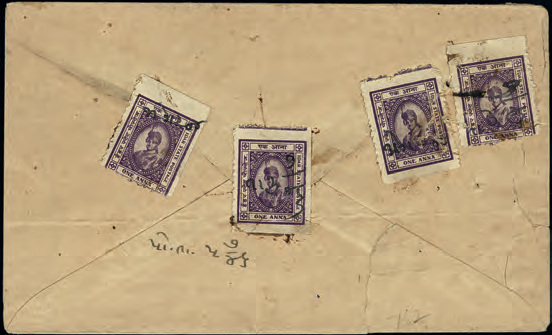
Corinphila’s lot 5122 shows six half-anna stamps on the back of a cover, two singles and a block of four, with violet circular cancellations: three annas in all. The catalogue describes a registered acknowledgment-of-receipt cover with a perforated registration label and its form. The photograph of the back alone does not show those other parts, the posting date, the weight or how the charge was made up.[34]
Routes reconstructed, not recorded
Röver said plainly that his postal lines were a reconstruction from the administration’s needs, postmarks, railway information and maps. His main lines ran south from the capital towards Bayad; north through Idar, Vadali and Khedbrahma towards Poshina; east through Bhiloda towards Meghraj; and on a shorter line towards Raigadh. Rail and road connections show how such a network could work, but this is not an official route table of the time.[19]
He also proposed smaller links, Jadar–Sabli and Bhiloda–Pal, and a possible Raigadh–Sabalpur connection. Bayad was taken to be a State post office even though he knew no cover with its postmark. An inferred office or line should not become a confirmed line on a map or an exact mileage.[19]
Two one-anna designs on letters
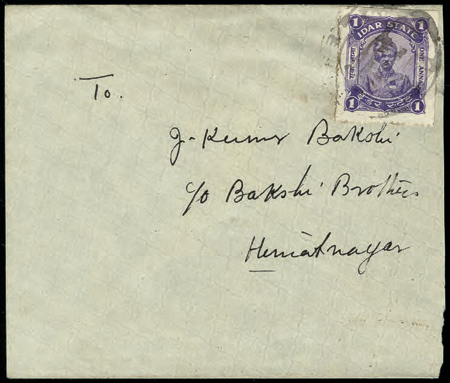
Two illustrated letters show the difference between a postage stamp and a fiscal accepted for postage. The rectangular portrait stamps on the registered letter read IDAR STATE POSTAGE. The plainer fiscal on the other envelope has the State’s name above the portrait and the value below it. The same face value does not make them the same issue.
The auction describes the fiscal letter as a combination with an Indian Gandhi stamp on the back. The photograph of the back shows a brown Gandhi 1½-anna stamp tied by a HIMATNAGAR circular mark with 15 AUG visible; the auction reads the full date as 15 AUG 48, but the last figures of the year run into the stamp. That establishes the stamp and the mark, not commercial carriage, the whole postal journey or the rate.[27]
A palace envelope addressed to Major de Sousa
Four portrait stamps of different colours are on the face, crossed by two violet circular strikes. The address names Major F. B. de Sousa, gives his post in abbreviation as military secretary to the Maharaja of Idar, and sends the envelope to the palace at Himmatnagar. The back has a coloured crest on the flap. No date can be read with confidence on the face, and the small picture of the back shows no clear transit or arrival mark.[25]
David Feldman catalogues the stamps as the 1944 issue, SG 3–6, describes the marks as G2a and thinks the cancellation probably to order. That is the cataloguer’s view. The address shows who the envelope was for; its posting date, journey, delivery and rate, and any part de Sousa played in ordering the stamps, are unproved.[25]
How to collect Idar
A useful collection separates the early half-anna panel designs, the four-value ordinary issue of 1944, the disputed larger portrait and the fiscal families. Dated covers and the official reports give postal context, but no complete tariff, no full list of Darbar offices and no secure match of every fiscal type.[6][13][19]
Some working rules follow from the research. Separate the open and fully shaded backgrounds without assuming one came after the other. Place a stamp in its pane by more than one feature. Compare gutters with the normal spacing, 3 mm in the small format and 5 mm in Type 3. Quote the Kothari imprint as it is on the wrapper. Treat paper and perforation figures as specialists’ measurements, not printer’s standards, and remember that a stamp on cover cannot be gauged for thickness. Keep Prava’s fiscal settings, De Sousa’s reported dates and Röver’s rate change as reconstructions, and leave the anonymous Branch Post mark anonymous.
What is still open
No designer, portrait artist, engraver or block-maker has been identified. The exact first day and the order of printings are unresolved; printing years, reported issue dates, dated covers and hypotheses are different things. Whether the larger green 1¼ anna was regularly used for postage, who authorised it and what rate it paid remain unproved. A verified map of postal routes and a full census of Darbar offices and postmarks are still to be made.
Sources
- [4] Christoph Gärtner, 17th auction, Indian States, 7 March 2011, Idar lots 1031–1053 and illustrated plates, printed pp. 43–44.
- [6] Smithsonian National Postal Museum, “Feudatory States: F–K”, Idar specimen caption: ½ anna “Maharaja Shri Himatsinhji”.
- [13] Report of the Administration of the Idar State, 1 October 1927 to 30 September 1928.
- [18] Peter Röver, “Idar State: ½ Anna SG1 & 2: The Story Behind the Stamps,” part 2, India Post 33, no. 141 (July–September 1999), pp. 106–111. Especially pp. 106, 109, Appendix B.
- [19] Peter Röver, “Idar State: ½ Anna SG1 & 2: The Story Behind the Stamps,” part 3, India Post 33, no. 142 (October–December 1999), pp. 124–125.
- [25] David Feldman SA, Peter Röver collection, lot 80115, 30 May 2025.
- [27] Heinrich Köhler, 377th auction, Idar lots 10734–10735, StampAuctionNetwork catalogue and linked original photographs.
- [34] Corinphila, 327th auction, The Enzo Carnio Collection (part I), 6 June 2024, printed pp. 54–55, lots 5119, 5121 and 5122.
Notes 0
Add what you know: a cover or stamp in your collection, a date or source, a correction or a question.
No notes yet.
Sign in to add a note.
Notes show straight away. Keep them kind and about the article; anyone can report one that isn't. House rules
