
The Duttia State Post: Offices, Rates, Postal Lines and Registered Mail
What a Duttia letter paid, the three postal lines from Datia, the work shared with the Imperial office, the eleven offices of 1893 shrinking to four, and the registered letter of 1910 with its receipts.
Updated October 8, 2026
In this article
Duttia’s post was small: a head office at the capital and a handful of village offices, carrying the state’s own letters and a good deal of mail for the British offices too. Its records and surviving covers show how it worked.
What a local letter paid for
Duttia charged for private letters within the state. Carrying Imperial mail locally, inward and outward, was free, and so was official correspondence. That is why the state’s postal work cannot be measured by counting paid private letters alone.[1]
For the reporting years 1909–10 and 1910–11, Röver gives yearly averages of about 236 paid ordinary letters and 108 registered letters. Ordinary postage was half an anna; a registered letter with an acknowledgement needed at least 3½ annas. He illustrates that minimum with half, one and two anna stamps, while allowing other combinations and stationery. These are figures for those years, not a rate table for the whole stamp period.[1]
The February 1897 account is an earlier and more cautious witness. It says postage charges were reported to be the same as in British India, but mentions an apparent quarter-anna charge for some articles besides postcards, without saying which articles or what weights. Neither an exact match with Imperial tariffs nor a quarter-anna letter rate can be built from that sentence.[12]
Three postal lines
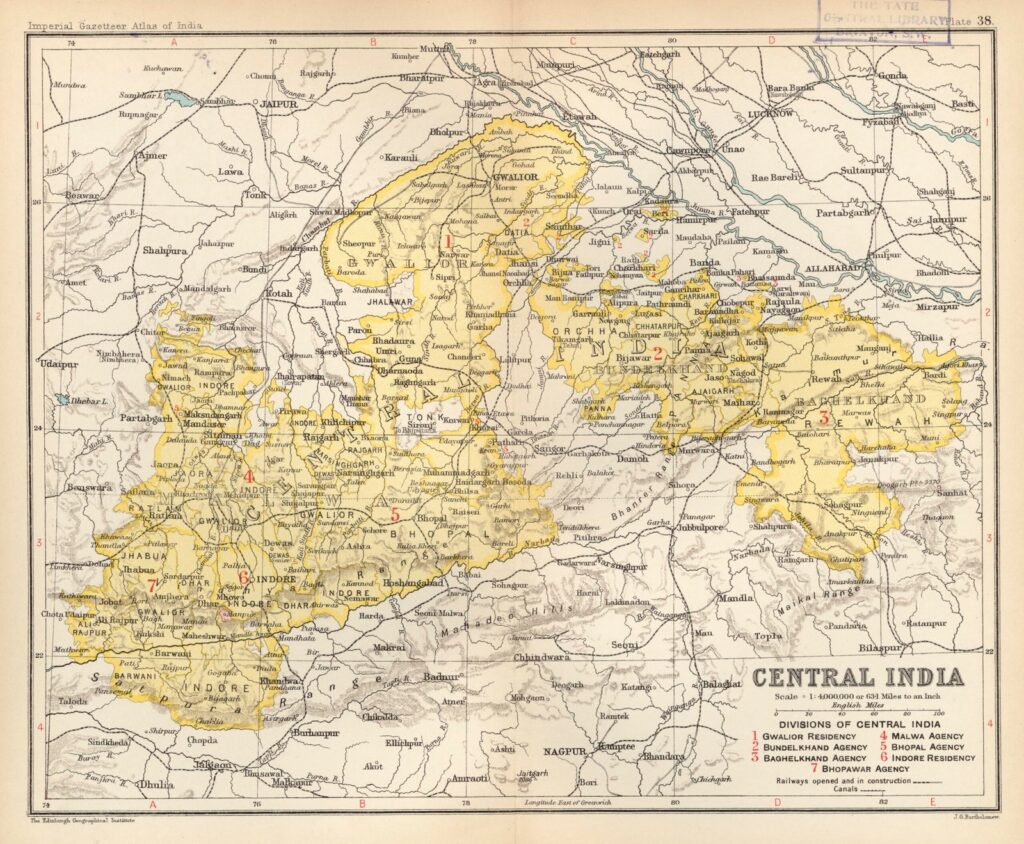
The Gazetteer of 1907 names three postal lines from Datia: to Nadigaon, 56 miles; to Kamad, 16 miles; and to Ronija, 14 miles. These are recorded postal connections, not routes guessed from a road or railway. The same passage describes the Midland section of the Great Indian Peninsula Railway, with stations at Datia and Sonagir, but that does not prove that any State-post letter went by rail.[9]
| From | To | Miles |
|---|---|---|
| Datia | Nadigaon | 56 |
| Datia | Kamad | 16 |
| Datia | Ronija | 14 |
The 1911 Britannica gives the state an area of 911 square miles and a population of 173,759 in 1901. The Jhansi–Gwalior branch railway crossed it, and Datia town had a station 16 miles from Jhansi.[2]
The State post also carried British-office mail
Luard reports that about 2,000 State letters and 2,500 letters from British offices were carried each year, and that postal revenue usually fell short of expenditure. He gives no year for these round figures, and they should not be compared with the later counts of paid private letters. They show that the State service did much more than sell its own stamps.[9]
How mail passed between the two posts
The Philatelic Journal of India in October 1906 describes the Datia and Charkhari State offices handling paid, unpaid and registered letters, parcels and packets, and notices that money orders or insured articles had arrived at the Imperial office. Mail for delivery inside the state, apart from money orders and insured articles, was handed over against a receipt at the State head office, and postage due on unpaid articles was collected in cash from the State postmaster. State stamps prepaid articles posted at a State office for delivery within the state.[10]
An arrival notice was not the money order or insured article itself: those were delivered at the Imperial office. And the separate statement that some Charkhari offices issued and paid their own money orders should not be carried over to Datia. The two administrations shared out the work; they were not one postal system.[10]
Offices and cancellations
Röver reconstructs a network that shrank from eleven offices in 1893 to nine by 1906 and four at the Imperial takeover, which he dates to 1 April 1921. English hooded marks reading DUTTIAH STATE or DUTTIAH were used outside the capital too, so their wording alone does not tell you which branch a letter came from.[1]
A large double-circle head-office mark and delivery marks are other evidence. Be especially careful with the Baroni strikes dated 1920 and 1940: Röver places the closing of that office in 1917–1918. A late date needs independent support, however old the lettering looks.[1]
An office list has a date
Röver worked from gazetteers and administration reports. His sequence ends with four offices at the takeover: Duttia, Indargarh, Seondha and Nadigaon. The dates mark the periods of his documents, not exact closing days.[1]
| Period reported | Offices or change | Note |
|---|---|---|
| By 1906 | Kamad; Padri | Missing from the later list |
| 1914–1915 | Ronija missing; Pulia appears | Pulia not securely placed on Röver’s map |
| 1915–1916 | Unao; Semai; Tharait; Pulia | Reported closures |
| 1917–1918 | Baroni | Reported closure |
| At the takeover | Duttia; Indargarh; Seondha; Nadigaon | The four offices left |
There is a trap in the directories: the Indian Postal Guide of 1917 still repeated the eleven-office list of 1893. A printed list shows what was listed, not that every branch was still open.[1]
The October 1906 journal prints eleven Datia offices, including Padri and Kamad, and Luard’s Gazetteer of 1907 speaks of ten village offices besides the head office. Read these beside Röver’s reconstruction rather than against it: a book’s date of publication is not necessarily the date of the office return behind it, and Luard warned in his preface that the latest figures were not always available. The difference does not prove that offices reopened, or that all were working in 1906–1907.[10][9]
The 1906 list, in its printed spellings, is: Duttia, Semoha, Nandigaon, Indergarh, Unao, Baroni, Padri, Tharet, Saimai, Kamad and Ronija. Semoha should not be quietly read as Seondha; matching the names needs geographical evidence.[10]
The February 1897 report gives one head office and nine branches, ten offices in all, another dated description to set beside the eleven-office lists. It also describes the accounts: branches sent daily accounts to the head office, which sent a monthly account to the State Treasury. Inspection by senior Darbar officials was irregular, not on a fixed schedule.[12]
A 1917 cancellation built from familiar forms
One Duttia cancellation, on an item of 1917, combines features of two Convention State marks. Katy Medhora compares it with the simpler outer form used by several Convention States and with the inner circle and date panel used by Chamba, Nabha and Patiala; the Duttia version leaves out the states’ emblems. A borrowed pattern of mark shows where postal equipment and practice came from; it does not make Duttia a Convention State.[4]
The item illustrated is addressed to a chief judicial officer. The study gives a 1917 example of this composite mark, not the date it was introduced, and it should be kept apart from undated hooded marks whose office still depends on other evidence.[4]
A registered letter of 1910 and its forms
A group sold by Heinrich Köhler as lot 10653 of sale 377, and again as lot 1509 of sale 380, keeps a letter with its postal forms. The photographs show the red registration number 200 on the cover and a sender’s receipt with the same number. A separate card headed On Postal Service names the office of posting. The franking side and the receipt carry a clear date, 12 SE 10. Together they show how one registered letter could leave evidence in several documents.[20]
The catalogue describes the group as a registered letter of 1910 with its contents, an acknowledgement receipt and a sender’s receipt, and divides the 3½ annas of stamps into half an anna postage, two annas registration and one anna for the acknowledgement. That division is the catalogue’s reading, not a recovered tariff order. The contents and full address have not been transcribed, so nothing is said here about the sender or the whole route.[20]
The two sales show the same group, not two examples. It sits well beside Röver’s figures for paid mail in 1909–10 and 1910–11, but one letter does not make a statistic.[20][1]
A mixed franking of 1920
David Feldman’s sale of the Peter Rover collection describes another registered envelope, dated 27 January 1920, with half, one and two anna stamps from different issues and, on the back, a registration label. The photograph shows the three stamps and hooded cancellations. The stamps again add up to 3½ annas, but the same total does not prove that the 1910 division of the charge was unchanged ten years later.[21]
The rupee was not one coin
Luard’s Gazetteer says the locally minted Rajashahi rupee remained Datia’s main currency up to 1903, while the Orchha Gajashahi, the Balashahi and Gwalior coins also circulated. That is the background to everyday payments; it does not tell us which coin a customer used to buy a stamp.[9]
Sources
- [1] Peter Röver, “Duttia: Duttiah: Dutia: Datia, 1893–1993: A Stamp Centenary?”, The London Philatelist, vol.103, November 1994, pp.290–297.
- [2] Encyclopædia Britannica, 11th edition (1911), “Datia”.
- [4] Mrs Katy Medhora, “Duttia State Cancellations”, IND DAK, December 1979, p.271.
- [9] C. E. Luard, Eastern States (Bundelkhand) Gazetteer, Central India State Gazetteer Series, vol. VI-A: Text, Lucknow: Newul Kishore Press, 1907, preface pp. i–ii and Datia pp. 104–106, 116–117.
- [10] “Notes on the Postal arrangements in some of the Native States”, The Philatelic Journal of India, vol. X, no. 10, October 1906, pp. 218–227; Duttia pp. 219–220.
- [12] “The Duttia State Post”, from notes supplied by C. L. Pigott, The Philatelic Journal of India, vol. I, no. 2, February 1897, pp. 38–40.
- [20] Heinrich Köhler, sale 380, lot 1509 (the same group as sale 377, lot 10653): registered letter of 1910 with sender’s receipt and postal-service card.
- [21] David Feldman, Indian States: the Peter Rover collection, 30 May 2025, lot 80103: registered cover of 27 January 1920.
Notes 0
Add what you know: a cover or stamp in your collection, a date or source, a correction or a question.
No notes yet.
Sign in to add a note.
Notes show straight away. Keep them kind and about the article; anyone can report one that isn't. House rules
