
Hyderabad Covers: Routes, Numeral Cancellations and the Railway Mail
Reading Hyderabad covers: combination frankings, State stamps disallowed abroad, numeral cancellations from 1874, Hijri and Fasli dates, and the Railway Mail Service.
Updated November 10, 2026
In this article
Two compartments on one train
Picture two postal compartments in the same railway van, one red, the other yellow. A. H. Burnett describes this in his study of Hyderabad’s Railway Mail Service, published in The Philatelist in October 1963. The British Indian and Hyderabad State services shared bogie postal vans but worked in separate compartments, each with letter boxes, sorting tables and bag racks; the Indian section was painted pillar-box red and the State section yellow. Two postal administrations travelled on the same train.[1]
Burnett warns that a Railway Mail Service cancellation alone does not show where a letter came from; the other marks on the cover matter. A destination, a mark of origin and a travelling office cancellation answer different questions.[1]
Two posts on one letter, 1870
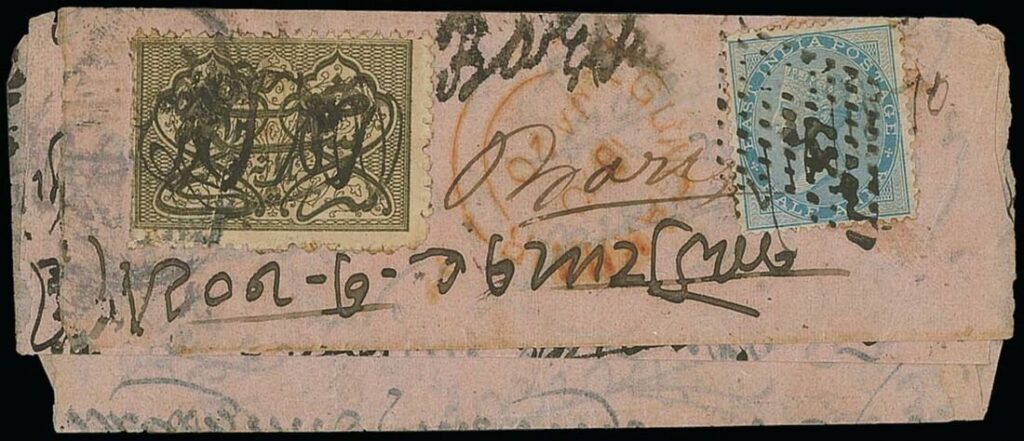
Spink’s lot 224 is a letter of 20 January 1870 from Gunkhair to Bombay. On the back are the Hyderabad one-anna olive-green with British Indian half-anna blue and one-anna stamps, handwritten cancellations, a rhombus-of-dots cancellation on the half anna and a red despatch datestamp beside it: a documented combination franking. The lot gives no weight or rate.
An early double-rate cover
Feldman’s lot 80313 describes a cover with the 1869 one-anna olive-green paying a double rate of one anna, tied by a rhombus bar obliterator, and notes that there was no half-anna stamp between 8 September 1869 and 16 May 1870. The rate is the auctioneer’s attribution.
1910: State postage disallowed abroad
Patrick Frost’s display to the Royal Philatelic Society London describes a cover to London in 1910 with Hyderabad stamps that were disallowed, showing the limits of the stamps beyond the State. The destination alone does not give the route, weight or charge.
A London card marked for postage due
Corinphila’s Asafia collection includes a Hyderabad postal card to London with an added Hyderabad stamp. The photograph shows a framed Indian postage due mark crossed out in red, a separate circular T and a large 5d. / F.B. charge mark: different stages of handling, and crossing out one did not erase every sign of postage due.[24]
The catalogue describes a half-anna stamp on a quarter-anna card, departure from Hyderabad-Deccan on 7 January and receipt in London on 26 January, and gives the fivepence mark to London’s Foreign Branch. The enlargement confirms 7 JA and the main tax marks, but not the whole dated journey or whether the money was collected. The Hyderabad values cannot simply be converted into the British charge.[24]
Where the State stamp stopped
Under the exchange agreement of 1882, local Hyderabad postage did not pay the Imperial postage on outgoing State mail. Incoming mail had different rules: a local charge on inland correspondence was allowed, on foreign correspondence prohibited. The half share in Article 4 is the Imperial claim on the State for inland postage due, not a reduced public rate, and the foreign exemption in Article 5 does not mean Hyderabad stamps prepaid an outgoing foreign letter. A cover study still needs its date, weight, class, origin, destination, prepayment and tariff.[17]
On the line towards Bezwada, Burnett separates the Bonakalu boundary from the special arrangements under which the State Railway Mail Service accepted Hyderabad-franked mail at Bezwada, where the State vans did not charge the late fee due elsewhere.[1]
Free service mail, shortages, exchange and fines
The Gazetteer of 1909 leaves free service covers out of the postal receipts and puts their notional value for 1901 at Rs. 3,67,500, an accounting statement for that period, not a rule that every official cover at every date was free. Lawder’s shortages of envelopes and half-anna stamps in 1898 do not prove a withdrawal, a provisional or a rate; his 24 gundas to the rupee is an accounting rate, not postage; and the reduction of a delay fine from four annas to one anna an hour is not a postage reduction.[12][H2][H44]
From bars to numerals
Nayeem places the first numeral cancellations in 1291 H, about 1873–74, with 15 April 1874 as his earliest dated example; the exact date of introduction was not recorded. Bar cancellations stayed in use alongside the numerals.[H9]
His article separates rectangular, square and rounded devices by their frames, parallel bars and numerals; a partial strike or too much ink can hide these features. The numbers are in Urdu and should be read from the strike, not guessed from a familiar office name.[H9]
| Numeral | Office |
|---|---|
| 1 | Hyderabad |
| 2 | Aurangabad |
| 19 | Nanded |
| 51 | Warangal |
| 80 | Raichur |
| 84 | Bidar |
| 85 | Lingsagoor |
| 91 | Kuppal |
The disputed circular number 1
Nayeem linked a circular number 1 with the Eastern Railway R.M.S. between Hyderabad and Warangal, and printed Burnett’s reservations: plausible, but needing more evidence. Not every number 1 is either the Hyderabad G.P.O. or a railway sorting office.[H9]
Different calendars
Hyderabad material can carry Hijri years in its designs and Hijri or Fasli dates in its markings. Record the inscription as it stands, name the calendar and keep the conversion separate; a badly read year should stay unresolved. On covers, separate despatch, railway handling and delivery: a railway strike can show carriage or sorting without naming the place of origin.[H1][1][H9]
Late fees and the Bezwada exception
Letters could be posted in the travelling boxes of Hyderabad’s railway service, but not always on the same terms as at a post office. Burnett’s follow-up of 1964 reproduces government resolutions supplied and translated by Nayeem, which date the notice of the RMS late fee to Postal Circular 82 of 29 May 1921, after sanction earlier that year.[H15]
Bezwada was in British territory and had no Nizam’s post office. A resolution of 1926 exempted mail posted there in the Hyderabad RMS vans from the late fee, a concession for mail entering the State by rail, not evidence that British Indian towns accepted Hyderabad stamps.[H15]
What a heavy obliterator can hide
A heavily inked cancellation can hide the details that tell a genuine early stamp from a counterfeit. Nayeem shows this in his study of the half-anna second issue, where the cancelling device could reach beyond the stamp and cover most of its lettering. That limits what can be read; it does not prove the stamp forged.[4]
Sources
- [1] A. H. Burnett, The Railway Mail Service of the Hyderabad State. The Philatelist, October 1963, pp. 4–5.
- [4] M. A. Nayeem, “Hyderabad—Second Issue: Postal Forgery”, The Collectors Club Philatelist, vol. 43, no. 6, November 1964, pp. 335–344.
- [12] Imperial Gazetteer of India, Provincial Series: Hyderabad State, Calcutta: Superintendent of Government Printing, 1909, pp. 47–48 (Post office) and pp. 17–19.
- [17] C. U. Aitchison, A Collection of Treaties, Engagements and Sanads Relating to India and Neighbouring Countries, vol. IX: Hyderabad, Mysore and Coorg, Calcutta, 1909, Part I, No. XXVII, Postal Agreement, pp. 124–130.
- [24] Corinphila, 205th auction, 15–17 June 2016, Asafia Collection of Hyderabad, lot 976.
- [H1] Gordon Roger, The Stamps of Hyderabad—I. The Philatelic Adviser, December 1946, pp. 8–10.
- [H2] C. Lawder, Report of Mr. C. Lawder, Post Master General, Nizam State, 1898 (inspection tour 9 November 1897 – 6 May 1898), typed copy, India Study Circle library, accession 393, pp. 1–29.
- [H9] M. A. Nayeem, “Hyderabad: The Numeral Cancellations”, The Collectors Club Philatelist, vol. 45, no. 5, pp. 269–276.
- [H15] A. H. Burnett, “Further Light on the Railway Mail Service of Hyderabad”, The Philatelist, September 1964, pp. 283–284.
- [H44] C. Lawder, “Annual Report by Lawder”, Ind Dak, July 1984, continuation, paragraphs 10–11.
- Spink, auction 24017, lot 224, Koichi Sato Hyderabad collection: 20 January 1870 Gunkhair–Bombay combination entire.
- David Feldman, Spring 2025 Peter Röver collection, lots 80313 and 80319: double-rate cover and 1880 reissues.
- Patrick Frost, Great Britain Postage Due Mail, RPSL 7 June 2012, Invalid Stamps section: 1910 Hyderabad–London cover.
Notes 0
Add what you know: a cover or stamp in your collection, a date or source, a correction or a question.
No notes yet.
Sign in to add a note.
Notes show straight away. Keep them kind and about the article; anyone can report one that isn't. House rules
