
POST STAMP, POSTAGE and POST & RECEIPT: Hyderabad’s Stamps, 1871–1930
Bradbury Wilkinson’s POST STAMP plates of 1871, the locally made quarter anna of 1902, the Wyon and Bradbury POSTAGE designs and the POST & RECEIPT stamps of 1915.
Updated September 11, 2026
In this article
Wording and drawing separate several long-lived families of stamps. Similar inscriptions in the centre do not mean all printings are the same.
The POST STAMP family
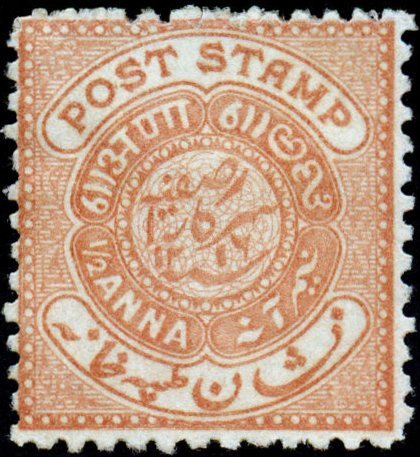
From 1871 the fuller framed designs supplied several values and continued through later printings. The quarter-anna blue of 1902 and the quarter-anna surcharge on a half-anna stamp belong to this longer low-value story. The grouped catalogue dates describe a family, not one day of issue for every stamp.[H14]
Plate numbers worked out by collectors
For the POST STAMP series of 1871, Rodger describes four Bradbury Wilkinson plates for each of seven values. The sheets carried no plate number, so the numbers in specialist studies were given by collectors, from recurring missing details. In his half-anna Plate 2, for example, the diamond above the long central character is missing at positions 7, 22, 37, 52, 67, 82, 97 and 112; his Plate 3 has a similar missing diamond, with a missing circle as well. It is the pattern, not a single blot, that makes the comparison work.[20]
Khusratullah and the locally made quarter anna
The quarter-anna blue of 1902 gives a local craftsman a name. The Stanley Gibbons Monthly Journal of 31 December 1902 (p. 108) relays Pyamji Shavakshah’s report that Abdul Ghany made two plates for the new quarter anna in Hyderabad, each with 96 subjects; the printed fraction is ¼, not four annas. J. Godinho’s account, reprinted in February 1913, also names Ghany as a local die engraver, and describes the need for a quarter anna and a surcharge on the half-anna vermilion while a new die was awaited.[15][16]
In July 1914 Captain H. F. Murland reported speaking at the Mint with the second engraver, whose name he printed as Abdul Chany. Chany denied making the plate and credited his brother Khusratullah, then still working as an engraver in Hyderabad. This is the original report behind Alexander Holland’s later attribution. The sources spell the name Abdul Ghany (1902), Abdul Chany (Murland) and Adbul Chany (Holland).[25][18]
Murland describes a design first engraved on steel, a “male die” taken from it, and repeated impressions struck into a carefully ruled mild-steel plate before hardening. He says two plates were reported, though he forgot to confirm it. Holland’s study of 1929 adds the retouching, two sheets of 96 in sixteen rows of six, and the labels Plate 1 and Plate 2.[25][18][21]
This is why the stamps can look individually different without ninety-six separate engravings. Holland used the retouches to reconstruct the plates, calling the fuller, more uniform one Plate 1 and the more heavily retouched one Plate 2; the sheets had no printed plate numbers. The year 1317 in the design is not the 1902 issue date. This steel die-and-plate method concerns the quarter anna of 1902, not the earlier skeleton plates.[25][18][21]
Five men and two plates at the Mint
Murland’s account shows the Mint at work. On his first visit five men were printing blue receipt stamps from two engraved steel plates on a hand press, the same method, he says, as for postage stamps. One man mixed the ink, a second rolled it onto the plate, a third wiped it with jute over a charcoal fire, and a fourth finished the wiping with a cloth dipped in French chalk. The fifth laid damp paper on the plate, added a leather pad and passed it through the press. The two plates moved between them so that one was ready while the other was printed.[25]
Making plates and printing were separate. Murland says most of the engraved steel plates then in use had come from Bradbury, Wilkinson & Co., while the printing he saw was done at the Hyderabad Mint. He also saw a Wharfedale surface-printing machine producing fiscal work, but said the Mint’s two Wharfedales had not yet been used for postage stamps. His account describes visits before 1914, not every later issue.[25]
Perforating, gumming and supplying the post
Murland lists four single-line guillotine perforating machines. He was told that Harold machine No. 3 was then the only one used for postage stamps; a new die plate punch had been fitted in about 1910, and its perforation matched 12½. Another Harold machine had holes of different sizes at its two ends but the same 12½ spacing, so the size of the holes and the gauge need separate attention.[25]
He watched gum being brushed onto sheets, which were hung on a line to dry. The stamps went from the Mint to the Government Treasuries on indent, and from there to post offices and stamp vendors.[25]
Seal and POSTAGE designs
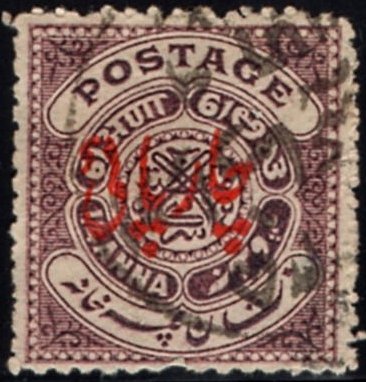
The POSTAGE family of 1905 and its later additions replaced the earlier frame. Plates made by Wyon and by Bradbury Wilkinson are told apart by drawing and measurement, not colour: Rodger gives the distance between the inner points of the side tablet as about 5 mm for Wyon and 7 mm for Bradbury. A plate maker’s credit is not proof that the sheets were printed in London.[H4][H14][22]
The POST & RECEIPT stamps of 1915–16 form another wording group. Read the inscription before giving a stamp a period; Sarkari and later new-value inscriptions are added markings with their own purposes.[H4][H14][22]
A design rejected before issue
According to Rodger, Allan Wyon prepared new POSTAGE plates in 1904. The quarter anna and half anna, with coloured lettering on a white ground, went on sale in 1905. The proposed one anna to twelve annas had white lettering on a coloured ground; thought indistinct, they remained proofs and were never issued.[21]
The replacement plates had coloured lettering on white and a different ornament for each value, but kept the Hijri year 1322. Rodger dates the one and two annas to late 1908, the three and four annas to 1909, and the eight and twelve annas to 1911. A design year, a proof and an issued stamp are three different things.[21]
The new Bradbury plates of 1912
Rodger’s next instalment identifies new Bradbury Wilkinson plates for the quarter-anna and half-anna POSTAGE stamps of 1912, again measured by the side tablet: about 5 mm for Wyon and 7 mm for Bradbury.[22]
Watermark and perforation have their own chronology. Rodger reports the same native-character watermark, and says perforations 11 and 13½ came into use in 1913, from the stamps he studied; they should not be assumed for every stamp of 1912. A stamp missing from his collection is not proof that a catalogue variety never existed.[22]
Paper, watermark and ink
Holland describes the 1902 quarter anna on white wove paper and puts some blue tint down to poor wiping of the plate; greasy ink could also blur details. A blue-looking scan is not evidence of a separate blue paper.[18][20][21][22]
Rodger warns that the native-character watermark of the Wyon group can be very faint, so a scan that does not show it is no proof of an unwatermarked variety. He treats missing crossbars on POST & RECEIPT stamps as probably caused by over-inking, not a new engraving. His account of the skeleton stamps mentions faint horizontal laid lines, but his checklist is not consistent on this, and deeply blued laid-paper proofs of 1871 are not normal paper varieties of the issued stamps.[18][20][21][22]
Reading a surcharge and an official marking
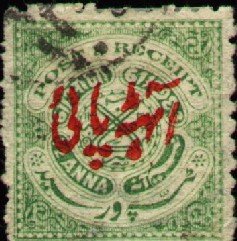
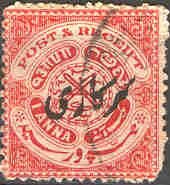
Two POST & RECEIPT stamps show two different jobs. A red eight-pies surcharge replaces the half anna’s value; a black Sarkari overprint on the red one anna marks it for official use and leaves its value unchanged. A stamp can carry both, so record the colour, wording, base design and value of each.[H14]
A black new-value surcharge is not necessarily Sarkari
The usual four-pies surcharge is red, but Rodger also records a black four pies on the purple quarter anna, so black ink alone does not tell whether a marking says four pies or Sarkari. Its status was debated. Rodger quotes Hurmuz Kaus’s view of 1945 that the black had been applied over red as a forgery, and Major H. B. Marcoolyn’s contrary report of a brief counter issue followed by withdrawal; Rodger’s own two copies showed no trace of red. It belongs with the qualified items, separate from the normal red surcharge and the black official overprint.[7]
Sources
- [7] J. Gordon Rodger, “The Stamps of Hyderabad—VII”, The Philatelic Adviser, pp. 10–14.
- [15] Stanley Gibbons Monthly Journal, vol. XIII, no. 150, 31 December 1902. New Issues and Varieties, Part I, Indian Native States: Hyderabad.
- [16] J. Godinho, extract from the January Philatelic Journal of India, reprinted in the Philatelic Journal of Great Britain, 20 February 1913.
- [18] Alexander Holland, Hyderabad: Issue of September 1902 – 1/4 Anna Blue, Collana di Pubblicazioni Filateliche no. 22, Turin: Editrice Filatelica, 1929, offprint from Filatelia.
- [20] J. Gordon Rodger, “The Stamps of Hyderabad—III”, The Philatelic Adviser, pp. 28–33, February 1947.
- [21] J. Gordon Rodger, “The Stamps of Hyderabad—V”, The Philatelic Adviser, pp. 7–10, 1947.
- [22] J. Gordon Rodger, “The Stamps of Hyderabad—VI”, The Philatelic Adviser, pp. 19–22, May 1947.
- [25] Capt. H. F. Murland, “Notes on the Stamps of Hyderabad”, The Philatelic Record XXXVI, no. 7 (July 1914), pp.115–119; no. 8 (August 1914), pp.125–126.
- [H4] Subhas Kulkarni, Hyderabad. The Stamp Magazine, February 1973, pp. 62–64.
- [H14] Evert Klaseboer, Indian States: Hyderabad. Early issues, perforations, officials and documented forgery comparison.
Notes 0
Add what you know: a cover or stamp in your collection, a date or source, a correction or a question.
No notes yet.
Sign in to add a note.
Notes show straight away. Keep them kind and about the article; anyone can report one that isn't. House rules
