
The 1942 Lotus and Airmail Stamps, and the Vichy Issues
Free France’s London-printed lotus and airmail stamps of 1942, and the Vichy stamps prepared in French India’s name but never sold there.
Updated July 6, 2026
In this article
The political message became part of a new stamp
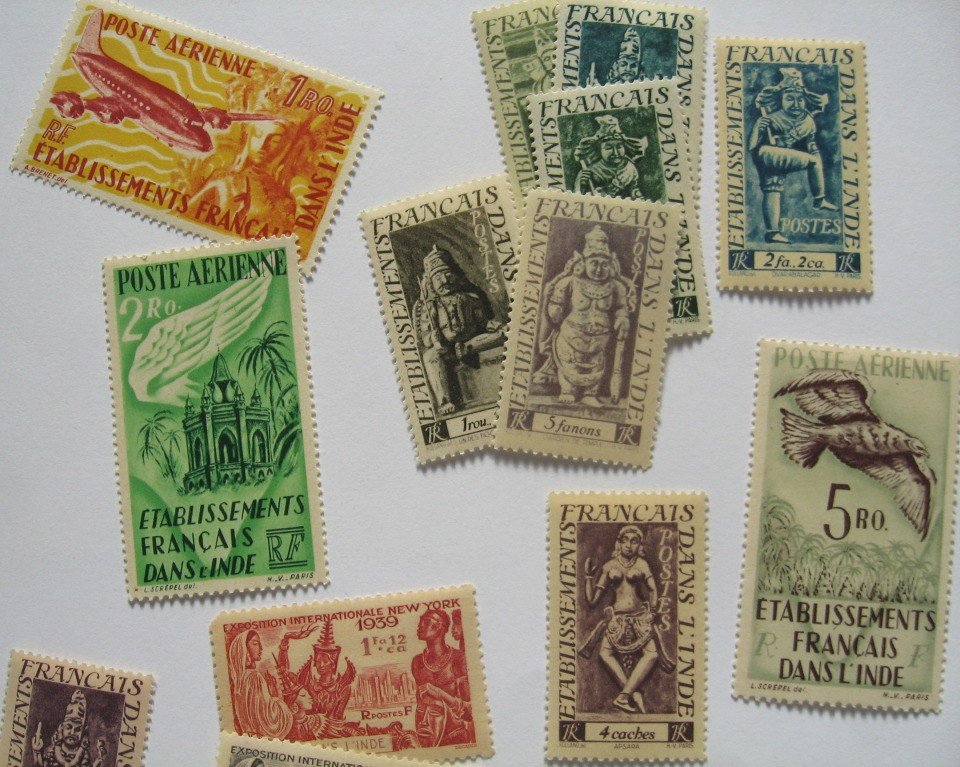
The 1942 lotus series was quite different from overprinting old stock. Its inscription and Cross of Lorraine were part of a new Free French design printed in London. The defence ministry counts fourteen values; Towler places them in a programme of twenty with the six airmails. This is a difference of design and production, not another overprint type.[1][2]
Start by asking whether the wording is part of the design or added later. The same political phrase does not mean two objects were made the same way. The difference shows how emergency local measures were followed by a purpose-made supply.[1][2]
The ordinary lotus stamps
The checklist gives fourteen lotus values, from low cache values to five roupies. It does not mean every value reached every settlement on the same day, or that later uses can be dated from the year of the design.[2][3]
The currency matters as much here as in the earlier pictorials. A fanon amount with caches is a compound value and the roupie a higher unit; write out the whole value before comparing a collection with an album or catalogue.[2][3]
| Year | Issue | Values |
|---|---|---|
| 1942 | Free French lotus | 2 ca, 3 ca, 4 ca, 6 ca, 12 ca, 16 ca, 20 ca, 1 fa, 1 fa 18 ca, 6 fa 6 ca, 1 r, 2 r, 3 r, 5 r |
Six airmails, a separate design
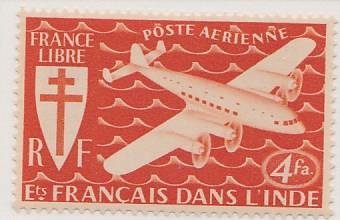
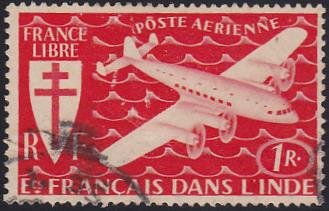
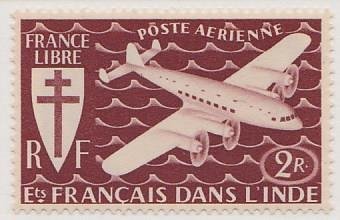
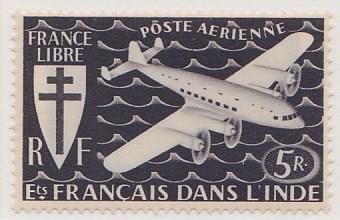
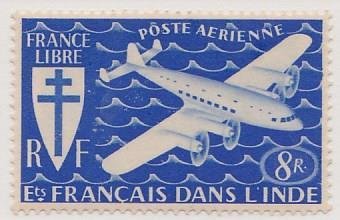
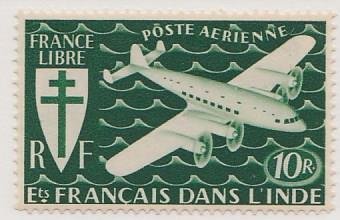
The programme also had six airmail values showing an aircraft above the waves. Their purpose and design set them apart from the lotus stamps, but an airmail stamp does not by itself prove that the cover it is on was flown: instructions, route and handling dates are still needed.[2][4][6]
A mint airmail set and covers can sit side by side without being treated as the same evidence. The set shows which designs and values were supplied; a flown cover shows one journey, as far as its own marks support it.[2][4][6]
The black value is five roupies, as in the current StampWorld table and the Steiner album, not the four roupies printed in an older list.[2][4][6]
| Year | Issue | Values |
|---|---|---|
| 1942 | Free French aircraft above the waves | 4 fa, 1 r, 2 r, 5 r, 8 r, 10 r |
Prepared elsewhere, never issued here
The Vichy government never controlled the Free French settlements in India, but it prepared stamps bearing their name. Towler treats them as a separate catalogue category, and the checklist names the Pétain and colonial charity stamps. Their existence is not proof that they were sold at any post office in India.[2]
A stamp can be genuinely printed for an administration that had no authority over the place it names, and a false local cancellation does not supply the missing link. Such stamps should be shown clearly as prepared and not issued, not with the fact hidden in a footnote.[2]
| Years | Issue | Values |
|---|---|---|
| 1941–1944 | Pétain; colonial charity stamps | 1 fa 16 ca, 4 fa 4 ca |
A premium adds another layer
Some wartime issues combined political identity with a charity supplement. Keep the postage and the extra amount separate, as with the earlier Red Cross stamps: a premium is a contribution built into the price, not money towards carriage.[2][5]
That holds whether a stamp was issued locally, prepared elsewhere or sold mainly to collectors. Status and value are separate facts: a genuine prepared charity stamp can be identified without claiming it was valid locally, and an issued airmail without claiming every cancelled copy was flown.[2][5]
A longer postal life
The lotus and airmail stamps stayed in use after 1942, alongside the new pictorials and commemoratives. Dated covers are needed to study how the wartime designs overlapped with the post-war issues, rates and administration.[2][1]
No census of complete panes, full printing record or inventory of recorded varieties exists yet; those questions need production records and identifiable objects.[2][1]
Designed by Edmond Dulac
An unsigned article of the time, “Free French Colonial Stamps: Designed by Edmond Dulac”, names Dulac as the designer, credits Major Joseph Hackin with choosing the lotus flowers over other subjects, and mentions help from the British Museum. In February 1942 it describes the Indian series as still in preparation and expects the common airmail design in the spring. These are the intentions of the administration that commissioned the stamps, not evidence of when stock reached India or went on sale.[8][9]
The Indian illustration in the article has no value, and the airmail illustration names French Equatorial Africa, so neither is an issued Indian stamp. The article names no aircraft maker or type. Hackin died on 24 February 1941 aboard the Jonathan Holt, according to his official biography, so his advice on the design must date from before that; the exact day is unknown.[8][9]
Printed by Harrison, not De La Rue
Colin Spong reproduces an inventory of Harrison & Sons material deposited at the National Postal Museum on 24 April 1989: the six French India airmail values in imperforate sheets of fifty, and the fourteen lotus values as de luxe proofs. His correspondence with former curators corrects an attribution to De La Rue. The sheets of fifty describe the deposited material, not necessarily the panes sold at post offices.[10][11][12]
The inventory lists fourteen ordinary values but ends its Yvert number range at 229, a discrepancy left as it is. Comparison material online that names De La Rue repeats numbers for the high lotus values and does not outweigh the archive inventory.[10][11][12]
A 2018 account by the Fondation de la Résistance discusses the photogravure printing and calls the aircraft only probably a DC-4. No engraver, cylinder history, quantities or delivery dates are known. The Ordre de la Libération holds, under 2B4, Philatélie, the wartime booklet in René Pleven’s collection. The original production papers and evidence of the first local sale are still to be found.[10][11][12]
Sources
- [1] French Ministry of the Armed Forces, Chemins de mémoire, “Un timbre «France libre» pour les établissements français dans l’Inde”: February 1941 overprints, London sales and 1942 lotus series.
- [2] Bernard Towler, “Forgotten Countries: French Indian Settlements”, The Stamp Lover, June 1999; reprinted in IND DAK, September 1999, p. 177.
- [3] Evert Klaseboer, online catalogue, French India 1914 onwards: denomination verification for pictorial, currency-conversion and Free French families.
- [4] Evert Klaseboer, online catalogue, French India miscellaneous: postage dues, airmails and late commemoratives.
- [5] StampWorld, French India, 1914 definitives and 1915–1916 Red Cross.
- [6] StampWorld, French India, postage 1940–1949, page 3,1942 airmail entries 233–238.
- [8] “Free French Colonial Stamps: Designed by Edmond Dulac,” La Lettre de la France Libre no.15, February 1942, pp.13–15.
- [9] Ordre de la Libération, official Joseph Hackin biography; death 24 February 1941.
- [10] Colin Spong, “The Year of Edmund Dulac,” Journal of the France & Colonies Philatelic Society, September 2000, pp.97–99.
- [11] Bruno Leroux and Frantz Malassis, “Les timbres de la France libre gravés par Edmond Dulac,” La Lettre de la Fondation de la Résistance 92, March 2018, p.VII.
- [12] Ordre de la Libération, thematic archive inventory, September 2024, pp.1–3; 2B4.
Notes 0
Add what you know: a cover or stamp in your collection, a date or source, a correction or a question.
No notes yet.
Sign in to add a note.
Notes show straight away. Keep them kind and about the article; anyone can report one that isn't. House rules
