
Free France, 1941: the FRANCE LIBRE Overprints
French India joined Free France in September 1940; from February 1941 old stamps were overprinted FRANCE LIBRE, many of them for sale to collectors in London.
Updated July 25, 2026
In this article
A political decision enters the stamp
In September 1940 the settlements joined Free France under Governor Louis Bonvin, and existing stamps became a way to show the new allegiance. The French defence ministry’s study dates the first large overprinting to February 1941, with FRANCE LIBRE on earlier issues. The political event and the overprinting are two different stages.[1][2]
Short histories can run together a rally, a proclamation and the postal measures that followed, so the September date is not used to date individual stamps. A stamp is identified from its own overprint and base stamp, with a dated cover or order where one exists.[1][2]
Many older issues received the new wording
The Brahma and temple definitives, exhibition stamps and other stock supplied the bases. Each overprinted stamp has at least two histories, the date of its design and its later political treatment: a 1937 exhibition stamp overprinted FRANCE LIBRE keeps both identities.[2][3]
This also avoids confusing the overprint with a currency surcharge. FRANCE LIBRE names an allegiance; a new figure changes the value. When both appear, record them separately; which was applied first needs a documented setting or production account.[2][3]
Printed and handstamped overprints
The ministry describes both printed and handstamped overprints in the 1941 programme. Towler also separates horizontal and diagonal wording and the later forms with the Cross of Lorraine. These are physical categories, not spellings of one stamp, and the size, spacing and alignment of the letters matter in identifying them.[1][2]
An uneven strike may fit hand application but does not prove it, and a neat one can be false. Record the base stamp, the colour and direction of the overprint, the presence of the cross and any new value before comparing catalogue numbers. No complete reconstruction of the settings, or proven test for every forged overprint, exists yet.[1][2]
Sales to collectors were part of the plan
The ministry reports that a large share of the first overprints was sent to London for sale to collectors, which gave the issue a financial purpose as well as a political one. Mint survival, sales to collectors and local commercial use are different questions and should not be merged into one assumption about normal circulation.[1][3]
A mint stamp can be entirely genuine even if it was sold to a collector rather than used on a letter. A cancellation, in turn, does not prove a real commercial rate: a cover needs its date, address and handling marks, the more so since earlier accounts mention sales to collectors and cancelling to order.[1][3]
A letter under controlled communication
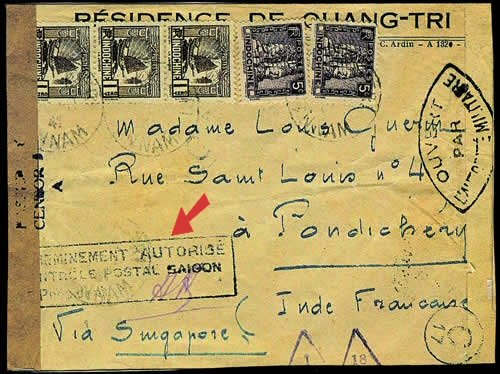
An envelope with Indochina stamps addressed to Pondicherry carries an endorsement authorising its forwarding, linked to the military postal service in Saigon. It shows controlled correspondence between administrations; it does not show that every letter on that route was accepted on the same terms.[4]
This is incoming mail, with Indochina stamps and a French India address, not a French India stamp going out. It widens the wartime picture while keeping the stamps’ issuer clear. Its face alone gives neither an exact year nor every stage of the journey.[4]
Keep issue, status and use together
A wartime page can set a base stamp beside its authorised overprint and a documented cover, and say what each adds: the stamp shows the printing and wording, an order gives the authority, a letter may show a dated use. None of them alone accounts for quantities, distribution and survival.[2][1][3]
The Free French overprints must also be kept apart from the stamps prepared by Vichy and from the new designs printed in London in 1942. All appear under French India in the catalogues, but they had different relationships with the post office in India.[2][1][3]
Sources
- [1] French Ministry of the Armed Forces, Chemins de mémoire, “Un timbre «France libre» pour les établissements français dans l’Inde”: February 1941 overprints, London sales and 1942 lotus series.
- [2] Bernard Towler, “Forgotten Countries: French Indian Settlements”, The Stamp Lover, June 1999; reprinted in IND DAK, September 1999, p. 177.
- [3] “The France Toujours Issue of French India”, France & Colonies Philatelist, no.55, vol.10, no.1, January–February 1951, pp. 1–2; translation from L’Officiel de la Philatélie, 15 June 1946, reporting the 6 March 1943 government order and postal-administration report.
- [4] Wikimedia Commons, File: Lettre pour inde gaulliste.jpg.
Notes 0
Add what you know: a cover or stamp in your collection, a date or source, a correction or a question.
No notes yet.
Sign in to add a note.
Notes show straight away. Keep them kind and about the article; anyone can report one that isn't. House rules
