
French India Postal Stationery: Envelopes and Cards
Envelopes and cards with printed postage from Karikal, Yanaon and Mahé, and why the whole object is worth keeping intact.
Updated October 10, 2026
In this article
Start with the object itself
A stationery envelope or card has its postage printed into the object. Its size, heading, printed instructions and format can set it apart from a loose stamp of the same value, and cutting out the printed stamp throws away evidence of the stationery type and often of its use.[1]
Stationery connected with French India also includes Indian forms used at offices in or near the settlements. They belong to its postal geography, but their issuer must stay named: a French settlement postmark or address does not turn an Indian printed value into a French India design.[1]
An envelope with added stamps
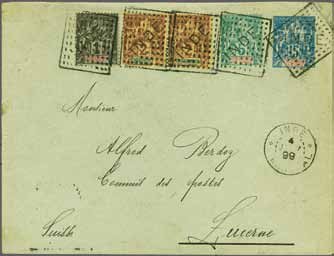
A Karikal envelope has a printed 15 centimes and added 1, 2 and 5 centime stamps, the 2 centimes twice, for a total of 25 centimes. Corinphila dates it 4 January 1899 and records its arrival at Lucerne on 21 January.[1]
The sum is useful but does not prove the tariff: the letter’s weight and service would be needed to show why 25 centimes was due, and its reported Bombay–Brindisi route depends on the back of the cover. Either way, the printed value has to be counted before any total can be tested.[1]
A card with a message and a picture
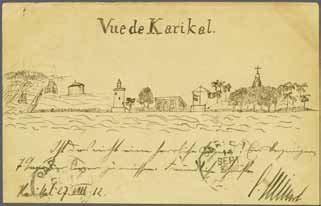
A Karikal ten-centime card of 1912 to New York has a hand-drawn Vue de Karikal on the back. A caption should say which side is shown, so the drawing is not taken for a stamp design.[1]
The message side can show a place, a date or a personal link that the address side cannot. Keep both sides together. A drawing can make a stationery card look like a picture postcard, but its class depends on its printed value and format, not on the picture.[1]
A general colonial card used at Yanaon
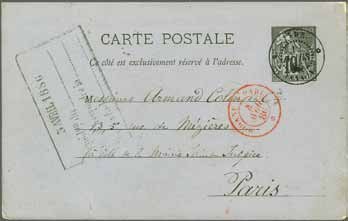
Corinphila lot 582 is a ten-centime Dubois postal card with the postmark INDE/YANAON, posted on 12 March 1886 and carried by Bombay and Suez and on by French railway. Its printed French instructions and value identify the card; the local postmark shows where it was used.[1]
The date is before the Navigation and Commerce stamps of 1892, so a stationery collection cannot simply follow the dates of the territory’s own stamps. The card is a different kind of object, and its use belongs to the earlier general colonial history of the settlement.[1]
A printed card is not necessarily stationery
The Yeomans collection also has a printed card from Mahé franked with two ten-centime Cérès stamps. A decorative border and postal instructions do not make it stationery with printed postage; find how it was paid before giving it a class.[1]
This matters when transcribing an auction description or an inherited collection. Note whether the value is printed, a stamp, a provisional mark or not visible on the side shown, and do not make up a stationery value from the stamps on it.[1]
Record the object and its use separately
A good stationery record has one set of fields for the object (class, printed value, wording, size and format) and another for its use (posting date, office, added stamps, destination and back-stamps). Two similar envelopes can then be compared without assuming that different frankings mean different stationery issues.[1][2]
These examples are a few documented objects and uses, not a catalogue of every envelope, card, reply card or printing; a fuller list needs a specialist stationery reference and more complete specimens.[1][2]
Sources
- [1] Corinphila, 291st auction, November–December 2022, John Yeomans FRPSL French India collection, printed pp. 121–142, lots 497–583.
- [2] India Study Circle, minutes of meeting held 15 December 2007, signed by chairman Martin Blatt 7 March 2008.
Notes 0
Add what you know: a cover or stamp in your collection, a date or source, a correction or a question.
No notes yet.
Sign in to add a note.
Notes show straight away. Keep them kind and about the article; anyone can report one that isn't. House rules
