
Reading French India Covers: Postmarks, Routes and Rates
How to read the marks, routes and charges on French India letters, from PAID in 1845 to a wartime airmail cover of 1945.
Updated August 25, 2026
In this article
Different marks do different jobs
A datestamp gives an office and a date, an obliterator cancels a stamp, and PD or a charge mark is about payment. All can appear on one letter without any one of them proving the whole journey. Start by transcribing each separately and noting whether it is on the front, the back or the folded sheet.[1]
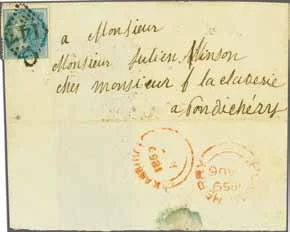
The Karikal–Pondicherry letter of 1859 combines an Indian stamp, the C/147 obliterator and dated office marks. Its value lies in the combination; a part numeral on a loose stamp would say far less about where the letter came from and where it went.[1]
PAID was not an unlimited promise
The 1845 Pondicherry–Marseille letter in Heath’s exhibit records one anna paid for the Indian stage only, which is why a PAID mark at the start can sit beside a later charge abroad. The payment covered a defined service.[2][1]
A rate reconstruction keeps each currency and step apart. Annas charged in India and décimes charged in France cannot simply be added; the dated route and the exchange arrangements must explain how each charge was raised or credited.[2][1]
A route needs more than a ship’s name
Corinphila’s descriptions link particular letters with Madras, Bombay, Galle, Suez, Marseille or Brindisi and with named ships. These are useful attributions, but not every stage shows on the front, and a sender’s endorsement gives the route asked for, which may differ from the route taken.[1]
Keep apart the instruction in the address, the transit marks you can see and the catalogue’s reconstruction. An arrival mark narrows the dates but can still leave a gap between ports; a familiar steamer working in the region that year does not prove the voyage.[1]
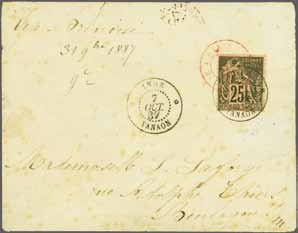
A Yanaon letter to Boulogne, Corinphila lot 583, was posted on 7 October 1887 with a 25-centime stamp, INDE/YANAON datestamps and a red French railway mark. The full Bombay–Suez route and the arrival on 31 October depend on more than the front.[1]
Find the class of rate before calculating
The published collection of tariff notices separates inland, Franco-colonial, foreign and airmail rates. That matters more than the value printed on a stamp: the rate to France is not the rate to a nearby Indian address, and an airmail fee can be an addition to the ordinary postage rather than a replacement.[3]
The notices also show that the date of an order and the date it took effect are not always the same, and that later records are incomplete. Treat any rate table as a dated transcription, keeping its weight and service headings; there is not yet a continuous tariff for every class.[3]
Incoming mail to Mahé
An 1867 letter from Amsterdam to Mahé, Corinphila lot 574, shows the other direction. It was posted at Amsterdam on 18 April, with FRANCO and P.P. marks, the sender’s instruction to go via Marseille and Suez by English mail, and an INDE/MAHÉ arrival mark of 17 May. The catalogue gives the Suez–Bombay stage to the P&O steamer Madras. That is one letter, not the route of all mail from the Netherlands to India.[1]
The endorsement records the route the sender asked for and the arrival date limits the sequence; the ship is the catalogue’s reconstruction. A route description is most useful when it says which facts are on the front, which need the back, and which come from a specialist shipping reference.[1]
Check the stamp and the cancellation separately
Fournier’s PONDICHERY 1 FEVR 92 INDE imitation shows that a convincing place name is not enough. A false mark can come with false material, or be added to a genuine stamp to create a territorial or special use, so authentication looks at the design, the material, the cancellation and the whole object together.[4][1]
Keep a word-for-word description and the basis for each conclusion. A certificate mentioned in an auction is a report until the certificate is seen, and an author’s claim of rarity belongs to the date of the study.[4][1]
Pondicherry to France in 1945: a charge that can be tested
Histoire et philatélie describes a letter from Pondicherry to Argenton-sur-Creuse dated 23 February 1945, sent via Algiers with 10 fanons 6 caches in stamps. The front shows two orange four-fanon aircraft stamps, two older overprinted pictorials, an airmail label, “Via Alger”, censorship marks and the French address; the date is the publisher’s. This is a cover with the aircraft stamps, not the lotus stamps.[5][6]
Governor Louis Bonvin’s order of 9 November 1944 cancelled the order of 31 October and set an air supplement to France via Algiers of 4 fanons 18 caches per 5 grams, so the October rate does not apply to a February cover. A separate inland schedule of 9 April 1943 gives 18 caches for an ordinary letter up to 11.66 grams, and the November order links the inland charge to the Franco-colonial and intercolonial rate. A different table of 6 February 1943 shows why a nearby tariff date is not enough.[5][6]
At 24 caches to the fanon, 10 fanons 6 caches is 246 caches. Two air steps of 4 fanons 18 caches make 228 caches, and 18 more make 246. That fits a letter over 5 and up to 10 grams under this reading of the combined rate. It is an inference, not proof of the weight, of the cover’s authenticity or of a particular flight; better images of both sides and the notices in between are still needed.[5][6]
The penny postage agreement behind the Canadian statement
The Canada Year Book of 1910 states that the Imperial penny postage covered both the British and the French offices in the French settlements (see British Offices in French India and the Exchange of Mail). New Zealand parliamentary papers (F.–7, 1909 Session II, nos. 16 and 18, pp. 5–6) report Lord Crewe’s request of 29 April 1909 for agreement and Findlay’s reply of 21 June: the first describes reciprocal treatment of the French offices, the second mentions only the British offices. These come from indexed transcriptions and are leads, not checked quotations.[7][8][9]
The same despatch reprinted in A.–2 (1910), no. 16, is a republication, not a second agreement. A Cyprus index names regulation 498 of 10 March 1911 and Gazette 1004 of 31 March 1911, but the regulation itself has not been read. The dates of a regulation, its publication and its coming into force are kept apart, and the original pages are needed before either the diplomatic timeline or a Cyprus rate is adopted.[7][8][9]
Sources
- [1] Corinphila, 291st auction, November–December 2022, John Yeomans FRPSL French India collection, printed pp. 121–142, lots 497–583.
- [2] Henry W.Heath, French India—Pondicherry, undated exhibit leaf 5: letter to Marseille dated 11 December 1845, via Madras 13 December 1845.
- [3] Histoire et philatélie, “Tarifs postaux des Établissements français dans l’Inde 1923–1952”, index and transcription references to the 13 October 1923 official notice.
- [4] Evert Klaseboer, online catalogue, French India 1892–1913: early issues, provisional surcharges and Fournier examples.
- [5] Histoire et philatélie, French Indian establishments: Pondicherry–Argenton cover.
- [6] Histoire et philatélie, reproduced orders of 6 February and 9 April 1943, 31 October and 9 November 1944.
- [7] The Canada Year Book 1910, printed p.xlv.
- [8] New Zealand F.–7 (1909 Session II), nos.16,18, pp.5–6.
- [9] Cyprus compilation index, regulation 498 and Gazette 1004.
Notes 0
Add what you know: a cover or stamp in your collection, a date or source, a correction or a question.
No notes yet.
Sign in to add a note.
Notes show straight away. Keep them kind and about the article; anyone can report one that isn't. House rules
