
French India Joins India: Chandernagore, 1950, and the Four Settlements, 1954
Chandernagore passed to India in stages from 1949 to 1954; Pondicherry, Karaikal, Mahé and Yanam were handed over on 1 November 1954, the legal transfer completed in 1962.
Updated November 7, 2026
In this article
Two separate transfers
French India did not pass to India in one event. Chandernagore followed its own, earlier sequence, while Pondicherry, Karaikal, Mahé and Yanam handed over their administration in 1954. The difference matters for late covers, official headings and captions, and a convenient last year in a stamp catalogue cannot stand in for either.[1][2]
The sources here are the official Chandernagore treaty and the Government of Puducherry’s Gazetteer. They fix the legal and administrative milestones; they do not, by naming a transfer date, fix the last day on which every earlier stamp or stationery form was accepted.[1][2]
Chandernagore: from a vote to an Indian administrator
The preamble of the Chandernagore treaty records the consultation of the people held on 19 June 1949 and the appointment of an Indian administrator on 2 May 1950 as a provisional measure. It separates the people’s decision from the later change of administration; saying simply that the town joined India in 1949 loses that difference.[1]
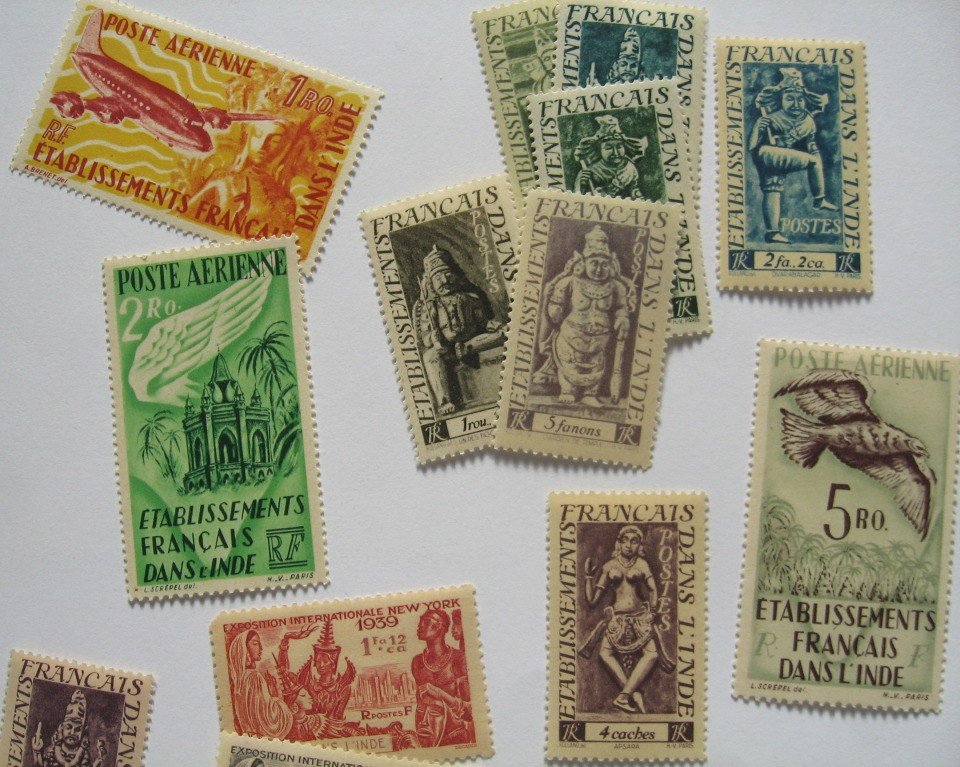
For a postal object, describe its dated evidence and wording before giving it a political label. A late French design on a cover does not show which stage of the transfer had been reached.[1]
Signature and entry into force
The Treaty of Cession of the Free Town of Chandernagore was signed in Paris on 2 February 1951. Its United Nations publication states that it entered into force on 9 June 1952, with the exchange of ratifications. The municipal history records the town’s incorporation into West Bengal on 2 October 1954.[1][3]
These are not rival answers to one question. Signature, legal effect and incorporation into a state are different acts, and a clear timeline says what each date stands for.[1][3]
| Date | Event |
|---|---|
| 19 June 1949 | Consultation of the people, recorded in the treaty preamble |
| 2 May 1950 | Indian administrator appointed, provisionally |
| 2 February 1951 | Treaty signed in Paris |
| 9 June 1952 | Treaty in force |
| 2 October 1954 | Incorporated into West Bengal |
The handover of the four settlements
The Puducherry Gazetteer records the agreement between India and France of 21 October 1954 and the transfer of administrative powers on 1 November. Pierre Landy for France handed over to Kewal Singh for India. This was the de facto transfer, separate from the treaty of 1956 and its ratification in 1962.[2]
The Gazetteer also describes how the new administration was organised and how institutions carried on during the transition, which is why administrative history cannot be reduced to everything old disappearing at the moment of handover. Postal changes need their own dated evidence.[2]
The 1956 treaty and the 1962 ratification
For the four settlements the Gazetteer dates the Treaty of Cession to 28 May 1956, signed in New Delhi, and the French parliament’s ratification to July 1962; the ratifications were exchanged on 16 August 1962. It then follows the constitutional and administrative arrangements into 1963.[2]
A study of the late period therefore separates de facto Indian administration from the later legal completion of the transfer. The two dates do not mean two posts ran every office side by side; what a post office accepted still has to be shown from postal notices and identifiable letters.[2]
| Date | Event |
|---|---|
| 21 October 1954 | Agreement on the future of the settlements |
| 1 November 1954 | Administrative powers transferred to India |
| 28 May 1956 | Treaty of Cession signed |
| 16 August 1962 | Ratifications exchanged; legal transfer complete |
The last stamp and the last accepted use
The last French India designs and the last accepted use of older stamps need postal documents. A 1954 commemorative, a treaty signature and a ratification are not interchangeable postal cut-off dates, and no single final day of validity is known from an official notice.[2][1][4]
A strong closing section keeps dated covers and cards from both sides of the handover, with their original headings and office marks, and keeps political commemoratives apart from mail actually handled during the transfer.[2][1][4]
Sources
- [1] Treaty of Cession of the Territory of the Free Town of Chandernagore, signed 2 February 1951, United Nations Treaty Series, vol.203(1955), no.2744, p. 156, French text p. 157.
- [2] Government of Puducherry, Gazetteer, “The period of transition (1954–1963)”, printed pp. 878–881.
- [3] Chandernagore Municipal Corporation, historical introduction: 2 May 1950, 9 June 1952 and 2 October 1954 transfer milestones.
- [4] Bernard Towler, “Forgotten Countries: French Indian Settlements”, The Stamp Lover, June 1999; reprinted in IND DAK, September 1999, p. 177.
Notes 0
Add what you know: a cover or stamp in your collection, a date or source, a correction or a question.
No notes yet.
Sign in to add a note.
Notes show straight away. Keep them kind and about the article; anyone can report one that isn't. House rules
