
French India: Stamps and Postal History
Five French settlements in India, one stamp programme and several postal networks, from the first English offices to the transfer to India in 1954.
Updated November 4, 2026
In this article
A French India stamp can tell three stories at once: the place where a letter began, the administration that carried it, and the political authority named on the stamp. The five settlements shared one colonial stamp programme but depended on several routes and on neighbouring postal services. This overview follows them through the surviving postal evidence; the articles listed at the end take each period and subject in detail.
Five settlements, several postal geographies
French India was a group of separate coastal and river settlements, not one province. Pondicherry, now Puducherry, was the capital on the south-eastern coast. Karaikal lay farther south; Yanam, Yanaon in French records, lay to the north-east near the Godavari delta. Mahé was on the Malabar coast, across the peninsula, and Chandernagore, now Chandannagar, on the Hooghly near Calcutta. One territory name on a stamp therefore covers very different places of posting.[1][2][20]
The place-name forms are evidence in themselves. PONDICHERY, KARIKAL, MAHE, YANAON and CHANDERNAGOR appear in French markings, while an Indian office could use another spelling. Each settlement had its own links with the Indian territory around it, and a letter could cross a border within a short distance of its origin, long before it reached an ocean-going ship.[1][2][20]
By the nineteenth century these settlements were what remained of a much larger contest for trade and influence, and their administration had changed hands repeatedly during European wars. Postal dates have to be read against those changes: a British office in a French settlement is a historical fact, not necessarily a misidentified cancellation.[1][2][20]
| Settlement | French postal form | Setting |
|---|---|---|
| Puducherry | Pondichéry, Pondichery | South-eastern coast; capital |
| Karaikal | Karikal | South-eastern coast, south of Pondicherry |
| Mahé | Mahé, Mahe | Malabar coast, south-western India |
| Yanam | Yanaon | Near the Godavari delta, eastern India |
| Chandannagar | Chandernagor, Chandernagore | Hooghly river, Bengal |
The post before French India had its own stamp
English post offices worked in the settlements before French India issued stamps. Madeleine Jamet places an English office at Pondicherry from 1787 and at Chandernagore from 1809, and dates the Yanaon office to 1876; the openings at Karikal and Mahé are not known. These are the histories of offices, not the dates of the first French stamps.[2][3][4][5][6]
The marks of the period make this concrete. Henry Heath’s exhibit records a Pondicherry despatch of 21 August 1818 to Karikal and another of 2 September 1835 to Madras. A later boxed PONDICHERY PAID mark left the date to be written by hand, so the struck mark and the written date together hold information neither has alone.[2][3][4][5][6]
A letter sent to Marseille on 11 December 1845 travelled via Madras, marked 13 December, with one anna paid for the Indian postage only. It did not become fully prepaid because PAID was struck at the start: the local payment covered one stage. Jamet also records an English Chandernagore mark on a letter of 23 May 1826 to Kishnagore, evidence of a working service under an administration other than the French one.[2][3][4][5][6]
From the general colonial issues to Navigation and Commerce
Before 1892 the French offices used the general stamps of the French colonies. The design alone does not show where such a stamp was used; a readable local cancellation such as INDE or PONDICHERY is needed, and an unused general colonial stamp cannot be called French India because it looks like one found there.[1][8][11][24]
In 1892 the colony’s name entered the design. The Navigation and Commerce issue, often called the Tablet series, carries ETABLISSEMENTS DE L’INDE in the lower panel; thirteen first values were printed in Paris. The same allegorical design served many French possessions, so the inscription is what identifies the stamp.[1][8][11][24]
Later colours and values extended the series. A ten-centime black and a ten-centime red are not faded copies of one printing, and two stamps of the same value are not necessarily the same issue.[1][8][11][24]
The 1903 provisionals: new values on old stock
Local shortages led to surcharges. The 25-centime stamp was surcharged five, ten and fifteen centimes, and the 50-centime forty centimes. A fiscal stamp was also overprinted INDE FRANÇAISE POSTES with a value of 0.05, a documented conversion of one revenue design, not a reason to treat every French Indian fiscal as postage.[1][8]
The overprint and the stamp underneath need separate examination: record the new value, the original value, the colour of the overprint and the position of the bars or wording. A forged surcharge may sit on a genuine stamp, and an irregular local impression is not automatically false. The literature dates these provisionals to 1903 and one online catalogue to 1904, so they are given here as 1903–1904.[1][8]
Brahma, the temple and a new currency
The 1914 definitives replaced the shared allegory with local subjects: Brahma on the low values and a temple near Pondicherry on the high ones. These designs came back with new colours, wartime charity inscriptions and currency surcharges, one continuing design history rather than a run of unrelated pictures.[1][7][22][24]
From 1923 the stamps changed from centimes and francs to caches, fanons and roupies. Old stock was surcharged, and later printings carried the local units in the design, so the abbreviation matters: a figure followed by C (centimes) is not the same as one followed by CA (caches). The usual reckoning for the later stamps is 24 caches to the fanon and eight fanons to the roupie, but it should not be applied to every older money account: Maurice Tyler’s study of 1995 shows how older exchange manuals contradict one another.[1][7][22][24]
The official tariffs also separate local, Franco-colonial and international rates, and exchange-rate notices set the franc prices of stamps sold in local units. The exchange rate and the postage are related questions, but not the same entry in a rate table.[1][7][22][24]
Wartime allegiance written over the old designs
In September 1940 Governor Louis Bonvin brought the settlements over to Free France. In February 1941 existing stamps were overprinted FRANCE LIBRE, by printing or by handstamp. The French Ministry of Defence counts thirty-one stamps and one souvenir sheet in that operation, a large share of them sent to London for sale to collectors: postal use and fundraising were both part of the story.[14][15][1]
The wording declared an allegiance; it did not make a stamp an official stamp. Postage dues, charity premiums and stamps prepared by the Vichy administration are separate categories, and a Vichy-printed stamp bearing French India’s name is no evidence that a post office in the Free French settlements ever sold it.[14][15][1]
Later overprints added the Cross of Lorraine, changed direction or added a new value. The 1942 lotus series was a new issue printed in London for Free France, not an old stamp with a local handstamp. A government order of 1943 authorised FRANCE TOUJOURS overprints on selected older definitives and exhibition stamps; the published 1951 transcription of the official report contains corrections and a mismatch in the number of blue overprints, a reason to treat its totals with care.[14][15][1]
Postage dues and stationery
Postage due stamps record money to be collected, not postage paid by the sender. French India first used French dues surcharged in local currency, then the INDE FRANÇAISE À PERCEVOIR design of 1929 and the ornamental TIMBRE TAXE series of 1948. A due on an incoming letter belongs to the history of its delivery, not necessarily to the office where it was posted.[10][12][23]
Stationery belonged to the same system. A Karikal envelope of 4 January 1899 has a printed fifteen centimes, made up with stamps and cancelled with the dotted INDE mark and the local datestamp; it travelled via Bombay and Brindisi to Lucerne. A Karikal ten-centime card of 1912 to New York is another dated example. Keep such items whole: the printed value, format, address, message, added stamps and transit marks explain far more than a cut-out stamp.[10][12][23]
After the war: Indian imagery and airmail
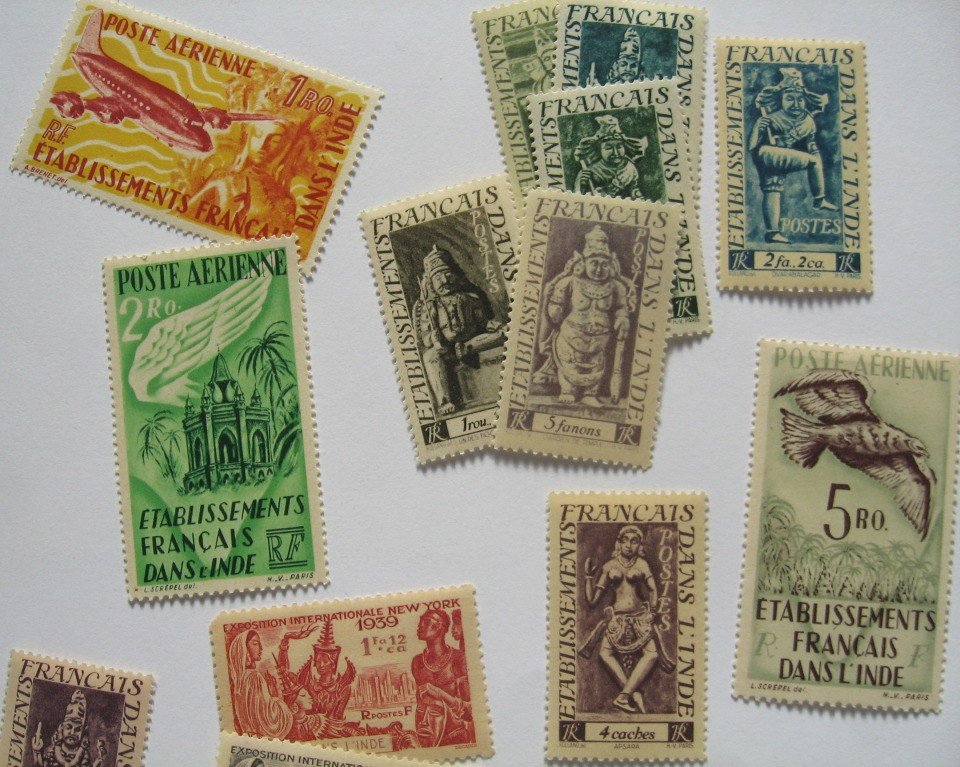
The pictorials of 1948 gave French India a distinctive range of religious figures and sculpture. The six-fanon airmail of 1949 for the 75th anniversary of the Universal Postal Union shared its design with other French territories. A registered cover posted at Pondicherry on 1 October 1949 with that value reached Soissons on 12 November; the published rate study calls the postage excessive for a simple registered letter and notes that the long journey does not suggest it flew. POSTE AERIENNE on the stamp does not prove that the letter went by air.[1][13][10][21]
The separate airmails of 1949, at one, two and five roupies, show an aeroplane and goddess, a wing above a temple, and a bird above a tropical landscape. Common-design issues continued with the Military Medal of 1952 and the Liberation anniversary of 1954. The political transfer, the last new design and the last lawful use of an old stamp are different dates.[1][13][10][21]
Reading the cancellation without losing the journey
A full description names both the territorial administration and the office that handled the letter. An Indian stamp cancelled at Karikal can be a genuine French India item without being a French India stamp: a letter of 1859 from Karikal to Pondicherry carries an Indian one-anna stamp cancelled C/147, with its dates of posting and arrival on the back.[23][3][6][8]
For the general colonial issues a local postmark may be the only link to the territory. For the Navigation and Commerce stamps, check the lower inscription as well as the datestamp: Fournier forgeries of the common design are documented, including a false PONDICHERY 1 FEVR 92 INDE mark found on more than one type of imitation. A crisp date is no guarantee.[23][3][6][8]
A mixed franking has to be shown, not assumed from two different stamps on a cover. Check that each stamp was tied by the right office, that the rate and route fit the date, and that transit marks support the hand-over; an added stamp or a favour cancellation can make an attractive cover without two posts having carried it.[23][3][6][8]
Chandernagore followed its own timetable
Chandernagore’s transfer came before that of the four southern settlements. Its referendum was held on 19 June 1949; Indian administration began on 2 May 1950; a treaty was signed in Paris on 2 February 1951 and came into force on 9 June 1952; and the town became part of West Bengal on 2 October 1954. Saying it joined India in 1949 confuses the decision with the later stages.[16][17][18][19]
For Pondicherry, Karaikal, Mahé and Yanam an agreement was signed on 21 October 1954 and power passed to India on 1 November 1954, the de facto transfer. The Treaty of Cession was signed on 28 May 1956, and the legal transfer was complete with the exchange of ratifications on 16 August 1962, which is why both 1954 and 1962 appear in accounts of the end of French India. A Chandernagore cover of 1951 and a Pondicherry cover of 1951 therefore belong to different administrations.[16][17][18][19]
| Territory | Administrative transfer | Legal transfer, later status |
|---|---|---|
| Chandernagore | 2 May 1950 | Treaty in force 9 June 1952; West Bengal 2 October 1954 |
| Pondicherry, Karaikal, Mahé, Yanam | 1 November 1954 | Treaty signed 28 May 1956; legal transfer 16 August 1962 |
The stamps
The issues and their values, from the research checklist. Official stamps and the varieties of each issue are not listed; dues, charity premiums and stamps prepared but not issued locally are marked as such.
| Period | Issue | Values |
|---|---|---|
| Before 1892 | French colonies general designs (colonial general issues) | Territorial use established by cancellation |
| 1892 | Navigation and Commerce / Tablet | 1 c, 2 c, 4 c, 5 c, 10 c, 15 c, 20 c, 25 c, 30 c, 40 c, 50 c, 75 c, 1 fr |
| 1900–1907 | Tablet: new colours and values | 10 c, 15 c, 25 c, 35 c, 45 c, 50 c |
| 1903–1904 | Tablet revaluations (postage surcharge) | 5 c on 25 c, 10 c on 25 c, 15 c on 25 c, 40 c on 50 c |
| 1903 | INDE FRANÇAISE POSTES on fiscal stamp (fiscal adapted for postage) | 0.05 fr |
| 1914; later colours | Brahma | 1 c, 2 c, 3 c, 4 c, 5 c, 10 c, 15 c, 20 c, 25 c, 30 c |
| 1914; later colours | Temple near Pondicherry | 35 c, 40 c, 45 c, 50 c, 75 c, 1 fr, 2 fr, 5 fr |
| 1915–1916 | Red Cross on Brahma (charity surcharge) | 10 c+5 c |
| 1920s | Small-value provisionals on 15 c (postage surcharge) | 1 c, 2 c, 5 c |
| 1920s | French dues surcharged in local currency (postage due) | 6 ca on 10 c, 12 ca on 25 c, 15 ca on 20 c, 1 fa 6 ca on 30 c, 1 fa 12 ca on 50 c, 1 fa 15 ca on 5 c, 3 fa 3 ca on 1 fr |
| 1923–1928 | Caches/fanons/roupies on pictorials (currency surcharge) | 1 ca, 2 ca, 3 ca, 4 ca, 6 ca, 10 ca, 12 ca, 15 ca, 16 ca, 18 ca, 20 ca, 1 fa, 1 fa 3 ca, 1 fa 6 ca, 1 fa 12 ca, 1 fa 16 ca, 2 fa 9 ca, 2 fa 12 ca, 3 fa 3 ca, 6 fa 6 ca, 1 r, 2 r, 3 r, 5 r |
| 1928 | French dues with barred value surcharges (postage due) | 4 ca on 20 c, 1 fa on 30 c, 1 fa 15 ca on 5 c, 3 fa on 1 fr |
| 1929 onwards | Brahma in local currency | 1 ca, 2 ca, 3 ca, 4 ca, 6 ca, 10 ca, 16 ca, 18 ca, 20 ca |
| 1929 onwards | Temple in local currency | 12 ca, 1 fa, 1 fa 6 ca, 1 fa 12 ca, 1 fa 16 ca, 2 fa 12 ca, 6 fa 6 ca, 1 r, 2 r, 3 r, 5 r |
| 1929 | INDE FRANÇAISE À PERCEVOIR (postage due) | 4 ca, 6 ca, 12 ca, 1 fa, 1 fa 12 ca, 1 fa 16 ca, 3 fa |
| 1931 | International Colonial Exhibition (commemorative) | 10 ca, 12 ca, 18 ca, 1 fa 12 ca |
| 1937 | Paris International Exhibition (commemorative) | 8 ca, 12 ca, 16 ca, 20 ca, 1 fa 12 ca, 2 fa 12 ca, 5 fa souvenir sheet |
| 1938 | Curie / discovery of radium (charity) | 2 fa 12 ca + 20 ca |
| 1939 | New York World Fair (commemorative) | 1 fa 12 ca, 2 fa 12 ca |
| 1939 | French Revolution anniversary (charity) | 18 ca + 10 ca, 1 fa 6 ca + 12 ca, 1 fa 12 ca + 16 ca, 1 fa 16 ca + 1 fa 16 ca, 2 fa 12 ca + 3 fa |
| 1941–1943 | FRANCE LIBRE; later Cross of Lorraine (political overprint) | Selected earlier definitive and commemorative values |
| 1941–1944 | Pétain; colonial charitable issues (prepared vichy issues) | 1 fa 16 ca, 4 fa 4 ca |
| 1941 | Defence of the Empire — Vichy preparations (prepared charity) | 1 fa 16 ca + 1 fa 16 ca, 4 fa 4 ca + 1 fa 16 ca, 2 fa 12 ca + 5 fa |
| 1942 | Free French lotus | 2 ca, 3 ca, 4 ca, 6 ca, 12 ca, 16 ca, 20 ca, 1 fa, 1 fa 18 ca, 6 fa 6 ca, 1 r, 2 r, 3 r, 5 r |
| 1942 | Free French aircraft above waves (airmail) | 4 fa, 1 r, 2 r, 5 r, 8 r, 10 r |
| 1943 | FRANCE TOUJOURS (authorised political overprint) | Selected earlier values; administrative list corrected in 1951 translation |
| 1944–1945 | Red Cross / French mutual aid (charity) | 3 fa + 1 r 4 fa |
| 1945 | Félix Éboué | 3 fa 8 ca, High value: 5 r 1 fa 16 ca / 5 r 1 fa 6 ca (reference disagreement) |
| 1946 | Victory airmail (airmail commemorative) | 4 fa |
| 1946 | Chad to the Rhine airmails (airmail commemorative) | 2 fa 12 ca, 5 fa, 7 fa 12 ca, 1 r 2 fa, 1 r 4 fa 12 ca, 3 r 1 fa |
| 1948 | Ornament / TIMBRE TAXE (postage due) | 1 ca, 2 ca, 6 ca, 12 ca, 1 fa, 1 fa 12 ca, 2 fa, 2 fa 12 ca, 5 fa, 1 r |
| 1948 | Indian figures and religious sculpture | 1 ca, 2 ca, 4 ca, 6 ca, 8 ca, 10 ca, 12 ca, 15 ca, 1 fa, 1 fa 6 ca, 2 fa, 2 fa 2 ca, 2 fa 12 ca, 3 fa, 5 fa, 7 fa 12 ca, 1 r 2 fa, 1 r 4 fa 12 ca |
| 1948 | Chidambaram temple — not locally issued (prepared / withdrawn airmail) | 3 r |
| 1949 | 75th anniversary of UPU (airmail commemorative) | 6 fa |
| 1949 | Aircraft/goddess; wing/temple; bird (airmail) | 1 r, 2 r, 5 r |
| 1950 | Overseas social welfare (charity) | 1 fa+10 ca |
| 1952 | Military Medal (commemorative) | 1 fa |
| 1952 | Brahman ascetic | 18 ca, 1 fa 15 ca, 4 fa |
| 1954 | Liberation anniversary battle scene (commemorative) | 1 fa |
Sources
- [1] Bernard Towler, “Forgotten Countries: French Indian Settlements”, The Stamp Lover, June 1999; reprinted in IND DAK, September 1999, p. 177.
- [2] Madeleine Jamet, “French Settlements in India”, extract from a study of French colonies during British occupation, Postal History Society Bulletin 227, p. 25.
- [3] Madeleine Jamet, “English Offices in the French Settlements in India”, Postal History Society Bulletin 228, p. 18.
- [4] Henry W.Heath, French India—Pondicherry, pre-stamp despatch marks, undated exhibit leaf: 21 August 1818 and 2 September 1835.
- [5] Henry W.Heath, French India—Pondicherry, undated exhibit leaf: boxed PONDICHERY PAID with manuscript date, 1842–1844.
- [6] Henry W.Heath, French India—Pondicherry, undated exhibit leaf 5: letter to Marseille dated 11 December 1845, via Madras 13 December 1845.
- [7] Maurice Tyler, “French Indian Currency”, Journal of the France & Colonies Philatelic Society, December 1995, pp. 196–197.
- [8] Evert Klaseboer, online catalogue, French India 1892–1913: early issues, provisional surcharges and Fournier examples.
- [9] Evert Klaseboer, online catalogue, French India 1914 onwards: denomination verification for pictorial, currency-conversion and Free French families.
- [10] Evert Klaseboer, online catalogue, French India miscellaneous: postage dues, airmails and late commemoratives.
- [11] StampWorld, French India 1892–1899, first Navigation and Commerce issue.
- [12] StampWorld, French India postage due stamps, 1923–1948.
- [13] StampWorld, French India 1940–1949, page 4: 1948 pictorial denominations.
- [14] French Ministry of the Armed Forces, Chemins de mémoire, “Un timbre «France libre» pour les établissements français dans l’Inde”: February 1941 overprints, London sales and 1942 lotus series.
- [15] “The France Toujours Issue of French India”, France & Colonies Philatelist, no.55, vol.10, no.1, January–February 1951, pp. 1–2; translation from L’Officiel de la Philatélie, 15 June 1946, reporting the 6 March 1943 government order and postal-administration report.
- [16] United Nations Treaty Series, vol.203, no.2744, Treaty of Cession of the Territory of the Free Town of Chandernagore, signed 2 February 1951; preamble and entry-into-force note.
- [17] Chandernagore Municipal Corporation, historical introduction: 2 May 1950, 9 June 1952 and 2 October 1954 transfer milestones.
- [18] Government of India, Ministry of External Affairs, Agreement for the settlement of the question of the future of the French Establishments in India, 21 October 1954.
- [19] Government of Puducherry, Gazetteer, “The period of transition (1954–1963)”, pp. 879–880: de facto transfer, 1956 treaty and 16 August 1962 exchange of ratifications.
- [20] Government of Puducherry, Rural Development, geographical description of the four separate regions.
- [21] Histoire et philatélie, postal history of the French establishments 1945–1950: illustrated 1 October 1949 UPU registered cover and rate analysis.
- [22] Histoire et philatélie, “Tarifs postaux des Établissements français dans l’Inde 1923–1952”, index and transcription references to the 13 October 1923 official notice.
- [23] Corinphila 291 auction catalogue, John Yeomans French India collection, descriptions of 1859 Karikal, Pondicherry-route mail, 1899 Karikal 15 c stationery envelope and 1912 Karikal 10 c card.
- [24] StampWorld History, French India profile, currency and postal-use overview.
- [25] StampWorld, French India, 1914 definitives and 1915–1916 Red Cross.
- [26] StampWorld, French India, 1920s value and currency surcharges.
- [27] StampWorld, French India, 1930s commemorative denominations.
- [28] StampWorld, French India, postage 1940–1949, page 3,1942 airmail entries 233–238.
- [29] StampWorld, French India 1892–1954, page6, entries 271–298.
- [30] William E.Steiner, French India album pages,30-page public PDF.
Notes 0
Add what you know: a cover or stamp in your collection, a date or source, a correction or a question.
No notes yet.
Sign in to add a note.
Notes show straight away. Keep them kind and about the article; anyone can report one that isn't. House rules
