
Exhibitions and Charity: French India’s Stamps of the 1930s
Colonial exhibitions, the New York World’s Fair, the radium appeal and the Revolution anniversary: French India’s 1930s common-design stamps.
Updated November 2, 2026
In this article
A shared programme in the local currency
The 1930s added exhibition and charity stamps to the everyday pictorials. Towler names the colonial exhibitions, the New York World’s Fair, the cancer appeal and the French Revolution series. They tie the settlements to French imperial and cultural publicity, while their local values and the territory’s name keep them French India stamps.[1][2]
A shared design should be described at two levels: the event or common programme, and the French India stamp itself. A similar picture from another colony is not a colour or value variety of the Indian issue, which is worth remembering when an inherited stockbook mixes several French possessions.[1][2]
The 1931 Colonial Exhibition
The Paris Colonial Exhibition set of 1931 has four values. Read the currency before comparing it with the other colonies’ stamps for the same event. The four values describe the set; they do not give the rate paid by any combination of them.[1][2]
An exhibition title printed on a stamp is also different from a postmark applied at an exhibition. A cover may carry the commemorative stamp with an ordinary office mark, or another stamp with a special event mark; the design alone does not prove a letter passed through an exhibition post office.[1][2]
Paris 1937: stamps and a souvenir sheet
The 1937 issue had six ordinary values and a five-fanon souvenir sheet. The sheet is a format as well as a value: its margins and presentation are part of the object, and a stamp cut out of it loses information a specialist needs.[1][2]
Record whether an item is a single stamp, a complete sheet, an imperforate or something else. Missing perforations alone do not decide whether an item is an authorised sheet, a proof or an alteration.[1][2]
| Year | Issue | Values |
|---|---|---|
| 1937 | Paris International Exhibition | 8 ca, 12 ca, 16 ca, 20 ca, 1 fa 12 ca, 2 fa 12 ca; 5 fa souvenir sheet |
A charity stamp has two amounts
The stamp for the discovery of radium, part of the Curie programme, reads 2 fanons 12 caches plus 20 caches. The 20 caches is a charity supplement, not part of the postage. The stamp belongs both in a common-design collection and in a French India collection, but its accounting is the same in both.[2]
In postal history, write the postage and the premium in separate columns, so that a charity franking is not described at its full price as if all of it paid for carriage. A cover and the tariff of the day are still needed to explain its use.[2]
New York and the Revolution anniversary
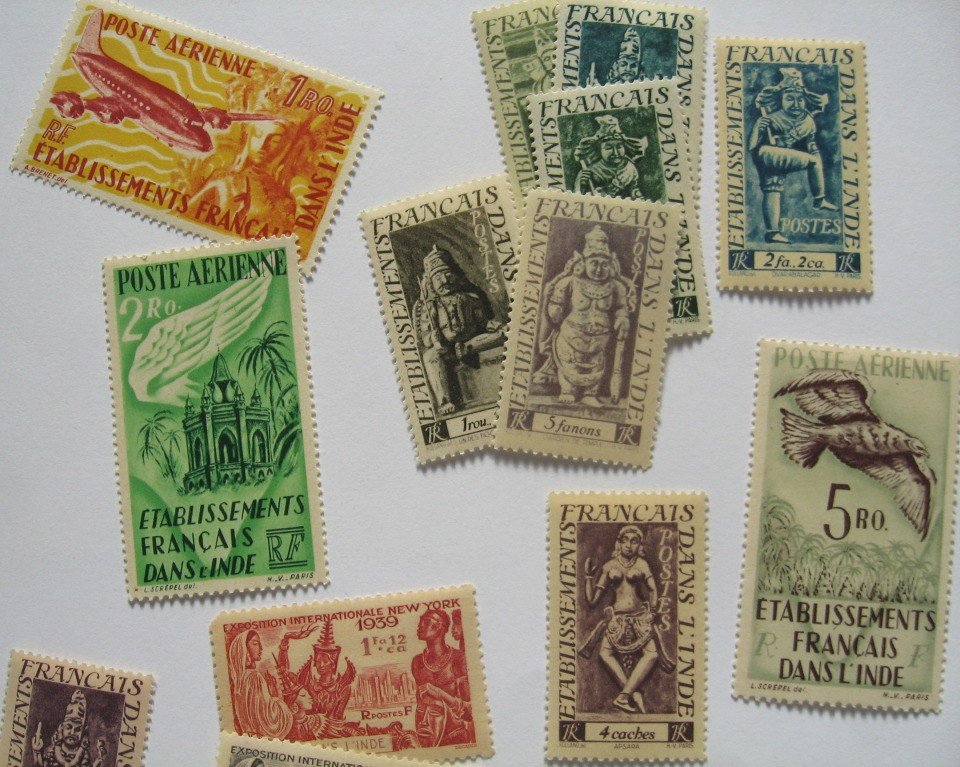
The 1939 New York World’s Fair issue had two French India values, and the 150th anniversary of the Revolution added a five-value charity set.[1][2][3]
Several of these designs were later overprinted with political wording. Keep the date of the event and the date of the overprint apart: a 1939 picture carrying wartime wording is not an original 1939 stamp because its picture is unchanged.[1][2][3]
| Postage | Premium |
|---|---|
| 18 caches | 10 caches |
| 1 fanon 6 caches | 12 caches |
| 1 fanon 12 caches | 16 caches |
| 1 fanon 16 caches | 1 fanon 16 caches |
| 2 fanons 12 caches | 3 fanons |
What a common-design collection can show
Common-design comparisons work best when the territory’s name, currency, postage, premium and format are recorded together. That places a French India stamp in the wider programme without borrowing another colony’s values or dates.[1][2]
It also keeps mint collecting and postal history together. A full unused set shows the designs; a few complete letters show particular offices and services. Neither replaces the other.[1][2]
Sources
- [1] Bernard Towler, “Forgotten Countries: French Indian Settlements”, The Stamp Lover, June 1999; reprinted in IND DAK, September 1999, p. 177.
- [2] StampWorld, French India, 1930 s commemorative denominations.
- [3] William E. Steiner, French India album pages, digital leaves 22–24.
Notes 0
Add what you know: a cover or stamp in your collection, a date or source, a correction or a question.
No notes yet.
Sign in to add a note.
Notes show straight away. Keep them kind and about the article; anyone can report one that isn't. House rules
