
British India’s Overseas Mail: Routes, Exchange Offices and Post Offices Abroad
Overland mail via Marseilles and Falmouth, the 6 annas 8 pies stamp, Indian post offices in the Gulf, Baghdad and Basra, mail contracts and the Suez Canal.
Updated July 17, 2026
In this article
Overland did not mean all the way by land
Clarke (chapter XIII, pp. 119–126) describes a chain of sea and land connections between India and Europe. An “overland” endorsement asks for a service through stages in between, not a journey by land from India to Britain, and changes at the Mediterranean ports, in Egypt and at the Indian ports altered what the route meant over the years.[1]
His example of 1798 from the Persian Gulf shows how particular the conditions could be: private letters sent by the government’s packet between Bombay and Basra were held to strict sizes, needed permission and paid high postage on delivery. That service cannot be described in terms of the later rules for stamps or a uniform inland rate.[1]
Chief and auxiliary mails in 1839
A cutting from the Calcutta Gazette (pp. 859–860) reproduces British instructions that mail via Marseilles was the chief or regular mail, and Falmouth the auxiliary route — meant for heavier dispatches, accounts and other papers that did not need to travel fast, and for letters or newspapers that the sender marked to go that way. These are classes of service in an overseas system, not other words for paid and unpaid.[3]
The same correspondence gives a uniform British single-letter rate of 2 shillings 8 pence for the Marseilles route, with 2 shillings 6 pence continuing for Falmouth, and separately mentions the Red Sea postage to be charged in India. These charges cannot be merged into one all-inclusive Indian stamp rate: in 1839 there were no general Indian postage stamps, and the wording shows which administration and which part of the route each charge belonged to.[3]
A value that remembers a route
Clarke links the six annas eight pies stamp with letters to the United Kingdom via Marseilles, says it was issued in 1867, and records that its sale stopped in 1874. In the chapter beside it he describes Brindisi replacing Marseilles in 1870. These short statements of dates should not be forced into one unbroken tariff without dated tables of the time.[1]
The safe lesson is that route and rate go together. A six annas eight pies stamp on a cover does not by itself prove the Marseilles route: the date, weight, route endorsement, exchange marks and any extra payment have to support that reading. Clarke’s short summary is not a complete chronology of rates to Britain.[1]
Consular post offices and their trading customers
Clarke’s chapter XV (pp. 137–150) records a regular six-weekly service between Bombay and Basra in 1862, and offices opened from 1864 at Gulf ports including Bushire, Muscat, Bandar Abas, Bahrain and Mohammerah; he dates the offices at Baghdad and Basra to 1868. A network kept up for political correspondence also served traders and other users.[1]
He describes parcels for Baghdad and Basra being handed to the Turkish Customs with declarations and invoices, while the addressees collected delivery orders from the British-Indian postmaster. An Indian post office abroad did not remove the local customs authority: the use of an Indian stamp overseas and the government of the territory around it are separate historical questions.[1]
Prove the office before telling the story
In chapter XIX Clarke also records Indian postal use at Singapore, in his discussion of bisects. With the Gulf offices, it shows why British India collecting reaches beyond the subcontinent. Even so, the town or numeral in a cancellation has to be identified from the device and its period, not assigned by geography alone.[1]
For every item from overseas, keep the original spelling of the office, the date, the stamp issue and the destination. Tell a genuine use at a local office apart from an Indian transit mark on mail that began elsewhere. A complete cover can show the hand-over between administrations; a single may show only that the cancellation was struck on that stamp. No complete list of opening dates or numerals is attempted here.[1]
| Feature | What it can show | What still has to be shown |
|---|---|---|
| Indian stamp | Supplied through Indian postal arrangements | Not proof of today’s borders |
| Cancellation of an office overseas | Handling at that office, if genuine | May need a specialist to attribute the device |
| Route endorsement | An instruction by the sender or office | Needs confirming by the transit dates |
| Customs note | Separate fiscal handling | Can exist alongside the Indian post |
A mail contract set a target, not a result on every cover
Clarke records a contract of 1 July 1898 with a limit of 14½ days from London to Bombay, and the contract of 1908 with a limit of 11¼ days from Brindisi to Bombay, plus thirty-six hours allowed in the monsoon. The end points differ, so the two figures do not measure the same journey.[1]
Nor does a contract target prove that a particular cover met it. Date marks may include time inland before embarking and after landing, and weather or a missed connection adds delay. Say where each measured interval begins and ends; only then can it be compared with a contract or a sailing schedule.[1]
Opening a canal did not change the mail route at once
Clarke separates the opening of the Suez Canal in 1869 from the mail service’s later use of it: he says mail went on crossing Egypt by rail until 1888. Even where a particular sailing needs another source, the point holds — a route being available does not show that a contract used it.[1]
He also separates the Southampton, Marseilles and Brindisi arrangements. An endorsement such as “via Brindisi” is about the European port, and does not establish the rest of the journey: the offices in between, the date of posting and whether the letter was going out or coming home still matter.[1]
Squared circles of Indian offices abroad
Danby’s appendix (p. 153) lists squared-circle families used at Indian-controlled offices outside India, including Aden, the Gulf ports, Baghdad and Basra. It separates, for example, several forms used at Bushire, and notes changes in the spelling of Muscat — observations of devices that add to Clarke’s account of the administration.[2][1]
Danby also warns that some later uses at Zanzibar belong to the East African administration, even where a familiar cancellation lived on. A device can outlast a transfer of administration, so identify the stamp, the office and the date together before calling anything “India used abroad”. The appendix is a list of 1960, not a full chronology of offices.[2][1]
A packet letter before stamps
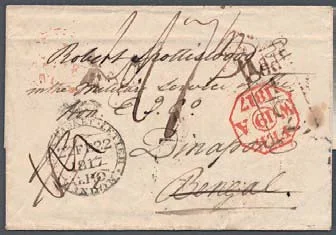
The catalogue describes this letter of 1817 as travelling from Inverness to Dinapore in Bengal by way of London, with an INDIA PACKET LETTER mark, an Edinburgh date mark and a boxed additional charge, and a KINGS POST mark on the back, which is not visible in this view of the front.[4]
It shows that an overseas journey could leave a full postal record without any stamp. Its notes belong to the packet and inland accounts of its own time: the Marseilles and Falmouth instructions of 1839 are later and do not apply to it, and a full reconstruction of its rate would need the British and Indian rules of 1817 for that route.[4]
Foreign origin, Indian transit and an Indian censor
Baker and Entwistle’s catalogue of Indian censorship records mail from Portuguese India to Britain examined at Belgaum, letters from Penang to America examined at Bombay, and mail from Britain to Basra examined at Karachi. These show another kind of Indian handling, on letters that did not necessarily begin in British India.[5]
A censor station shows that the letter was examined at that stage. It cannot by itself identify the postal administration of origin, the office that sold the stamps or the final delivery. Record the franking of origin, the exchange marks and the censor’s work as separate entries when documenting India’s postal links abroad.[5]
Sources
- [1] Geoffrey Clarke, The Post Office of India and Its Story, John Lane/The Bodley Head, London, 1921, chapter XIII, pp. 119–126; chapter XV, pp. 137–150; chapter XIX, pp. 178–187.
- [2] G. C. Danby, “The Indian ‘Squared Circle’ Cancellation”, India’s Stamp Journal, July 1960, p. 153 (appendix on offices outside India).
- [3] Calcutta Gazette, 1839, pp. 858–861: London dispatches and General Post Office correspondence of June–August 1839, published by the Fort William Marine Department.
- [4] Auktionshaus Christoph Gärtner, India: Park Collection, auction catalogue, 7 March 2011, lot 1 (photograph p. 6, description p. 65).
- [5] A. Baker and C. Entwistle, Catalogue of Indian Censorship 1914–20, 1994, pp. 3–11.
Notes 0
Add what you know: a cover or stamp in your collection, a date or source, a correction or a question.
No notes yet.
Sign in to add a note.
Notes show straight away. Keep them kind and about the article; anyone can report one that isn't. House rules
