
How British India’s Stamps Were Printed: Methods, Printers and Records
Lithography in Calcutta, typography at the Stamp Office and De La Rue, and the move to Nasik: what the production records do and do not prove.
Updated June 18, 2026
In this article
Three values lithographed, one typographed
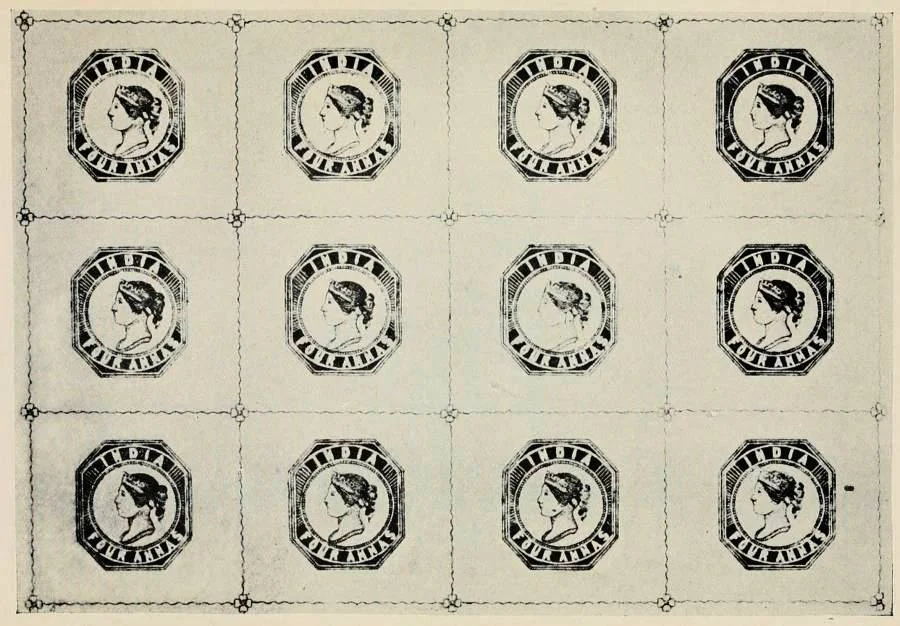
The 1854 stamps are often called “the 1854 lithographs”, but that hides a real difference. The official centenary album of 1954 says the half anna, one anna and four annas were lithographed in the Surveyor General’s Office in Calcutta, while the two annas was typographed at the Stamp Office.[1]
The two processes work differently. In lithography the image is printed from a flat surface; in typography the printing parts stand up in relief. Transferring, retouching and setting up the printing surface affect a lithograph in other ways than they affect the making of relief printing material. Two stamps with a similar portrait are not, for that reason, made by the same method.[1]
What the London correspondence shows
H. R. Holmes printed letters of July to November 1854 in his article of April 1941 (pp. 41–43). They show the East India Company first looking into recess printing through the Board of Inland Revenue. The Board’s existing contractors could not easily take on more work, and the talk turned to De La Rue, who were already printing receipt stamps. A process proposed in a letter is not proof that the issued stamps were made that way.[2]
In a letter of 16 November 1854, De La Rue reported that the original material had been hardened successfully at the Mint, that the subsidiary dies were coming along, and that printing could not begin until February. That fixes a stage of production and a forecast, not a first day of sale. Holmes’s extract ends “To be continued”, so the later letters are a separate matter.[2]
Printer, process, dispatch and issue date
The album calls the De La Rue issues typographed and dates the move of India’s stamp printing to the Security Printing Press at Nasik to 1926. Clarke writes that the designs were engraved on steel. That fits engraved original material used to make a relief printing surface; it does not mean the stamps themselves were printed by intaglio.[1][3][2]
A sound account of production keeps its stages apart: the design or die, its transfer or multiplication, printing and gumming, perforating, dispatch, arrival and first postal use. A printer’s letter may settle only one of them. To say a stamp comes from a particular printing, its paper, watermark, perforation gauge and plate evidence all have to agree.[1][3][2]
| Production family | Process or change | Where the distinction comes from |
|---|---|---|
| 1854 ½ anna, 1 anna, 4 annas | Lithography | Surveyor General’s Office, Calcutta |
| 1854 2 annas | Typography | Stamp Office |
| London De La Rue series | Typography from engraved original material | The album’s account of the issued stamps |
| 1926 onward | Indian security printing | Nasik takes over; a date alone cannot identify an undated single stamp |
Why the Inland Revenue Board was involved
Holmes’s page 41 opens with a letter of 13 July 1854 from James W. Melvill for the East India Company. It asked how India’s postage stamps should be engraved and supplied, and how far the Board’s experience could be used. The Board’s minute separated its busy postage-stamp contractors from De La Rue’s receipt-stamp work.[2]
The reply on page 42 also raised legal protection against forgery and the control of stock. The choice of printer was bound up with supervision, accounts and legislation; it was not simply a contest between engravers. A design could be ready while the arrangements to authorise, guard and record its output were still being settled.[2]
Edwin Hill’s estimate of October 1854
Holmes also reproduces Edwin Hill’s minute of 21 October 1854 on supervising the work at De La Rue. Hill put the cost of the existing attendant at about £70 a year and discussed the extra work the Indian stamps would need. He expected little more time to be needed while the original dies and plates were being made, but suggested that the same official might later supervise both streams of work.[2]
These are rare, concrete glimpses of the control around production, and they show why the printer, the supervising department and the die maker should not be run together into one credit. The minute is a proposal with estimated costs; it does not prove that every suggested staffing arrangement was carried out as proposed.[2]
The method outlasts the look
The album calls both the 1854 two annas and the London issues typographed, although their design size and paper differ. In the same way, a later pictorial design that looks more elaborate has not necessarily changed process. Naming a process needs the production record, or a clear enough impression compared with a suitable reference.[1][2]
The move to Nasik in 1926 did not end the earlier line of designs: the album says the same dies stayed in use when printing moved to India. A portrait introduced by De La Rue therefore does not tell you who printed every later example. For that you need dates of use, paper, watermark and a specialist chronology of printings.[1][2]
A forecast and an arrival report
Holmes’s November 1854 letter says printing could not start until February; Clarke reports the London stamps arriving in India in November 1855. The first is a forecast made while work was being prepared; the second looks back at an arrival. They are not two competing first-issue dates.[2][3]
The same care applies to proofs. A proof that clearly belongs to the preparation may come months before printing, dispatch and sale. A postmark on a used stamp shows the latest time by which that stamp was available; it says nothing about when its die was first made.[2][3]
Nasik: foundation, first work and the stamp contract
The press’s own history separates stages that are often squeezed into one opening date. Its milestones give the project report in 1923, approval and the foundation stone in 1924, and the start of printing stationery and stamps in 1925. Its Profile says the press was established in 1925, while its History uses 1924: they describe different stages in setting up a working factory.[4][1]
The album’s date of 1926 is for Nasik taking over India’s adhesive stamps from De La Rue, on the new Multiple Star paper. It does not contradict an earlier start at the factory. When you give a date for Nasik, say what it marks: approval of the project, the factory’s first work, a particular stamp supply or the end of the London contract.[4][1]
Sources
- [1] Indian Posts and Telegraphs Department, India Postage Stamp Centenary 1854–1954: Souvenir Album, 1 October 1954, explanatory pp. 1–3 and plates 1–16.
- [2] H. R. Holmes, “India: The Typographed Stamps on Unwatermarked Paper, 1855–1862”, The Philatelic Journal, April 1941, pp. 41–43 (contemporary production correspondence).
- [3] Geoffrey Clarke, The Post Office of India and Its Story, John Lane/The Bodley Head, London, 1921, chapter XIX, pp. 178–187.
- [4] India Security Press (SPMCIL), “About Us”: Profile, History and Milestones, consulted 31 October 2026.
Notes 0
Add what you know: a cover or stamp in your collection, a date or source, a correction or a question.
No notes yet.
Sign in to add a note.
Notes show straight away. Keep them kind and about the article; anyone can report one that isn't. House rules
