
Caches, Fanons and Roupies: French India’s New Currency, 1923–1929
In the 1920s French India’s stamps changed from centimes and francs to caches, fanons and roupies, first by surcharge and then in new printings.
Updated May 22, 2026
In this article
A new currency on an old picture
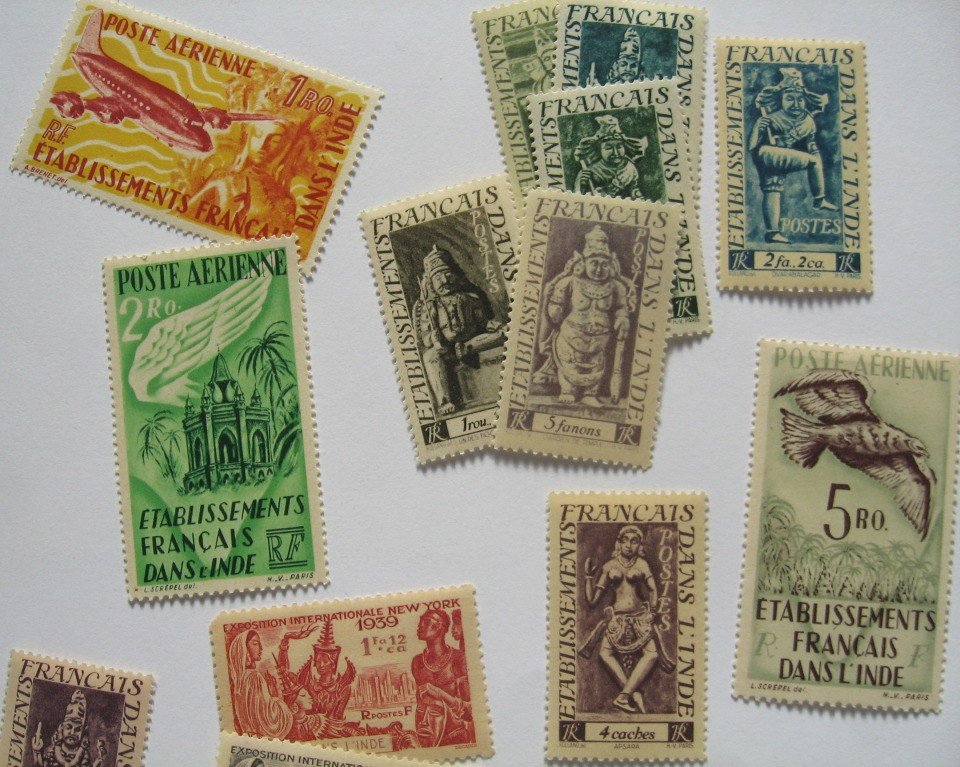
French India’s early stamps were in centimes and francs. In the 1920s caches, fanons and roupies appeared, first as surcharges and then printed into the stamps. The change is easy to miss because the Brahma and temple designs stayed the same: a stamp can look familiar while its value is in a quite different currency.[1][2]
Towler places the currency change in 1923 and the stamps printed in the new units in 1929. The exact day of issue, or the day an old value stopped being valid, needs its own notice: the broad dates do not show that all the surcharges appeared together, or that every centime stamp stayed valid through the decade.[1][2]
The postal reckoning
For the later stamps the reckoning is 24 caches to a fanon and eight fanons to a roupie. One fanon twelve caches is therefore one and a half fanons, and two fanons twelve caches two and a half. This arithmetic applies to dated postal values; it should not be imposed on every older money account from the region.[3][2]
Maurice Tyler’s article of 1995 is useful because it shows how older reference books contradict one another, with different rupees, fanams and pagodas. It does not give one settled historical exchange rate, and the same word roupie in two sources does not prove the same silver content or value.[3][2]
| Amount | In caches |
|---|---|
| 1 fanon | 24 caches |
| 1 roupie | 8 fanons = 192 caches |
| 1 fanon 12 caches | 36 caches |
| 2 fanons 12 caches | 60 caches |
Read the old and the new value separately
The conversion put the new units on existing stamps. A full description needs the original value, the new value and any bars or extra words. The surcharge replaced the stamp’s value; the old centimes are not added to the new caches. Keeping the two apart also helps tell apart different base stamps that carry the same new amount.[1][4]
The table below groups the known conversions; it is not a full list of settings. Some base colours and overprint details need a specialist catalogue and a clear copy, and a genuine Brahma stamp can still carry a false or wrongly identified surcharge. Check each layer on its own.[1][4]
| Years | Issue | Values |
|---|---|---|
| 1920s | Small values on the 15 c | 1 c, 2 c, 5 c |
| 1923–1928 | Caches, fanons and roupies on the pictorials | 1 ca, 2 ca, 3 ca, 4 ca, 6 ca, 10 ca, 12 ca, 15 ca, 16 ca, 18 ca, 20 ca, 1 fa, 1 fa 3 ca, 1 fa 6 ca, 1 fa 12 ca, 1 fa 16 ca, 2 fa 9 ca, 2 fa 12 ca, 3 fa 3 ca, 6 fa 6 ca, 1 r, 2 r, 3 r, 5 r |
Values printed in the design
From 1929 the Brahma and temple stamps were printed with the local units as part of the design, not surcharged. The difference is physical as well as one of date: a value in the frame was printed with the stamp, while an overprint was added later to existing stock.[1][4]
The Brahma and temple stamps have different ranges of value. Read C, CA, FA and the full word ROUPIE before comparing catalogue entries: the same figure is not the same value. Colour and printing differences need a further level of description.[1][4]
| Years | Issue | Values |
|---|---|---|
| 1929 onwards | Brahma in local currency | 1 ca, 2 ca, 3 ca, 4 ca, 6 ca, 10 ca, 16 ca, 18 ca, 20 ca |
| 1929 onwards | Temple in local currency | 12 ca, 1 fa, 1 fa 6 ca, 1 fa 12 ca, 1 fa 16 ca, 2 fa 12 ca, 6 fa 6 ca, 1 r, 2 r, 3 r, 5 r |
Exchange rates and postal rates are different records
The official notices collected in the postal-rate study separate local, Franco-colonial and foreign rates. They also give franc selling prices for stamps and stationery in the local currency, so a price quoted in francs may be about exchange or sales accounting rather than the postage printed on the stamp.[2]
The notice of 13 October 1923 is the place to start, with later dated changes and conversion instructions in the same series. A rate table should say whether each date is that of the order, its publication or its coming into force, and should not invent the others where a notice gives only one.[2]
Convert only after finding the class of mail
For a dated cover, first find the service and the destination’s rate, then add the postage in one unit, keeping any charity premium apart. A total of two and a half fanons may be simple arithmetic but still need a weight step or a registration fee before it explains the rate.[3][2][1]
A useful collection has a stamp before surcharge, a documented surcharge and a stamp printed in the local currency, with the notice or a cover where possible. Together they show how the new currency came into the post, without pretending every old money word had one fixed value.[3][2][1]
Sources
- [1] Bernard Towler, “Forgotten Countries: French Indian Settlements”, The Stamp Lover, June 1999; reprinted in IND DAK, September 1999, p. 177.
- [2] Histoire et philatélie, “Tarifs postaux des Établissements français dans l’Inde 1923–1952”, index and transcription references to the 13 October 1923 official notice.
- [3] Maurice Tyler, “French Indian Currency”, Journal of the France & Colonies Philatelic Society, December 1995, pp. 196–197.
- [4] Evert Klaseboer, online catalogue, French India 1914 onwards: denomination verification for pictorial, currency-conversion and Free French families.
Notes 0
Add what you know: a cover or stamp in your collection, a date or source, a correction or a question.
No notes yet.
Sign in to add a note.
Notes show straight away. Keep them kind and about the article; anyone can report one that isn't. House rules
